
540Hz OLEDs nearly recreate CRT clarity, but Windows is the last bottleneck
Blur Busters' CRT beam simulation is stunning on Asus's 540Hz OLED, yet Windows scheduling and GPU drivers keep it from reaching full retro nirvana.
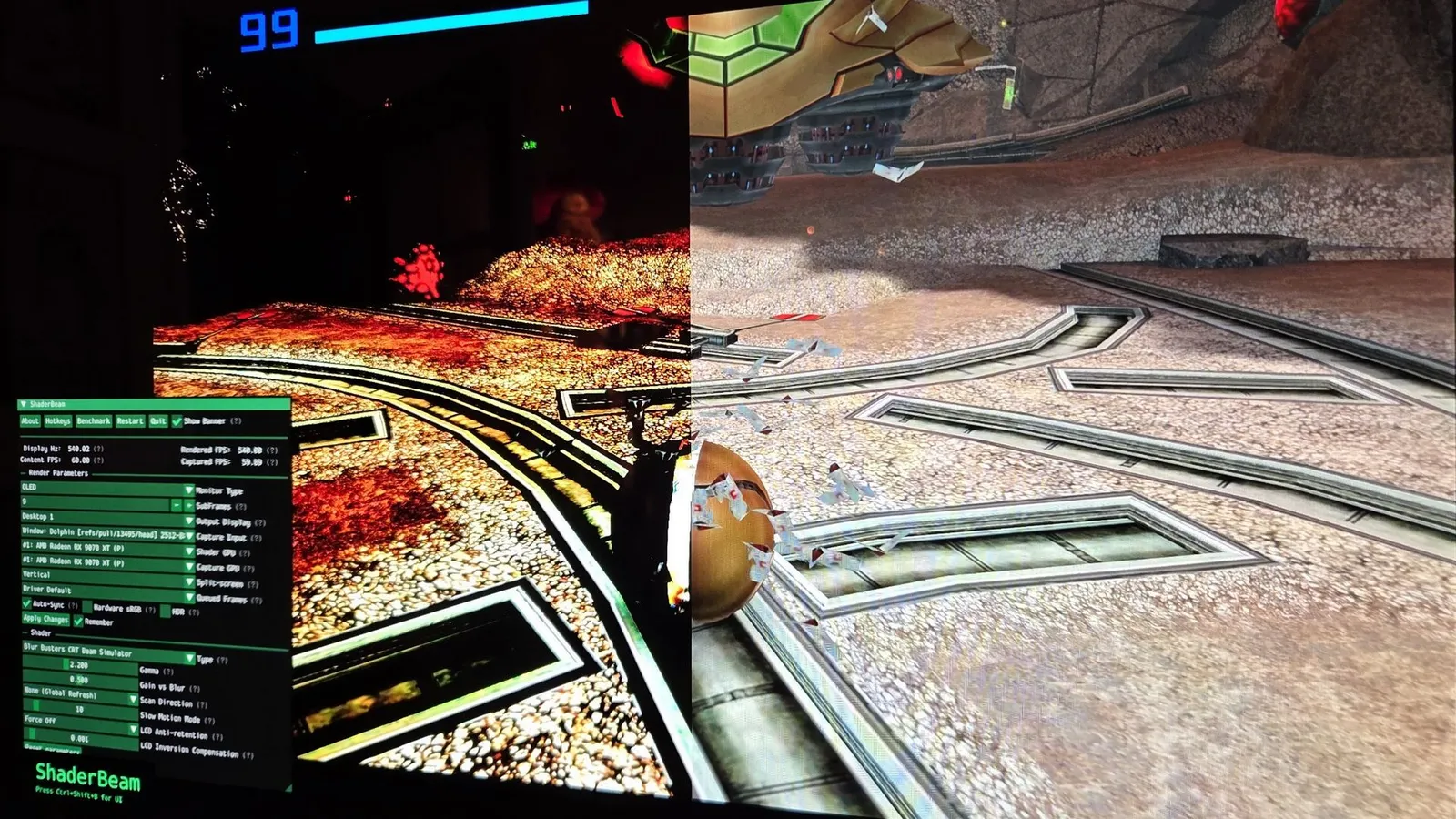
Mark Rejhon, founder of Blur Busters, and former Nvidia developer Timothy Lottes have created a CRT beam simulation algorithm that lets 540Hz OLED monitors nearly match 1990s CRT motion clarity. For display makers and gamers, this means near-CRT motion without massive frame rates, but Windows and GPU driver scheduling remain the final barrier to mainstream adoption.
The 540Hz OLED panel in Asus's ROG PG27AQWP-W can nearly recreate the motion clarity of a 1990s CRT, but the last barrier is Windows itself. That is the conclusion from Blur Busters founder Mark Rejhon, whose CRT beam simulation algorithm, developed with former Nvidia engineer Timothy Lottes, turns a 60fps retro game into something that looks as clean as 540fps. The hardware is finally there; the operating system is not. Rejhon's algorithm, debuted in late 2024, mimics the phosphor fade and rolling scan of a CRT, avoiding the harsh flicker of black frame insertion.
On the Asus PG27AQWP-W, which also offers a 720Hz mode at 720p, the effect is dramatic. But ShaderBeam, the standalone app that implements it, is "at the mercy of opaque scheduling algorithms built into the OS and GPU drivers," says developer Mausimus. Windows simply was not designed for frame-perfect presentation at these refresh rates. The setup requires disabling VRR, turning off driver features, unplugging secondary monitors, using Process Lasso for priority, and even a registry edit. Mausimus recommends splitting rendering between two GPUs, using integrated graphics for the shader to avoid desync.
The quest to get back what we lost began with the LCD transition. Rejhon notes that people over 40 remember CRT motion clarity, while younger users never saw it. The mid-2000s LCDs were particularly bad, with pixels taking "an eternity" to change color and leaving ghost trails. Even today's best high-refresh monitors are still chasing CRTs, which could flicker pixels brightly for less than 1/1000 second without needing extra frame rate. That is the core advantage: CRTs achieved low motion blur without high fps. "The two main ways to reduce display motion blur is either flicker the frames (like a CRT) or add more frame rate (for high Hz)," Rejhon said.
The new algorithm works like DLSS for motion instead of resolution. When it is working right, a game locked at 60fps can look as smooth and clean as one running at 540fps, without requiring an RTX 5090. The Asus monitor's 540Hz refresh rate and OLED's ability to go completely black get much closer to CRT contrast. The higher the refresh, the more perceived motion blur is reduced. But the implementation is bleeding edge. The first version appeared in Retroarch, then in ShaderGlass, and now in the dedicated ShaderBeam tool. "The ideal application of beam simulation technology requires perfect synchronization with both the display and input content," Mausimus said.
ShaderBeam's setup is a tinkerer's nightmare, but the payoff is real. "By moving beam simulation to another GPU there is less contention for the primary GPU's time and effectively better scheduling consistency," Mausimus said. "The issue with single GPU isn't lack of GPU power, rather its unpredictable distribution." If ShaderBeam is not given enough GPU time by the OS to present a frame on time, users experience flashing. That fragility is why this remains a niche tool for enthusiasts, not a mainstream feature.
Nvidia is attacking the same problem in hardware with G-Sync Pulsar, built into gaming monitors this year. It works with VRR and uses backlight strobing plus a rolling top-to-bottom refresh cycle, much like a CRT, to create a perceived clarity of 1,000Hz. But there are no OLEDs yet, and the tech is locked to Nvidia GPUs. For now, the software route is the only way to get CRT simulation on OLED, and it is fragile. The contrast with Rejhon's open algorithm is stark: one is a closed hardware feature, the other an open-source experiment.
The strategic stakes are significant for display makers and platform owners. As OLED high-refresh monitors become more common, the ability to simulate CRT motion could become a differentiator for gaming hardware, but it depends on OS-level cooperation. Microsoft has not announced any changes to Windows scheduling to support frame-perfect presentation. If Windows does not change, true "nirvana" remains out of reach, and the burden falls on developers to hack around the OS. For executives in gaming and display tech, this is a reminder that hardware advances can be capped by software ecosystems. The next step is for Microsoft, AMD, or Nvidia to build this into the rendering pipeline. Until then, the gap between what OLEDs can do and what Windows allows will remain the final boss.
This story's Key Insights and Take-aways are locked.
Create a free account to unlock Executive Actions for one credit.
Register to UnlockAlways free for Executives Club members. Join the Club
More in Technology

A Chinese rocket deorbited over Minnesota and landed in a farmer's cornfield
Experts tied the fragment to LandSpace's Zhuque-2E, which launched on September 15 and shed debris over the American Midwest after deploying 10 satellites.

JPMorgan Chase deploys first $5B into defense tech and hypersonic missiles
The bank is moving off its balance sheet to back robot factories, hypersonic missiles, and supply chains, signaling a new era of bank-backed military innovation.

Cop fired after sharing Flock login with ICE husband: 983 searches
A Savannah officer's shared credential let an ICE agent run hundreds of plate searches on Hispanic drivers, exposing a surveillance backdoor.