

Amazon’s multi-year Corning optical-fibre deal pumps billions as fibre becomes AI’s bottleneck
The wiring upgrade for US data centres turns glassware into a strategic constraint, with jobs landing in North Carolina.
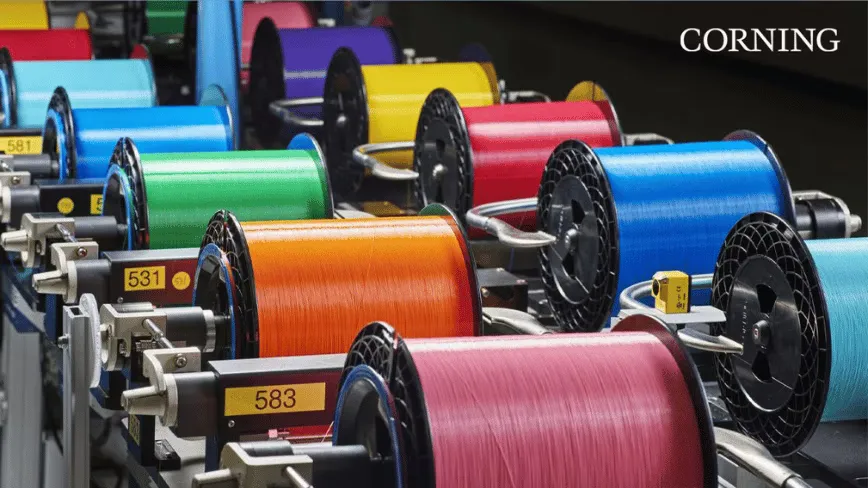
Amazon and Corning announced a multi-year agreement to supply optical fibre for Amazon’s rapidly expanding US data centres. For decision-makers, the deal signals that the AI build-out is increasingly constrained by networking hardware, not just chips and power.
Amazon is paying Corning billions of dollars for optical fibre to wire up its rapidly expanding US data centres, according to a Monday announcement from the two companies. The agreement is multi-year, and it is also expected to create about 1,000 jobs at Corning’s North Carolina factories, though neither side disclosed additional details in the announcement reported by The Next Web.
That sounds like “just more infrastructure.” But it is also a loud signal that the bottleneck in the AI build-out is shifting. Everyone has been watching chips and electricity. Now, fibre is getting dragged into the spotlight as the real-world bottleneck that determines whether the compute rush can actually scale where it needs to.
To understand why this matters, remember what data centres are trying to do during the AI boom: move enormous volumes of data quickly, reliably, and at low latency, day after day. Chips power the training and inference work. Power keeps the machines running. Fibre, meanwhile, is the physical plumbing that connects racks, clusters, and regional footprints. When Amazon expands data centres rapidly, it also expands its need for the network pathways that carry traffic between systems and between sites.
Optical fibre is not just a component on a bill of materials. It is a supply chain and manufacturing constraint, which means timelines and capacity can become the limiting factors even when money and demand are there. That is exactly what makes this Amazon-Corning move feel consequential. In a market where hyperscalers are racing to secure AI capacity, the fastest way to fall behind is to hit a bottleneck that looks mundane until it breaks your schedule.
Corning is the obvious beneficiary here because it is a supplier tied to the “glass” side of the stack. The companies’ announcement pairs the capital expenditure with an operational footprint: about 1,000 jobs in North Carolina. Even though neither side disclosed more specifics, that job figure hints at manufacturing scale and local production involvement, rather than treating fibre as something that can be instantly ordered from anywhere with no tradeoffs.
There is also a strategic budgeting angle for boards and CFOs. When an AI build-out is underway, capital planning has to balance multiple simultaneous constraints: servers, power infrastructure, cooling, networking, and the physical delivery of components. A multi-year agreement framed around fibre suggests Amazon is trying to reduce uncertainty in one of those critical categories. In other words, it is not only buying capacity. It is buying reliability of supply for the connectivity that makes the capacity useful.
For peers, this is a reminder that “AI infrastructure” is becoming a portfolio, not a single purchase. Competing hyperscalers and large cloud operators face the same reality: even if you can fund GPUs and contract for electricity, you still have to connect the systems and sites in a way that meets performance needs. Optical fibre becomes a competitive variable because it can determine how quickly new data centres can be turned into functioning nodes of an AI network.
Finally, the way this story is framed by The Next Web matters for context. The AI boom is often described through the lens of chips and power. This announcement places Corning’s optical fibre deal into that narrative, explicitly linking the “wiring” of Amazon’s expanding US data centres with the scale-up of AI itself. If fibre is truly the new bottleneck, executives should treat supplier agreements like this as risk management, not procurement footnotes. It is one of the clearest second-order moves in AI that is still hiding in plain sight: the fastest compute plans can still stall if the glass plumbing cannot keep up.
This story's Key Insights and Take-aways are locked.
Create a free account to unlock Executive Actions for one credit.
Register to UnlockAlways free for Executives Club members. Join the Club
More in Business

Anthropic’s Levant Alpöge cracks the Jacobian conjecture after 87 years
A Harvard valedictorian used Claude to hit a 1939 breakthrough, but the missing “why” is the real problem.

Uber buys Delivery Hero for nearly $15B, vaulting to top food delivery outside China
The deal doubles Uber's dual-services footprint and pushes a ride-and-eats bundling play into 50 more markets.

Epic and Google drop settlement bid, forcing rival Android app stores by July 22
Google told the court it is ready to carry third-party app stores starting Wednesday, July 22.