

Amazon's Proteus robot now takes spoken instructions in warehouses
Amazon is giving its Proteus warehouse robot language skills, a move that could make human-robot handoffs faster while deepening automation pressure on warehouse labor.
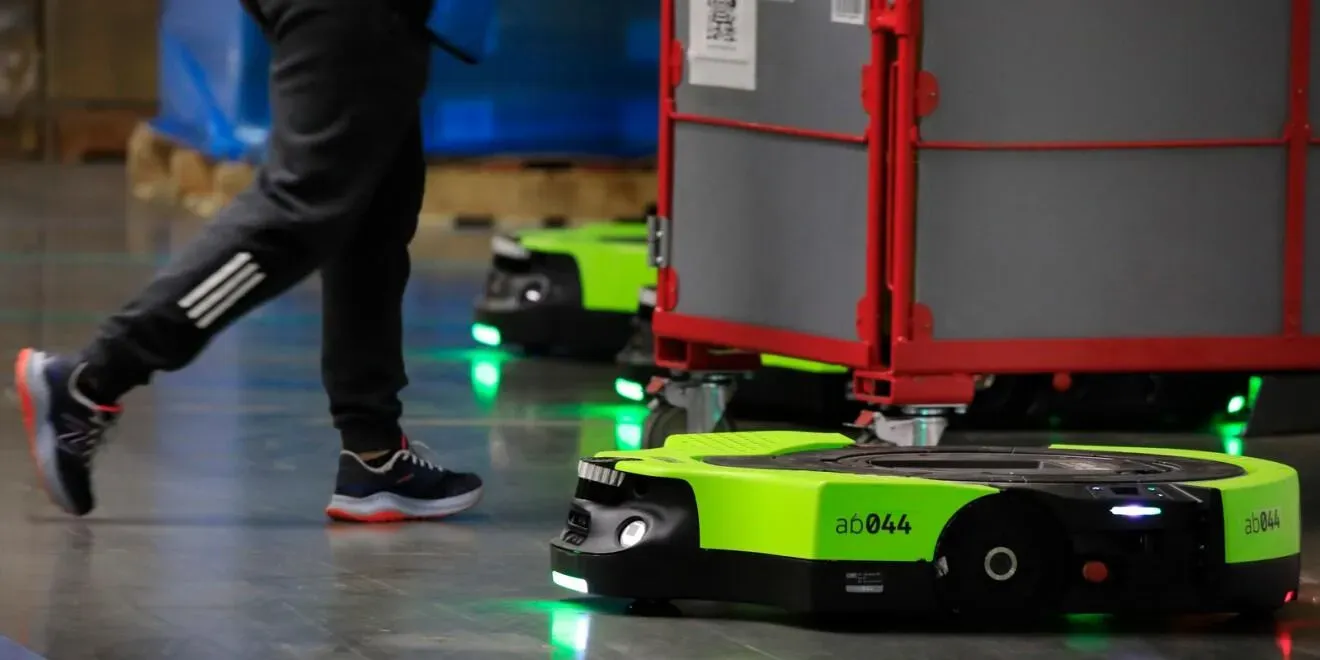
Amazon has announced a new version of Proteus, its fully autonomous warehouse robot, that can interact using language instead of code. For operators, the shift shows how quickly warehouse automation is moving from specialized tools to everyday workflow infrastructure.
Amazon just turned a warehouse robot into something closer to a coworker. The company has announced a new version of Proteus, its fully autonomous warehouse robot, and the main upgrade is simple to describe but big in practice: workers can now talk to it using language instead of relying on code or specialized software. Amazon says the AI-powered upgrade lets human employees assign tasks the same way they would communicate with colleagues. That means the robot is no longer just a machine on the floor. It is becoming part of the conversation.
That matters because Proteus is not a novelty demo. It is a floor-level robot, described as tortoise-like, built for heavy lifting and moving large carts throughout Amazon's warehouses. In its earlier form, workers had to use specialized software to direct it. The new version removes some of that friction. If a warehouse manager can simply tell the robot what needs to happen, the task handoff gets easier, faster, and potentially available to more workers without technical training. For an operation as large and speed-sensitive as Amazon's, even small reductions in coordination time can ripple across the whole warehouse.
The announcement also fits a broader shift inside Amazon toward automation. The source notes that the expanded capabilities arrive as part of a growing pivot toward replacing human workers with robots. That is the part executives, labor leaders, and rivals will all read closely. Amazon has long been one of the industry's most aggressive adopters of warehouse automation, and Proteus is a clean example of the next phase: not just automating movement, but making the interface between humans and machines less awkward. The more natural the command layer becomes, the easier it is to insert robots deeper into daily operations.
This is where the business logic gets interesting. Warehouse robotics has always had two bottlenecks: the machine itself and the human workflow around it. The first is obvious. The second is sneakier. If employees need special software, training, or extra steps to coordinate with a robot, the robot becomes useful but not seamless. Amazon's pitch is that Proteus can now absorb instructions the way a human teammate would. That may sound like a small UX change, but in operational terms it lowers the barrier to deployment. A robot that is easier to direct can be rolled into more tasks, in more places, by more workers.
It also raises the stakes for labor strategy. The source says the automation push comes as Amazon replaces its human workers with robots. That does not require any dramatic reading between the lines. It is already the strategic direction described in the announcement. For Amazon's peers, the question is not whether warehouse automation is coming. It is how quickly the interface between human and machine will become ordinary enough that automation spreads from isolated use cases into the basic rhythm of warehouse work. Once a robot can be instructed in plain language, it starts to resemble infrastructure rather than a project.
For executives outside Amazon, the lesson is broader than one robot model. Language-based control lowers friction, and lower friction usually means wider adoption. That can change staffing plans, training requirements, throughput assumptions, and capital budgeting for facilities that rely on repetitive physical movement. It can also change the political optics of automation. A robot that is easier to talk to may feel friendlier than one hidden behind a specialized terminal, but the operational consequence is the same: fewer human steps between intent and execution. In industries where labor is expensive, hard to retain, or difficult to schedule, that is not a side note. It is the point.
Amazon did not say Proteus's design has changed much from the original version announced in 2022, which is another clue about where the value is coming from. The hardware may look familiar, but the software layer is becoming the differentiator. That is a familiar pattern in automation: once a machine can already do the physical job, the race shifts to making it easier to deploy, control, and scale. For companies watching Amazon, the immediate takeaway is not that every warehouse needs a talking robot tomorrow. It is that the next wave of automation may arrive less as a flashy new machine and more as a quieter upgrade to how humans tell machines what to do.
And that is why this matters beyond the warehouse floor. Amazon is showing how automation changes when it stops feeling like machinery and starts feeling like workflow. If your business runs on people giving instructions, moving goods, or coordinating repetitive tasks, the question is no longer whether robots can do the job. It is whether they can be made easy enough to use that the organization starts reaching for them first. Amazon's new Proteus suggests that future may be closer than it looks.
This story's Key Insights and Take-aways are locked.
Create a free account to unlock Executive Actions for one credit.
Register to UnlockAlways free for Executives Club members. Join the Club
More in Technology

OpenAI says 10,000 agents cracked a 90-year math problem in 88 hours
The company's claim is audacious, but one mathematician is pushing back. Here's what it means for AI-driven discovery.

Meta still serves child sexual abuse ads on Instagram in India - BBC report
A new report following the BBC Eye investigation says the ads are still there - what it signals for every platform with a self-serve ad engine.

White House yanks 'Build the Wall' game after Tetris Company copyright warning
The administration's arcade game vanished in hours - and the takedown playbook every brand can learn from.