
Amy Hawkins says China is fully embracing AI, from AI doctors to food drones
The Guardian’s senior China correspondent breaks down how Chinese AI adoption moved from apps to factories and surveillance.
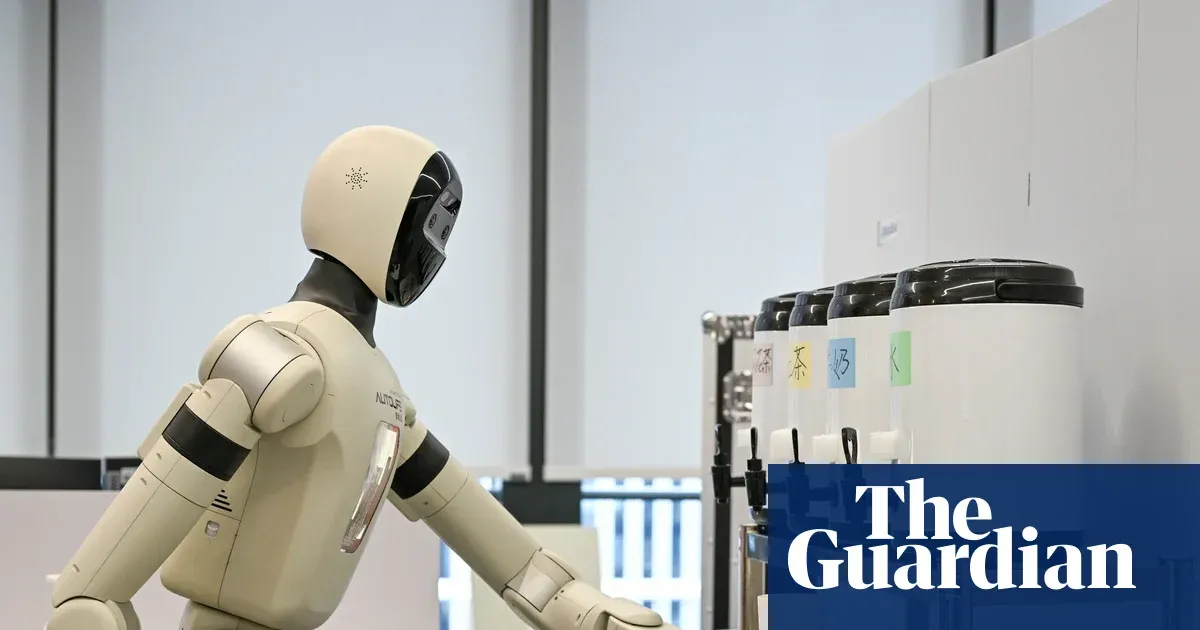
Amy Hawkins, The Guardian’s senior China correspondent, describes China’s embrace of AI across everyday services and industry, including AI medical avatars, robots in factories, and drones delivering food. For decision-makers, the big implication is that the state and enterprises are treating AI not as a novelty, but as infrastructure that reshapes oversight, operations, and risk.
Amy Hawkins, The Guardian’s senior China correspondent, says China has fully embraced AI, and the proof is all over daily life. She points to millions of users talking to AI doctors, and she also flags AI-enabled delivery drones and intelligent robotics in factories. If the West has often approached AI with skepticism, China has taken a more direct route: deploy it, scale it, and keep building while others debate.
Hawkins’ reporting puts state surveillance at the center of why this rollout matters beyond convenience. She explains that the opportunities AI creates for further surveillance are a key reason the technology has been eagerly taken up by the state. That pairing, AI services for the public alongside AI-enabled monitoring, is the through-line of the story. It helps explain why adoption can look so fast. When deployment is tied to both economic utility and governance, “slow and cautious” is not the default mode.
To understand what China is doing, it helps to remember how AI is typically sold. In much of the West, AI discourse has often leaned on prototypes, guardrails, and public debate before mass deployment. Hawkins’ framing suggests China is doing the opposite, leaning into real-world use cases that generate data, improve workflows, and increase the payoff of each new iteration. The examples she names are not abstract. They are concrete applications: AI medical avatars that users can talk to; intelligent robots that operate within factories; and drones that can deliver food, even in high-visibility settings like the Great Wall of China.
There is also an industrial logic to this that executives should recognize. Factories are where automation turns into measurable output, cost control, and scheduling precision. Hawkins notes the use of intelligent robots in factories, which implies a broader approach: treat AI as an operational layer that can integrate with existing manufacturing systems, not as a standalone product. Once AI is embedded into production, it becomes harder to pause, harder to reverse, and harder to regulate after the fact. That is the hidden management challenge. The moment AI shifts from experiments to operations, it starts shaping KPIs, labor needs, supply chains, and compliance obligations at the same time.
Then there is the state angle, which Hawkins calls out directly. She says AI has been eagerly taken up by the state, not least because of the opportunities it provides for further surveillance. In practice, that means AI systems can be deployed in ways that go beyond customer service. Surveillance is not just cameras. It is the broader ability to identify patterns, classify behavior, and track events at scale. When a government has both the incentive and the administrative capacity to deploy, AI becomes a multiplier for governance. For companies operating in this environment, that creates second-order pressure: products must fit the broader policy and monitoring landscape, and data strategies become existential rather than optional.
This is where the market context gets real for decision-makers outside China too. AI deployment is not only about technical capability. It is about how quickly incentives line up between companies and regulators. Hawkins’ account implies that in China, the incentives for adoption and the mechanisms for scaling are aligned. That alignment can compress timelines for learning and iteration, letting the systems improve faster. It can also raise the stakes for privacy, cybersecurity, and legal exposure, because systems built for operational efficiency can simultaneously be built for oversight.
Boards and executives should also think about what such an “AI as infrastructure” mindset does to competition. If AI is already present in medical conversational experiences, factory robotics, and drone delivery, then companies that wait for a more cautious or consensus-driven approach may find themselves behind on distribution, data volume, and operational know-how. The strategic question becomes less “is AI real?” and more “what layer of the economy will AI become default in, and who controls the distribution of that default?” Hawkins’ examples suggest China is pursuing a wide surface area, from consumer interactions to industrial automation and state surveillance.
The strategic takeaway is uncomfortable but clear: AI rollout at this scale creates winners and losers, but it also creates a new baseline. If AI is used to deliver services and to support surveillance, then the trade-offs are baked into the system design, not bolted on later. For executives in any region, Hawkins’ reporting is a reminder that adoption pace is not just a technology story. It is a governance, business model, and data governance story. And once AI becomes embedded across medicine, manufacturing, and delivery, the conversation shifts from experimentation to control, compliance, and competitive survival.
This story's Key Insights and Take-aways are locked.
Create a free account to unlock Executive Actions for one credit.
Register to UnlockAlways free for Executives Club members. Join the Club
More in Technology

Google quietly links your phone number to every Android account on your SIM
Adding a SIM now ties your phone number to all Google accounts - and future accounts inherit it. Here's the security and privacy stakes.

Hijacker AI 'Skynet mode' runs 100,000 attack steps against exposed models
Symantec caught a criminal AI agent that borrows other models, steals data, and mines crypto; the only relief is no confirmed victims yet.

Nvidia's AI-financier shift faces its first big test as neoclouds stumble
A rout in neocloud stocks is forcing investors to weigh Nvidia's hidden exposure as both supplier and lender to the AI buildout.