
Ancient bronze chariot in Spain shows a gorgon-Achelous mashup unlike Iberia ever saw
A 2,400-year-old ritual object was deliberately broken in a culture that burned its own buildings and then vanished.
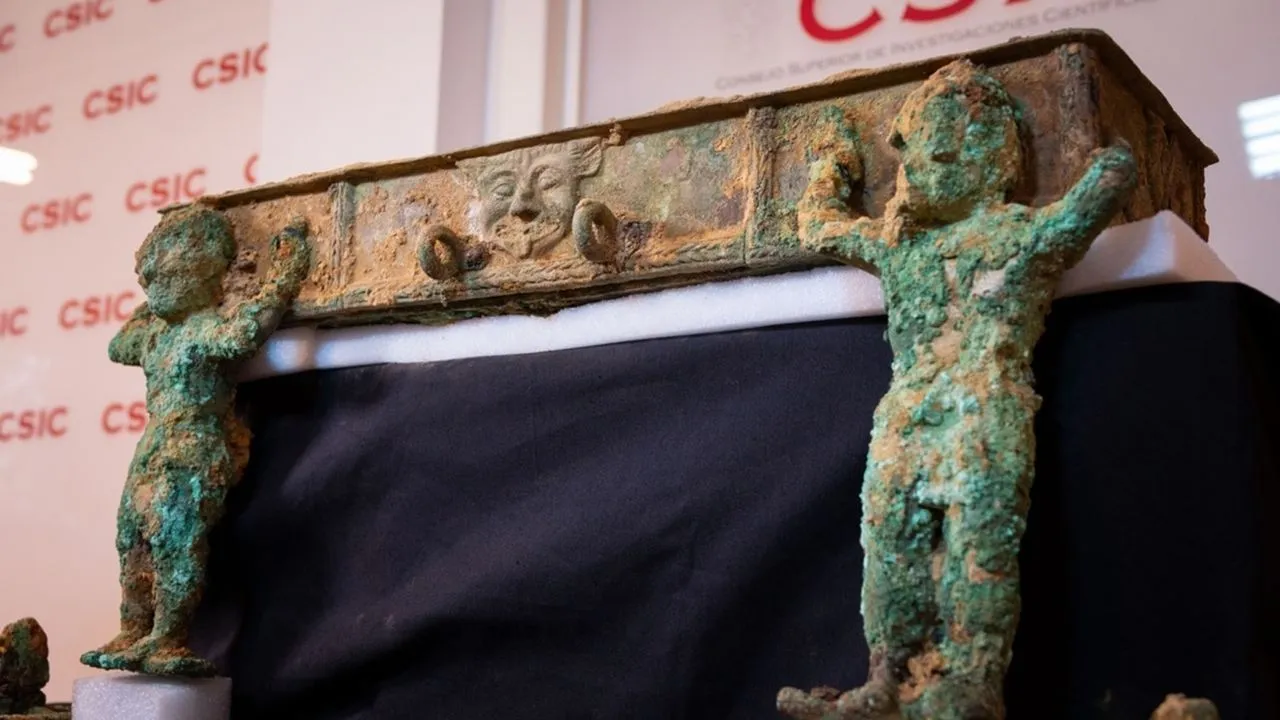
Archaeologists in Spain have found the remains of a roughly 2,400-year-old bronze chariot at Casas del Turuñuelo in Badajoz province, including a face that fuses a gorgon with the river god Achelous. The find is described as without known parallels in Iberia and adds a new piece to a mystery culture that disappeared around 400 B.C.
Spain just put a new, oddly specific fingerprint on an ancient mystery: a 2,400-year-old bronze chariot discovered at Casas del Turuñuelo, a site in the Middle Guadiana River Valley in Badajoz province near the Portugal border. The headline-grabber is its iconography. Restorers and researchers report a face that appears to be a fusion of a gorgon, an ancient protective symbol associated with Medusa, and Achelous, a Greek river god who could turn into a bull. The research team says the overall discovery has no known parallels in Iberia.
Why should decision-makers care? Because this is what happens when rituals, power, and trade networks collide, then the society steps off the board. The chariot is roughly 24 inches long, about 60 centimeters, and it was built with a flat, table-like top. The team interprets that surface as a place for burning incense as a divine offering. That is not just decoration. It suggests the object played a role in ceremony, and the way it was treated after use helps archaeologists argue for something far more intentional than random destruction.
Archaeologists uncovered part of the chariot, including two legs and two wheels. The legs appear designed like two people holding up the table part of the chariot. On the two short sides, there are mythical creatures associated with safeguarding: a griffin, described as a lion with wings and an eagle head. And the main face, the gorgon-Achelous mashup, is not just any stylized monster. It is an unusual combination that, according to lead archaeologist Guiomar Pulido González of the Mérida Institute of Archaeology (part of the Spanish National Research Council), is unique as a known chariot feature for Iberia.
Here is where the trade and identity plot gets messy, in a good way. Pulido explains that archaeologists have previously discovered similar chariots made by the Etruscans, a pre-Roman people who lived in what is now Italy from about 900 to 100 B.C. However, this newly found Iberian example is described as the first known chariot to feature that specific gorgon-Achelous mashup, and the first of its kind found in the Iberian Peninsula. The working theory is that the chariot was made by the Etruscans and arrived in Spain via trade routes.
But there is an anomaly worth spotlighting: restorers noticed that the two humanlike figures holding up the chariot are wearing skirts. Pulido says this would be unusual for an Etruscan chariot, because typically, Etruscan-crafted bronze figures are naked. Despite that mismatch, the team still leans toward Etruscan origin because the broader iconography and the overall “look” fits a pattern of imported elite objects crossing Mediterranean networks. Pulido is also a doctoral student at the Autonomous University of Madrid studying ancient Mediterranean imports throughout the Iberian Peninsula, and she points to additional supporting evidence for trade links, including imported pottery from Greece and other Etruscan bronze objects associated with the same general mystery landscape.
Then comes the part that sharpens the mystery into something operationally chilling: how the object ended up. The chariot was found in a stratigraphic layer suggesting it was discarded around the end of the fifth century B.C. Yet the design details of the gorgon-Achelou face indicate it could have been made as early as the sixth century B.C. In other words, the object may have traveled time-wise before being deposited. And the chariot was intentionally broken. Pulido notes it has no other damage besides being halved, and it was included in debris.
The site itself provides the larger context. Casas del Turuñuelo sits in the Middle Guadiana River Valley, an area known to have 14 sites left behind by an enigmatic people. Pulido says those people completely disappeared from the archaeological record around 400 B.C. Each of the 14 sites contains the remains of burnt buildings that were subsequently filled in with soil and fragmented objects. The leading theory, as Pulido frames it, is that inhabitants burned down their buildings, filled them in, and abandoned the sites around the same time, for unknown reasons. Crucially, the burning and filling seem too intentional to be explained by an enemy attack.
So instead of a battlefield story, the interpretation shifts toward ritual closure. Pulido suggests it may have been “a carefully planned ritual of closure,” a symbolic farewell to buildings that were intentionally decommissioned. Then, that culture “disappeared from the archaeological record.” That disappearance may be the biggest business-like lesson in the whole article: when communities are connected to trade, wealth, and imported goods, their sudden absence can leave behind a paper trail of objects, not explanations.
For executives and boards thinking about risk, culture, and continuity, this is the second-order takeaway. If the objects in this archaeological record reflect elite networks and ceremonial practices, then their deliberate destruction or decommissioning is a form of governance. It is a way societies manage endings, not just beginnings. The chariot’s gorgon-Achelous face and griffin safeguards, its incense-burning design, and its intentional halving all become pieces of a larger governance puzzle. And until more finds connect the dots, the central question remains: what kind of “closure” would end with disappearance around 400 B.C., even as imported Greek pottery and Etruscan bronze objects show the people were plugged into the wider Mediterranean world?
This story's Key Insights and Take-aways are locked.
Create a free account to unlock Executive Actions for one credit.
Register to UnlockAlways free for Executives Club members. Join the Club
More in Science

Alaska's 1,580-foot tsunami had warning signs. Scientists just found them.
Rapid glacier retreat, heavy rainfall, and thousands of tiny tremors preceded Alaska's 1,580-foot tsunami, a warning for every coastal community in a warming world.

The rare mutation that lets high-risk brains dodge Alzheimer's
Scientists found a natural defense against protein buildup, opening a new path to preventive treatments.

3,000 steps a day may halve Alzheimer's decline, study finds
New research links a modest daily walk to less tau buildup and nearly half the cognitive and functional decline, even for those with early signs.