
Apple turns Siri into an enterprise app action layer across iPhone, Mac, Watch, Vision Pro
WWDC 2026’s Siri AI upgrade changes how companies’ apps get found, indexed, and acted on inside Apple’s OS.
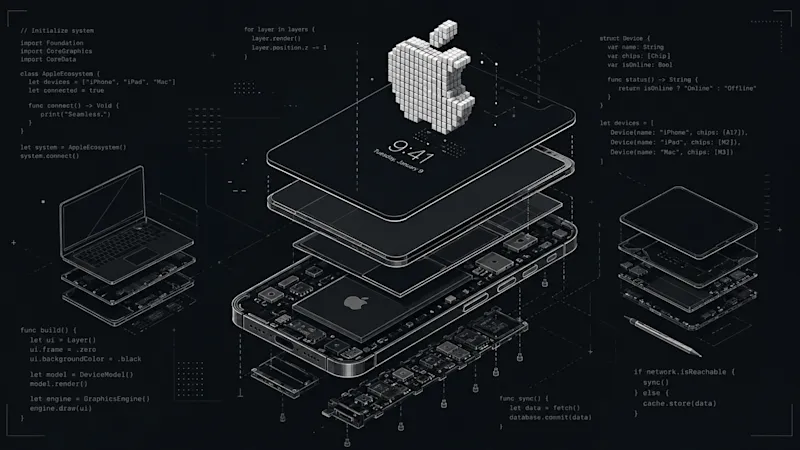
Apple unveiled Siri AI at WWDC 2026, and the WWDC26 Apple Intelligence developer guide shows it is evolving into a systemwide AI interface for apps, data, and workplace actions. For enterprise teams, that means adopting App Entities, App Intents, App Schemas, and View Annotations to make workflows Siri-driven, Spotlight-searchable, and governed by new device management controls.
Apple just reframed Siri. At WWDC 2026, the company is turning Siri AI from a smarter voice assistant into a systemwide app action and content-discovery layer across iPhone, iPad, Mac, Apple Watch, and Vision Pro, according to the WWDC26 Apple Intelligence developer guide.
For enterprise decision-makers, this is the part that matters: Apple is no longer treating assistant features as a thin integration that only works when users speak a narrow command. Instead, enterprise developers can expose app content through App Entities, make it available to Apple’s Spotlight semantic index, define actions through App Intents and App Schemas, and map onscreen UI elements to app objects through View Annotations. In practical terms, employees will be able to ask Siri to retrieve or act on a specific object they are viewing, and developers will be expected to describe data and capabilities in Apple’s system frameworks so the OS can surface and execute those actions.
So what does this change, beyond “Siri got smarter”? It changes discovery and workflow timing. In a typical enterprise app world, users open an app, search manually, click through menus, and stitch tasks together by hopping between tabs. Apple’s model points toward an alternative: users ask Siri to summarize, update, or act on specific content like customer records in a CRM, open tickets in an IT service desk, project tasks, invoices, calendar events, documents, expenses, notes, messages, or field-service records. The developer mandate becomes clear: if your app wants to show up well inside Siri AI, you likely need to make your data, actions, and onscreen context understandable to the system.
Apple also makes the Spotlight connection the “hook” for enterprise search. The WWDC26 guide states that entity schemas contribute app content to the Spotlight semantic index, while intent schemas let users take action on that indexed content without developers defining a rigid list of command phrases. That is a big shift from older voice-assistant patterns where you basically wrote a scripting language of exact prompts and invocation behavior. Here, Apple is asking developers to model what an app is, what it contains, and what it can do, so Siri, Spotlight, and Shortcuts can use those descriptions together.
And Apple is trying to fix the enterprise testing problem, not just the demo problem. The company is adding AppIntentsTesting, described as a framework that validates App Intents through the same infrastructure used by Siri, Shortcuts, and Spotlight without requiring UI automation. For enterprise software teams, this matters because natural-language actions create reliability and regression risks that conventional unit tests do not cover well. Apple’s approach also suggests a more integrated engineering workflow: instead of treating assistant support as a manual feature teams demo at the last minute, the Siri and Spotlight behavior can live in normal testing pipelines.
Under the hood, Apple is expanding the AI developer stack that feeds these assistants. Apple updates Foundation Models, giving Swift developers access to Apple on-device models, Apple models running through Private Cloud Compute, and third-party model providers that conform to Apple’s Language Model protocol. The guide says the framework now supports multimodal prompts, Vision tools, dynamic model profiles, and evaluations. In theory, an enterprise app could choose an on-device model for private or lightweight tasks, call Private Cloud Compute for heavier reasoning, or plug in outside providers such as Claude or Gemini, or open-source and company-controlled models through Apple’s model-provider interface.
Apple is also introducing Core AI, an operating system-level framework for running developers’ own models on Apple silicon. For enterprises that do not want sensitive data sent to a cloud model, local inference is one of the strongest selling points. Core AI is positioned as Apple’s first-party path to deploy custom models with Swift APIs, memory controls, and optimized execution on Apple hardware.
Then there is a governance and security layer that enterprises will care about as much as the UX. Apple’s WWDC26 materials include a session on how developers can mitigate risks to agentic features, covering indirect prompt injection, data exfiltration, unintended actions, threat modeling, user confirmations, authentication, and safeguards for App Intents and Foundation Models. That acknowledgement is notable because cross-app assistants that can read context and take actions create new attack surfaces, not just new conveniences.
Finally, Apple is addressing enterprise IT controls directly. Device management documentation for Apple Intelligence, Siri, and external intelligence integrations describes new management controls for supervised devices. Apple says organizations can allow or deny features such as Genmoji, Image Playground, Writing Tools, Image Wand, app-specific intelligence in Mail, Notes, and Safari, Apple Intelligence Report, Visual Intelligence Summary, and on-device-only processing for dictation and translation. It also notes that additional management for Siri AI and Visual Intelligence will arrive in later beta releases, meaning the control story is underway but not fully complete yet. Apple is also adding controls for external intelligence services, including whether users can access outside AI services and whether they can sign in. If you are an enterprise trying to manage when employees use Apple’s models, Apple’s private cloud architecture, or third-party AI systems, those controls are the difference between “cool feature” and “manageable platform.”
The second-order stake for peers is simple: Apple is building an OS-centered AI distribution path that could compete with Microsoft and Google in enterprise AI using a different pitch. Instead of being locked to productivity clouds, Apple is tying the assistant layer to the devices and the OS where work actually happens. For enterprise developers, that means Siri AI readiness is becoming a product requirement, not a nice-to-have. For IT leaders, it means new policy knobs are emerging alongside new integration surfaces. Either way, WWDC26 is signaling that Siri is no longer optional when you map the future of workplace software on the Apple platform.
This story's Key Insights and Take-aways are locked.
Create a free account to unlock Executive Actions for one credit.
Register to UnlockAlways free for Executives Club members. Join the Club
More in Technology

OpenAI says 10,000 agents cracked a 90-year math problem in 88 hours
The company's claim is audacious, but one mathematician is pushing back. Here's what it means for AI-driven discovery.

Meta still serves child sexual abuse ads on Instagram in India - BBC report
A new report following the BBC Eye investigation says the ads are still there - what it signals for every platform with a self-serve ad engine.

White House yanks 'Build the Wall' game after Tetris Company copyright warning
The administration's arcade game vanished in hours - and the takedown playbook every brand can learn from.