
Apple TV and Google TV Streamer enable Thread 1.4 credential sharing
tvOS 27 developer beta and a Google TV Streamer update move Thread Border Routers toward joining existing Thread networks.
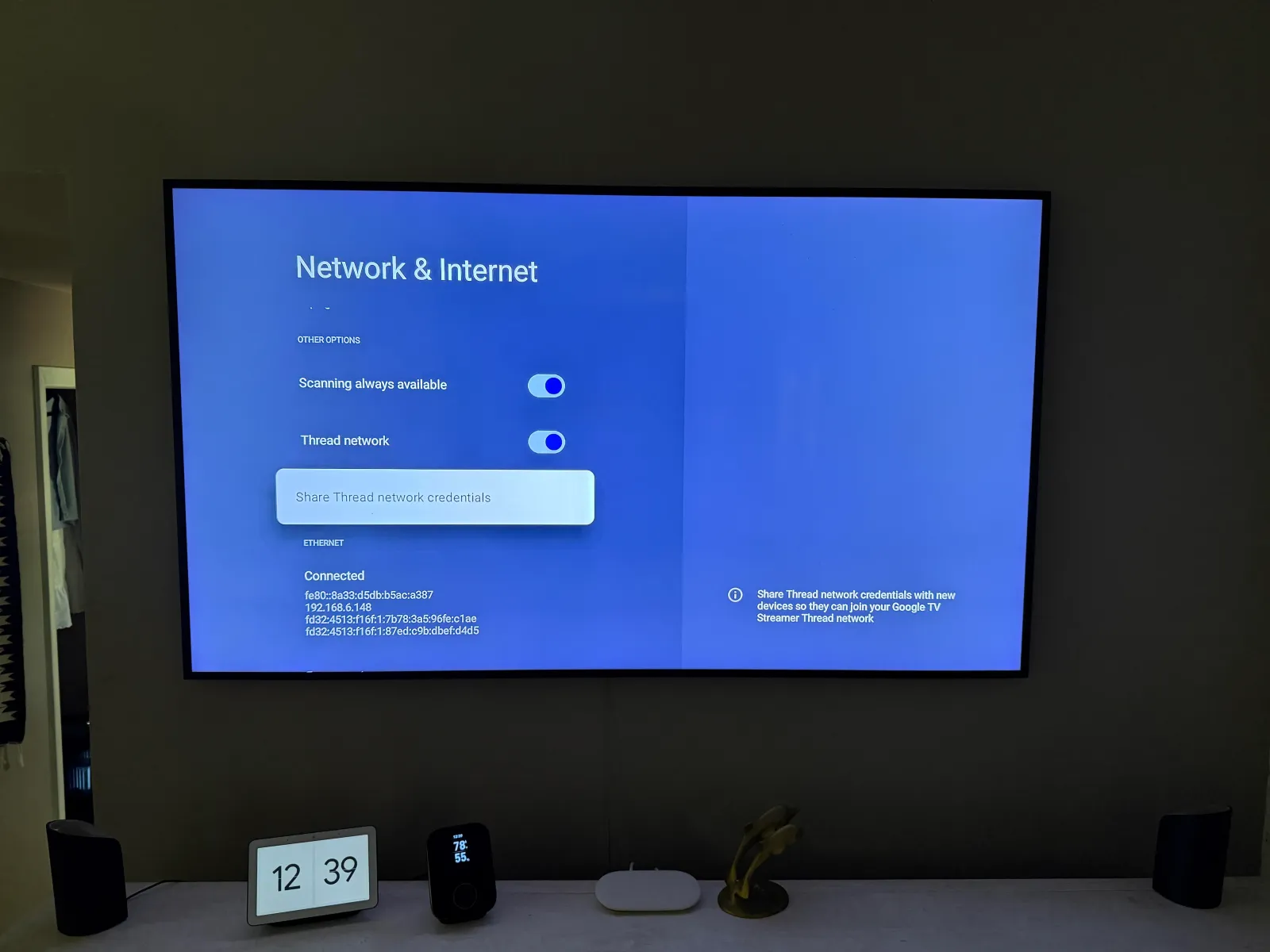
Apple and Google are updating their smart home streaming devices to support Thread 1.4. The change lands in a tvOS 27 developer beta on compatible Apple TVs and via a software update for the Google TV Streamer.
Apple and Google are quietly pushing their smart home streaming devices toward easier Thread networking. As first spotted by Matter Alpha and 9to5 Google, the latest spec, Thread 1.4, has arrived on compatible Apple TVs in the tvOS 27 developer beta and on the Google TV Streamer through a software update. The practical upshot is that these devices can access a way to manually share Thread credentials.
That detail matters because these streamers are Thread Border Routers. In Thread networks, a Border Router sits at the edge of the Thread mesh and bridges it to the wider world, which means how it joins a network is not a minor setting. Thread credential sharing is the mechanism that helps a Border Router connect to an existing Thread network instead of setting up (or effectively recreating) its own.
The industry context here is smart home interoperability, where users still feel the pain most: one household has multiple brands, multiple apps, and too many onboarding steps. Matter is the interoperability standard that has tried to tame that chaos, and Thread is one of the connectivity protocols Matter runs on. So when Apple and Google improve Thread support in devices that act as Border Routers, they are adjusting the plumbing that underlies Matter-based device control.
Why “Thread credential sharing” is such a big deal is simple: credential sharing reduces friction at the exact moment a new hub or router needs to become part of a network. Without it, you often end up with duplicated setup flows, confusing onboarding prompts, or devices that do not immediately attach to the network you already built. With it, a Border Router can join an existing Thread network more directly. That shifts onboarding from “create something new” to “attach to what’s already there.”
This also lines up with the original direction for Thread Border Routers. The source notes that the original plan was for Thread Border Routers to all work seamlessly. Thread 1.4 support is a step toward making that “seamless” vision more real in practice, because shared credential handling is the difference between interoperability as a slogan and interoperability as a working system. If Border Routers can coordinate joining behavior more cleanly, the ecosystem gets closer to the goal of fewer reconfigurations across brands.
Timing matters too. A tvOS 27 developer beta is the early gateway for Apple’s platform changes, which suggests Apple is testing and validating this Thread 1.4 plumbing before it reaches broader audiences. On the Google side, a software update for the Google TV Streamer indicates the same theme: these are not just documentation updates. They are feature changes that will affect real onboarding and network behavior once deployed.
For decision-makers in the smart home space, there is also a competitive and operational angle. Companies that ship reliable Border Router behavior can reduce the number of support tickets tied to setup failures and improve activation rates for downstream devices. When users do not have to fight credential prompts or network attachment issues, more Matter and Thread devices become “it just works” stories. That is how interoperability standards gain momentum: not by being technically correct, but by being predictably smooth in living rooms.
There are second-order implications for the broader ecosystem, including device makers and app developers. Matter devices often rely on the Border Router role to translate and route connectivity. As Apple and Google update their hubs toward Thread 1.4, accessory manufacturers and platform teams will likely need to validate that their onboarding paths still match expected network attachment behavior. If credential sharing behaves more consistently, it could also change what device makers choose as their default user flows. Less friction means less time spent designing workarounds for “wrong network” moments.
Bottom line: Thread 1.4 support is not a headline feature for the average shopper, but it is a meaningful step for anyone building, distributing, or governing smart home interoperability. By adding a way to manually share Thread credentials across Apple TV (tvOS 27 developer beta) and the Google TV Streamer, Apple and Google are enabling Border Routers to connect to existing Thread networks. That is the kind of behind-the-scenes adjustment that determines whether Matter ecosystems feel effortless or exhausting. And for executives watching adoption curves, the difference is real.
This story's Key Insights and Take-aways are locked.
Create a free account to unlock Executive Actions for one credit.
Register to UnlockAlways free for Executives Club members. Join the Club
More in Technology

OpenAI says 10,000 agents cracked a 90-year math problem in 88 hours
The company's claim is audacious, but one mathematician is pushing back. Here's what it means for AI-driven discovery.
Meta still serves child sexual abuse ads on Instagram in India - BBC report
A new report following the BBC Eye investigation says the ads are still there - what it signals for every platform with a self-serve ad engine.

White House yanks 'Build the Wall' game after Tetris Company copyright warning
The administration's arcade game vanished in hours - and the takedown playbook every brand can learn from.