
ASML says it can't meet chip tool demand in 2027 or 2028
The Dutch chip-equipment giant just told investors its supply plans fall short for two straight years, and customers are already booking for 2030.
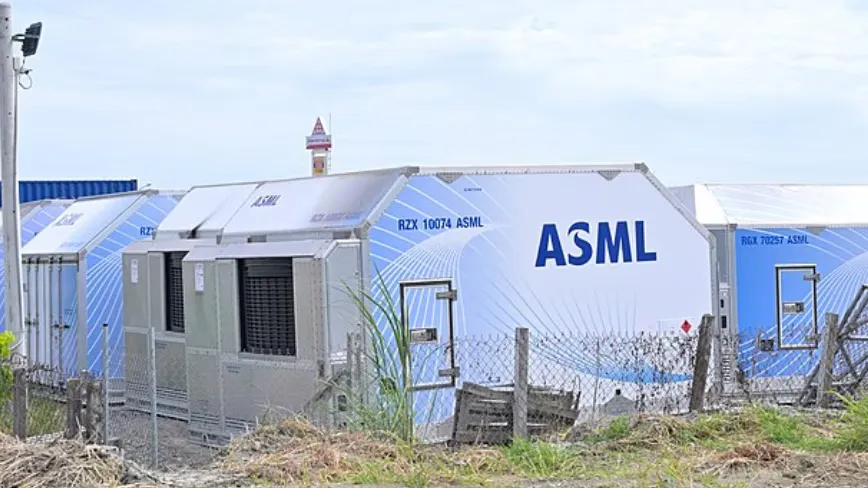
ASML, the Dutch semiconductor equipment maker, said its supply plans cannot fully meet demand for its machines in 2027 or 2028, with some customers already seeking orders for 2029 and 2030. The admission, paired with a raised low end of 2026 sales guidance, sent shares up 2.8% and signals sustained pricing power for the industry's bottleneck player.
ASML just told investors the uncomfortable truth: it cannot fully meet demand for its chip-making machines in 2027 or 2028. The Dutch semiconductor equipment giant, whose lithography systems are essential for producing advanced chips, said its current supply plans simply fall short of what customers are asking for. Some customers are already trying to place orders for 2029 and 2030, according to the company's latest update. That is not a forecast of a future problem; it is a statement about the present state of the company's order book and production capacity.
That admission is the headline, but the market reaction tells the real story. ASML raised the low end of its 2026 sales guidance, and shares rose 2.8% on the news. Investors read the supply-demand gap as a sign of pricing power, not a problem. When a company says it cannot make enough of the machines everyone needs, that is a seller's market. The guidance raise is a direct consequence of that leverage: ASML can now see enough demand far enough out to lift its own expectations.
For context, ASML is not just any equipment maker. It is the dominant supplier of advanced lithography tools, the machines that use light to etch microscopic patterns onto silicon wafers. The most advanced systems, known as extreme ultraviolet or EUV, are effectively a one-company market. That means ASML's capacity constraints are the entire industry's constraints. If ASML cannot build enough machines, chipmakers like TSMC, Samsung, and Intel cannot build enough advanced chips. There is no second source for the most critical step in modern chip production.
The timing is particularly consequential. The AI boom has sent demand for cutting-edge semiconductors soaring, from data center GPUs to AI accelerators. Every one of those chips requires lithography steps that only ASML's tools can perform. The company's inability to meet demand in 2027 and 2028 suggests the chip supply chain will remain stretched for years, not quarters. This is not a cyclical dip; it is a structural shortage in the most important piece of manufacturing equipment in the world.
Governments in the United States, Europe, and Asia are pouring billions into domestic chip production, from the CHIPS Act in America to similar programs in Japan and the EU. But every new fab, no matter who funds it, needs ASML's machines to produce leading-edge chips. That means the supply crunch ASML is describing is not just a company problem; it is a strategic bottleneck for entire economies. The countries and companies that secure ASML capacity early will have a decisive advantage in the AI race.
The fact that customers are already trying to lock in orders for 2029 and 2030 is a striking signal. It means the world's biggest chipmakers are planning around ASML's capacity constraints years in advance. That kind of forward ordering is rare in the semiconductor industry, where lead times are long but not usually measured in half-decades. It also gives ASML extraordinary revenue visibility, which likely explains the raised guidance. For a company that sells machines costing hundreds of millions of dollars each, having a multi-year order pipeline is a massive competitive advantage.
For executives and boards, the implications are clear. If you are a chipmaker or a company that depends on advanced chips, your supply chain is only as strong as ASML's factory output. The company's admission is a reminder that the semiconductor industry's bottleneck is not design or even capital, but the physical production of the machines that make the chips. For investors, ASML's pricing power is now even more entrenched. For competitors, there is no easy path to challenge ASML's position, because the technology and manufacturing know-how are decades deep.
The bigger picture is that this is not a temporary mismatch. ASML is telling the market that demand will outrun supply for at least two full years, and customers are already planning for the next decade. That is the kind of structural tailwind that defines a company's fortunes. For everyone else, it is a warning: the chip shortage never really ended, it just moved upstream. The companies that secure access to ASML's tools early will be the ones that win the next wave of AI and computing.
This story's Key Insights and Take-aways are locked.
Create a free account to unlock Executive Actions for one credit.
Register to UnlockAlways free for Executives Club members. Join the Club
More in Business

Elon Musk unveils a flying car, and SpaceX helped build it
The Tesla CEO's showcase at a SpaceX facility signals a future where road and rocket engineering converge.

Apple's $2,000 iPhone Duo opens preorders, taking on Samsung and Google
Apple's first foldable hits the market at a premium price, reshaping a category Samsung and Google have led.

Pope Leo XIV, first American pope, diagnosed with lung cancer
The 71-year-old Chicago-born pontiff underwent successful surgery on his right lung, and his diagnosis raises new questions about his AI-focused papacy and the Vatican's future.