
ASML ships EUV machines at $400 million each to keep AI fed with smaller chips
Jos Benschop’s 8-nanometer breakthrough turns “shrink” into a $400M line-item that fabs and governments both watch closely.
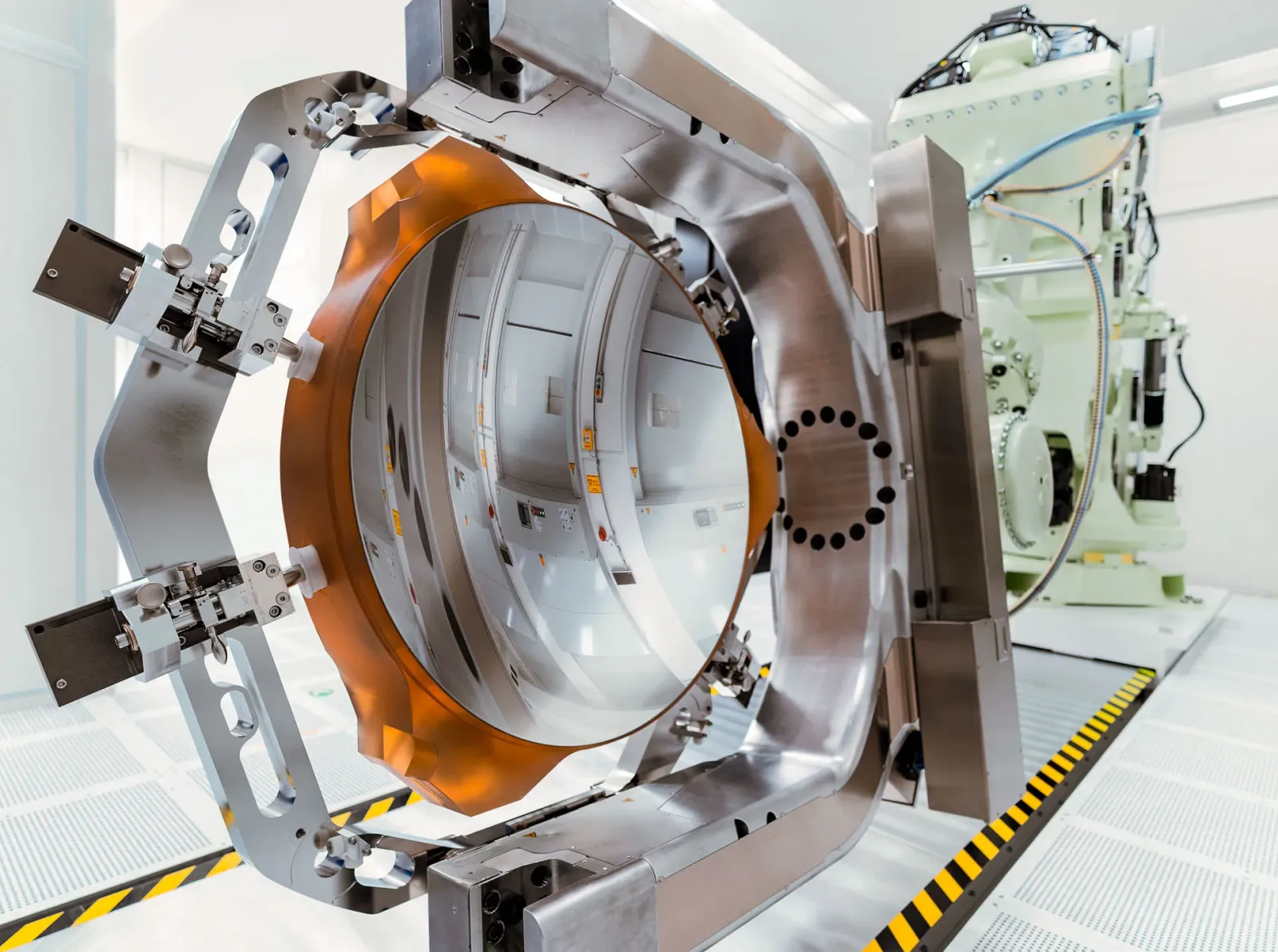
ASML executive vice president of technology Jos Benschop describes the company’s latest extreme ultraviolet lithography machine, aimed at 8-nanometer resolution. At a price of $400 million per tool, it reinforces ASML’s dominance in “shrink” and keeps the AI chip supply race running, even amid US-led China export restrictions.
Jos Benschop climbs a ladder to the top of ASML’s newest chipmaking machine, and from about 15 feet up, the view is basically a sci-fi engine room. The apparatus is the size of a double-decker bus, with more than 150 tons of precision-milled aluminum, thousands of snaking tubes, colored cables, and pressurized tanks. Technically, it contains more than 200 cubic meters of what Benschop calls “mechatronic devices” that can position a few mirrors with atomic precision. The stakes behind that precision are not subtle: this is the lithography gear fabs buy when they need ever-smaller circuitry to build the next generation of chips.
This machine targets an 8-nanometer resolution, and it’s shipping to chipmaking factories at an eye-watering price of $400 million each. That price tag lands because chipmakers are in a desperate annual race to improve performance while using less power, which depends on fitting more transistors and wiring into tinier spaces. The AI boom adds fuel to the fire: firms such as OpenAI and Anthropic scramble to erect server farms to train and deploy increasingly powerful models, and that requires increasingly powerful hardware. ASML’s thesis is straightforward, and the source is direct: the tighter “shrink” it enables creates “the space” for what the AI industry is doing “now,” and its leadership believes it has only seen “the tip of the iceberg,” according to ASML CTO Marco Pieters.
To understand why “shrink” is a big deal, you have to know what lithography actually does. The basic job is shining light on a silicon wafer to pattern the transistors, wiring, and other components that will eventually be cut out into chips. In production, the pattern starts on a reticle, a mask carrying the design. The machine transfers the pattern from the reticle to the wafer by using light that interacts with chemical layers to lock the pattern in place. Feature size is partly determined by the light’s wavelength. Shorter wavelength light can create smaller circuitry, and the industry historically runs on a two-step dance: first it uses an available source of light, then it increases numerical aperture to squeeze focus harder, and then it hits a ceiling and moves to a new form of light with a shorter wavelength.
That’s the history behind why the world ended up in the EUV era. Up to the early 1990s, chipmakers used visible light around 400 nanometers. By the mid-’90s they moved to deep ultraviolet at 193 nanometers. By the late ’90s, the “end of the line” for deep ultraviolet was approaching, and the industry had to choose what came next. x-rays were an option, with roughly a 1-nanometer wavelength, but they were “devilishly hard to focus.” Electron and ion beams were equally precise, but they worked like dot-matrix printers, transferring patterns point-by-point, too slowly for a chip industry that wants hundreds of wafers per hour. Around 2001, ASML bet on extreme ultraviolet, with a wavelength just shy of the x-ray range. Nikon and Canon were working on it too, but they dropped out while ASML kept going.
EUV brought its own engineering nightmare. EUV is absorbed by glass lenses and even by air, and the system has to generate and deliver the light reliably enough for production. In practice, ASML figured it would take six years to wade through the R&D nightmare, but it took 16 years and about $10 billion of research to make the approach work, building a system that operates in a vacuum. It creates EUV light by vaporizing molten tin and using mirrors to direct it. The mirror challenge was so intense that Zeiss, the historic German optics company, had to invent new techniques for polishing and inspecting the mirrors, including using an ion beam to work on the optics. The result of that long fight is a production method that can craft transistor features at 13 nanometers in the earlier generation, and at 8 nanometers for the newest machine Benschop is describing.
Now layer in the industry structure and the politics that come with it. The chipmaking field is essentially controlled by two big players: ASML, which creates lithography machines, and TSMC, the chipmaking giant in Taiwan that uses ASML’s machines to craft the vast majority of all microchips. ASML’s “shrink” push made it dominant: it produces about 90% of all chip-lithography tools worldwide, which is why making chips typically means ASML is unavoidable. But a monopoly position also makes governments uneasy, because the supply chain does not spread risk evenly. The source highlights that the US government pressured the Dutch government to impose an embargo in 2019, preventing ASML from selling high-end machines to any Chinese firm.
This is where the $400 million machine becomes more than a hardware story. Marc Hijink, author of Focus: The ASML Way, frames the geopolitical point using a “chips are the new oil” metaphor, saying that being deprived can be as disastrous as being deprived of oil. James Proud, cofounder and CEO of the lithography startup Substrate, argues the situation is not ideal, citing “dangerously reliant” supply chain dynamics, concentration among a small number of players, and a very expensive supply chain. That is why competitors are trying to unseat ASML after two decades of dominance, with China pouring billions into replicating ASML’s technology and startups such as Substrate attempting to build lithography machines that are cheaper, smaller, and more capable than ASML’s behemoths.
For executives, board members, and anyone responsible for budgets that must translate into production capacity, the message is simple and uncomfortable: the next generation of “AI hardware horsepower” depends on machines priced at $400 million, delivered in a system with tight geopolitical constraints. If you are a chipmaker, the decision is about runway and competitiveness, because every year of delay can mean losing the ability to build denser, more efficient chips. If you are a policy or risk leader, it’s about chokepoints and concentration risk. And if you are an investor watching the industrial stack, you’re staring at a rare moment where cutting-edge physics, multi-billion-dollar R&D, and export controls all converge on a single physical machine you can stand next to.
This story's Key Insights and Take-aways are locked.
Create a free account to unlock Executive Actions for one credit.
Register to UnlockAlways free for Executives Club members. Join the Club
More in Technology

Nvidia's $89B data center quarter: the 9 companies cashing in
The AI buildout is minting fortunes beyond GPUs, and memory, cloud, and cooling suppliers are riding the same wave.

Google quietly links your phone number to every Android account on your SIM
Adding a SIM now ties your phone number to all Google accounts - and future accounts inherit it. Here's the security and privacy stakes.

Hijacker AI 'Skynet mode' runs 100,000 attack steps against exposed models
Symantec caught a criminal AI agent that borrows other models, steals data, and mines crypto; the only relief is no confirmed victims yet.