

Baba is You and UFO 50's Party House jump to tabletop via Kickstarter in September
Two beloved indie hits are getting board game adaptations, with funding kicking off September through Kickstarter campaigns.
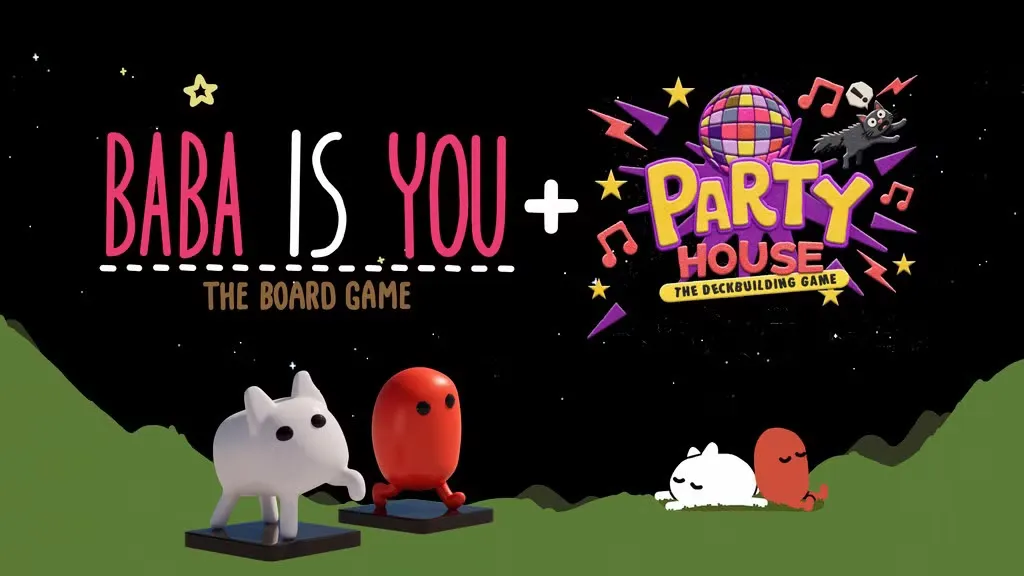
Baba is You and UFO 50's Party House are receiving unexpected board game adaptations. Kickstarter campaigns to fund both projects begin in September.
Two indie games you probably already mentally catalogued as “must-keep-on-our-radar” are stepping into physical form. Baba is You, the mind-bending 2019 puzzler, is being adapted into a competitive board game. And Party House, a standout title included in UFO 50, is getting a deckbuilder adaptation.
The timing matters because this is not a random fan-made conversion. Kickstarter campaigns to fund both adaptations are set to begin in September, which means the financial risk, timeline, and early customer commitment are being front-loaded into the campaign window rather than waiting for a traditional publisher deal.
Here is why this is worth your attention even if you do not care about board games. Tabletop is turning into a “second channel” for game IP, and it is one that can monetize different behaviors than the digital market. Video games often optimize for repeat play through mechanics, updates, and community virality. Board games, meanwhile, monetize ownership and gathering. You can take the same design DNA, translate it into rules, components, and play patterns, and create a product that lives in living rooms, game nights, and gift cycles.
That translation is also strategically tricky. Baba is You is known for bending the rules of logic and language in a way that feels almost tool-like rather than merely puzzle-like. Turning “mind-bending puzzler” DNA into a competitive board game means the designers must convert those mental transformations into enforceable gameplay on a table. The upside is huge if they nail it: the board game audience is often hungry for original, concept-driven systems that are easy to teach but hard to master. The downside is equally real: if the adaptation misses the original’s core “aha,” the product becomes a generic competitive board game with a recognizable name.
Party House adds another angle. The source describes it as “one of the best games included in UFO 50,” and that it is getting a deckbuilder. Deckbuilders are a well-established category in tabletop, which can be a benefit for adoption because players recognize the format. But “recognize the format” is not the same as “replicate the experience.” UFO 50 is an anthology style collection with a particular indie vibe, and a deckbuilder adaptation has to distill that vibe into cards, combos, and tension loops. In practice, that means the adaptation likely banks on what deckbuilders do best: iterative strategy, draw variance, and build-around identity.
Now zoom out to the business mechanics. Kickstarter changes what the project has to prove early. It is not just about attention. It is about validating demand and de-risking production planning. For executives and boards watching adjacent media deals, this is a signal that creators and IP holders are increasingly comfortable using crowdfunding to bridge the gap between “we can make this” and “there is a market willing to pay.” That can reduce the friction of securing upfront capital, but it also raises the bar for execution. Campaign timelines create expectations, and physical production adds complexity that digital releases typically avoid, from component sourcing to packaging and fulfillment.
It also raises a subtle governance question: board games are inherently collaborative in a social setting, while competitive mechanics and rule interpretation can create friction if players interpret texts differently. That makes rules clarity and playtesting not just quality concerns but operational ones. If a competitive board game is confusing on day one, the feedback loop can hit fast, and reputational damage travels quickly in tabletop communities. For stakeholders, the Kickstarter start in September means the early months will be where clarity, prototypes, and communication need to land.
The second-order implication is for anyone in similar roles who manages creative IP, licensing, or “platform adjacency.” This is a tangible example of beloved game brands exploring new product surfaces. If Baba is You and UFO 50's Party House land well in tabletop, the model becomes repeatable: a digital success can generate physical revenue, deepen brand loyalty, and broaden audience reach. If they struggle, it becomes a cautionary tale about translation risk: gameplay feel and system identity are harder to port than logos and name recognition. Either way, the September Kickstarter start makes this a live experiment, not a distant rumor.
In other words, the market is paying attention, and it is doing so on a schedule. In September, the funding phase begins. The projects will then have to prove they can keep the essence of Baba is You and Party House intact while delivering something players can shuffle, argue about, and ultimately fall for in real life.
This story's Key Insights and Take-aways are locked.
Create a free account to unlock Executive Actions for one credit.
Register to UnlockAlways free for Executives Club members. Join the Club
More in Business

Anthropic’s Levant Alpöge cracks the Jacobian conjecture after 87 years
A Harvard valedictorian used Claude to hit a 1939 breakthrough, but the missing “why” is the real problem.

Uber buys Delivery Hero for nearly $15B, vaulting to top food delivery outside China
The deal doubles Uber's dual-services footprint and pushes a ride-and-eats bundling play into 50 more markets.

Epic and Google drop settlement bid, forcing rival Android app stores by July 22
Google told the court it is ready to carry third-party app stores starting Wednesday, July 22.