

Beehive ramps 3D-printed jet engines to 8,000/year with Air Force cash and $70M Ohio buildout
Scaling from prototypes to 8,000 units demands printers, machining, and money. Here is what Beehive is adding, and why it matters.
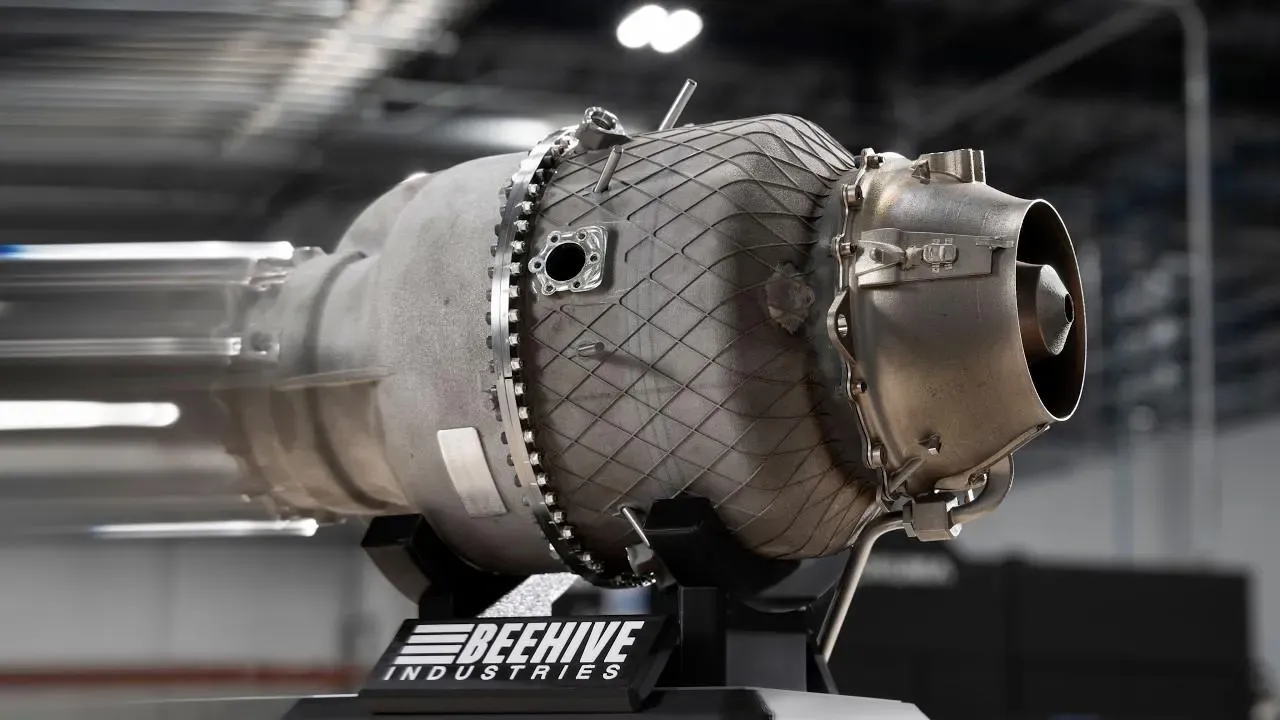
Beehive Industries is pushing its 3D-printed drone jet engine production into full scale, targeting 8,000 units per year. The plan combines Air Force funding, 30 new printers, machine shops, and a $70M Ohio expansion, reshaping how fast manufacturing capacity can be built.
Beehive Industries wants to hit full production for 3D-printed drone jet engines at a rate of 8,000 units a year, and it is backing that target with both government funding and industrial scale-up. According to the report, the company is using Air Force funding to expand production capacity, including adding 30 new printers and building out machine shops, plus a $70M expansion in Ohio.
The key implication for decision-makers is simple: Beehive is treating additive manufacturing like a production system, not a novelty. The jump to 8,000 units per year signals that the bottleneck is no longer design feasibility, but throughput. If you are tracking defense supply chains, that is a big deal because throughput is what turns “can we build it?” into “can we deliver it on schedule?”
To understand why the Air Force angle matters, you have to look at how defense procurement tends to work. Production at meaningful volume usually requires more than engineering progress. It requires qualified manufacturing processes, repeatability, supply chain readiness, and capacity that can run at tempo. When the federal government funds scale, it is often because the service has a concrete need for ramping output, and it expects contractors to industrialize. Beehive’s plan reads like an answer to that pressure: printers for layer-by-layer manufacturing, machine shops to support finishing and related work, and physical expansion to house it all.
The 30 new printers detail is where the “full production” claim becomes operational. Additive manufacturing can be fast to prototype, but it becomes a factory problem at higher volumes. Printers are the obvious lever, but they are only one part of the puzzle. Production also needs equipment for post-processing, quality control, tooling support, and the supporting industrial infrastructure that keeps output steady. The report explicitly points to machine shops alongside the printers, which suggests Beehive is not just printing parts in isolation. It is building a manufacturing workflow that can withstand volume pressure.
Then there is the $70M Ohio expansion, which is the loudest signal of all. Capital expenditures on that scale usually mean a company believes it needs a long runway for production demand, or it needs to be ready for demand quickly. For peers, the second-order question is whether additive manufacturing suppliers are shifting from “capacity-on-demand” to “capacity-on-hand.” In other words, the market implication is that printer fleets, machining capability, and dedicated facilities are becoming strategic assets, not overhead.
There is also a strategic feedback loop for boards and executives. When you plan around a specific unit target like 8,000 units a year, every business function has to align to hit it. Manufacturing has to hit yield and cycle-time. Operations has to manage throughput and changeovers. Finance has to align capex with long-term funding, contracts, and ramp schedules. Even legal and compliance teams matter more when production scales, because defense-adjacent manufacturing typically comes with heightened scrutiny and expectations for traceability and consistent output.
If you are in a leadership seat at a defense supplier, an advanced manufacturing company, or an investor evaluating industrial tech, Beehive’s move should raise a practical question: what part of additive manufacturing is ready to be industrialized, and what part still behaves like a prototype lab? The report does not list the internal benchmarks, but it does show the direction: scale production, expand printer count, add machining capability, and invest heavily in facilities. The Air Force funding and the Ohio buildout point to seriousness, not experimentation.
The strategic stakes go beyond one company’s factory. When a supplier can credibly scale 3D-printed jet engine production to thousands of units annually, it can alter procurement expectations across the ecosystem. Demand planning, delivery timelines, and competitive positioning shift when manufacturing capacity is no longer constrained by traditional supply chain lead times. For decision-makers watching defense manufacturing, the message is clear: additive is moving from “promising” to “producing,” and Beehive is investing to make that happen at scale.
This story's Key Insights and Take-aways are locked.
Create a free account to unlock Executive Actions for one credit.
Register to UnlockAlways free for Executives Club members. Join the Club
More in Business

Anthropic’s Levant Alpöge cracks the Jacobian conjecture after 87 years
A Harvard valedictorian used Claude to hit a 1939 breakthrough, but the missing “why” is the real problem.

Uber buys Delivery Hero for nearly $15B, vaulting to top food delivery outside China
The deal doubles Uber's dual-services footprint and pushes a ride-and-eats bundling play into 50 more markets.

Epic and Google drop settlement bid, forcing rival Android app stores by July 22
Google told the court it is ready to carry third-party app stores starting Wednesday, July 22.