
Block CFO: AI agents will appear on org charts as AI spend tops $730B
Amrita Ahuja says companies will list AI agents alongside human roles, forcing leaders to rethink workforce planning and ROI.
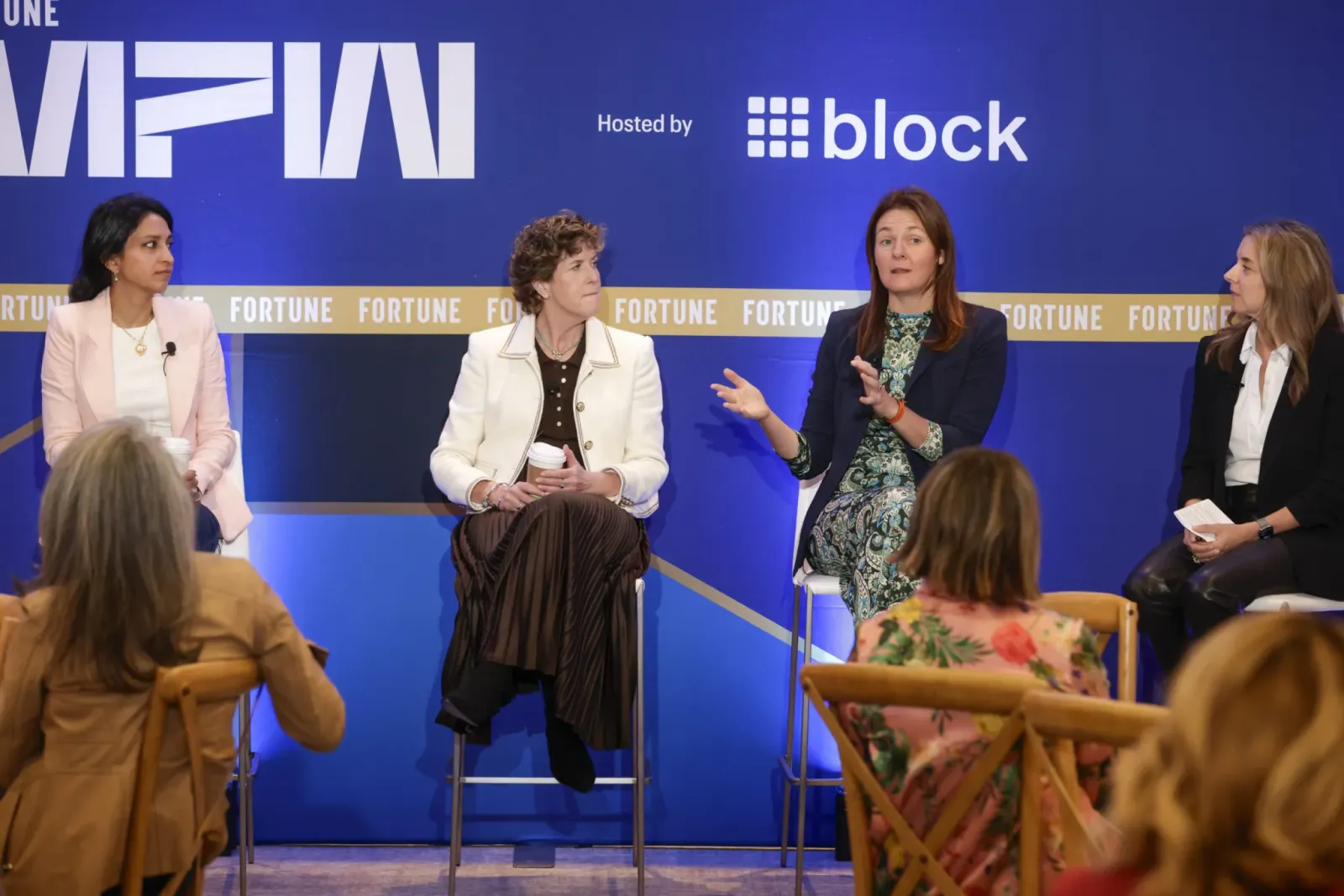
Amrita Ahuja, Block's CFO and COO, said at the Fortune Most Powerful Women Summit that AI agents will soon appear on corporate org charts as companies justify over $730 billion in AI spending. The shift will force executives to treat AI agents as developable team members and redefine how they measure workforce ROI.
Block CFO and COO Amrita Ahuja has a prediction for the future of work: AI agents will start showing up on your company's org chart. Speaking Tuesday at the Fortune Most Powerful Women Summit in Santa Barbara, Ahuja said companies are already beginning to list AI agents alongside human units, a shift driven by the need to justify more than $730 billion in expected AI spending this year. "Where things are headed - and I've already heard about a couple companies doing this, so we're on the frontier - is you look at your work chart that your company publishes, and it will have not only units, but agents," she told Fortune senior writer Sheryl Estrada.
The prediction comes as Block itself undergoes a radical restructuring. Earlier this year, CEO Jack Dorsey laid off 40% of his entire staff as part of a structural overhaul tied to the company's ballooning adoption of AI to automate workflows. Ahuja said workers will be responsible for both training and deploying these agents, which she likened to human employees that need development over time. "Those agents, not too dissimilar to humans, need to be developed over time," she said. "They need more context. They need more information. They need to understand their goals, and those may change. And so, I do think we're headed into a new frontier as to what the organization looks like."
The push to put AI on the org chart is fundamentally about justifying the cost. Shelagh Glaser, CFO of Synopsys, likened AI spending to snacks in the break room, where some customers need premium tiers and others internal models. "The cost for AI was pretty reasonable until it wasn't," Glaser said at the summit. "We are investing in AI. It is an important investment. We want our team to have the latest greatest tools, but just along with everything else, is being super intentional about what that investment is, and that then forms the strategy of how we think about how we get the customer."
For some executives, the return on AI investment comes from unlocking talent that already exists inside the company. Michelle Zatlyn, cofounder, president, and board co-chair of Cloudflare, said AI agents have become "an extension of our team," while thousands of employees now have access to software that lets them become "builders" and uncover new use cases. "It's been amazing to see where the best builders come from," she said. "It's not where you'd expect."
Amazon, meanwhile, is measuring AI returns through a structured funnel. Heather Zorn, Amazon's vice president of customer experience products and services, said the company tracks adoption first, then engagement, then efficiency through outcomes like time saved. But the ultimate metric, she said, is simple: "The ultimate KPI is revenue growth. That is the ultimate KPI. We don't need another KPI."
The implications for executives are significant. If AI agents become formal units on org charts, companies will need to define how those agents are onboarded, trained, and evaluated. Ahuja's framing suggests agents will require context, information, and evolving goals, much like human employees. That means managers may need new tools to supervise machine workers, and HR departments may need to design career paths for software that learns on the job.
For CFOs and COOs, the shift also raises questions about accountability and cost allocation. If an AI agent is responsible for a workflow, who owns its performance? How do you measure its contribution to revenue? The answers will determine whether the $730 billion in AI spending delivers real returns or becomes another line item that fails to justify itself. Glaser's point about intentionality is a warning: without a clear strategy, AI investments can quickly become an expensive break-room perk.
The bottom line: AI is moving from a tool employees use to a colleague they manage. Leaders who start treating agents as part of the org chart, with defined goals and development plans, will be better positioned to capture the productivity gains and revenue growth that Amazon and others are chasing. As Ahuja put it, "We're headed into a new frontier as to what the organization looks like." The question is whether your organization is ready.
This story's Key Insights and Take-aways are locked.
Create a free account to unlock Executive Actions for one credit.
Register to UnlockAlways free for Executives Club members. Join the Club
More in Business

Elon Musk unveils a flying car, and SpaceX helped build it
The Tesla CEO's showcase at a SpaceX facility signals a future where road and rocket engineering converge.

Apple's $2,000 iPhone Duo opens preorders, taking on Samsung and Google
Apple's first foldable hits the market at a premium price, reshaping a category Samsung and Google have led.

Pope Leo XIV, first American pope, diagnosed with lung cancer
The 71-year-old Chicago-born pontiff underwent successful surgery on his right lung, and his diagnosis raises new questions about his AI-focused papacy and the Vatican's future.