
Built Robotics piles 1,000 steel beams daily for Meta’s Hyperion, CEO says
Autonomous retrofits are taking over the mud, the monotony, and part of the power buildout behind an AI data center.
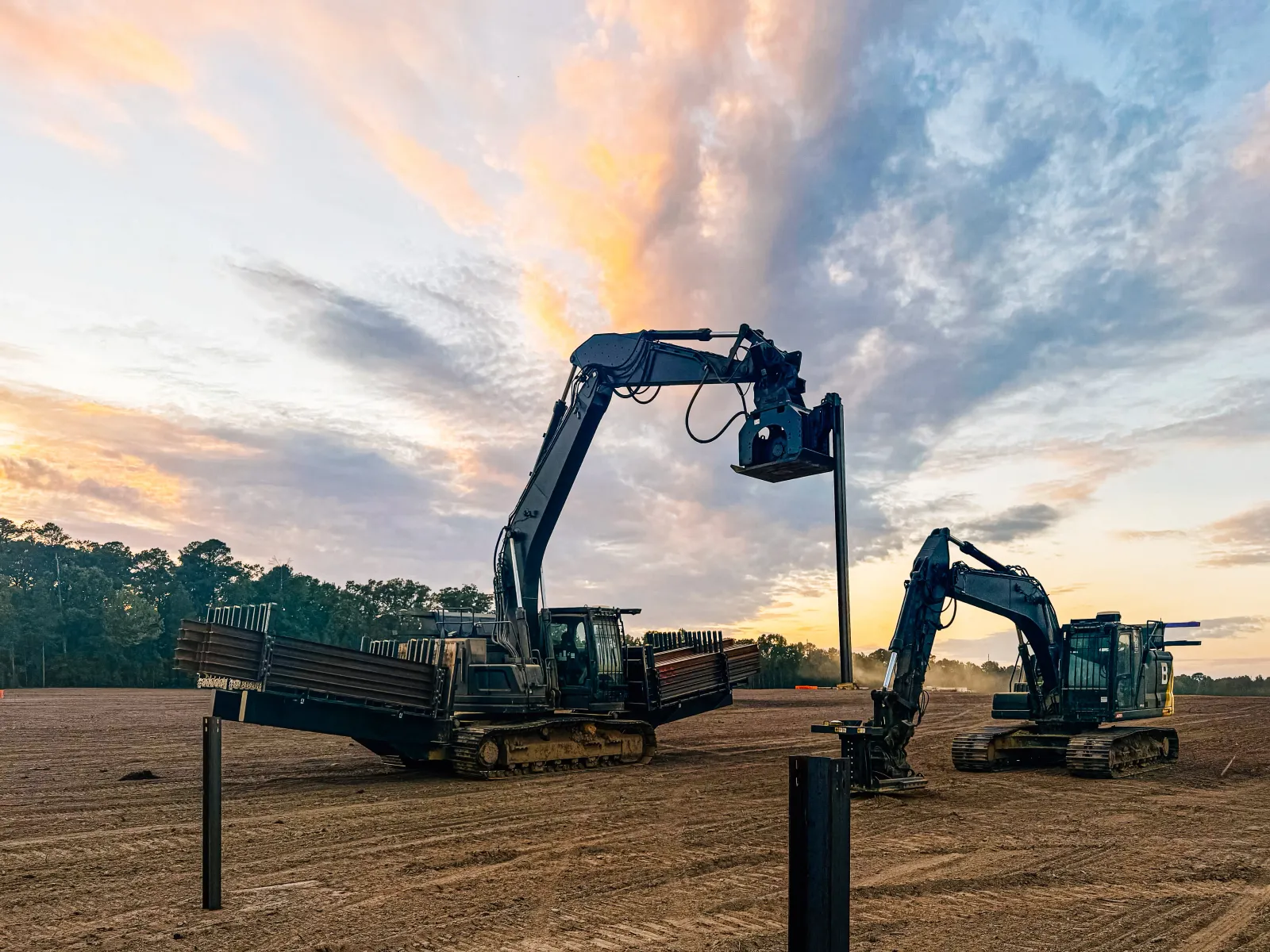
Built Robotics CEO Noah Ready-Campbell says its retrofitted robots are driving about 1,000 steel piles a day at a Louisiana solar site tied to Meta’s Hyperion AI data center. The move signals how grid-scale AI expansion is forcing construction, labor, and “behind-the-meter” energy buildout to evolve fast.
In swampy northeastern Louisiana, Built Robotics’ retrofitted machines are driving about 1,000 steel piles a day for solar infrastructure, and CEO Noah Ready-Campbell says the work is laying the foundation for Meta’s Hyperion AI data center. This is not a sci-fi construction demo. It is a logistics and labor strategy, executed in real mud, with 72-ton robots that can operate upward of 12 hours a day and handle roughly half the pile-driving scope at the site.
Ready-Campbell, Built Robotics’ cofounder and CEO, describes the output in the kind of terms that get boards excited because they hint at throughput under pressure: each steel beam can be 14 feet long and weigh 200 pounds, and conventional methods often require workers to slide or lift beams just enough to rig a sling before a pile-driving machine hoists them into place. “This guy's effectively having to deadlift half the weight of this beam,” Ready-Campbell told Business Insider. Built’s pitch is that no human is handling the beams in that step. Robots remove workers from the deadlift part of the job.
Built Robotics retrofits existing heavy equipment to enable autonomy. Instead of building machines from scratch, the startup “installs a mix of sensors, cameras, GPS, and software” on equipment from major manufacturers, including Caterpillar, enabling operation within defined work zones. The core idea is a “physical AI upgrade” for heavy machinery: the hardware and software together let robots perform tasks like pile driving, trenching, and pre-drilling. Built says it has completed over 40 deployments, primarily in utility-scale solar and data centers. In other words, this Louisiana project is one of several, not a one-off headline grab.
The Hyperion tie-in matters because it connects autonomous construction to the AI power bottleneck. The Hyperion data center, in Richland Parish, spans 3,650 acres and is expected to require roughly 2 gigawatts of power during the initial operating stage. Built is not a direct contractor for Meta, and a Meta spokesperson did not return a request for comment, but Ready-Campbell said the robots are part of building the solar power infrastructure that supports Hyperion. That is a key nuance for decision-makers: these deployments sit in the supply chain between power demand and power delivery, where timelines and labor constraints can become bottlenecks.
This is happening while the AI boom simultaneously adds pressure to the electrical grid. Ready-Campbell said developers are increasingly looking for power “behind the meter,” meaning through dedicated energy infrastructure, because they cannot get enough electricity from the grid. Solar is a natural beachhead for this kind of autonomy, he said, because solar work tends to be repetitive, large-scale, and often located in remote areas, and because solar construction is relatively newer, with decision-makers “more open-minded.” Built has also tackled oil and gas, heavy highway construction, and residential and commercial building projects, suggesting the autonomy play is meant to travel beyond solar.
Labor shortage is the other engine. Ready-Campbell said with 10 robots at the Louisiana site, a conventional crew would require about 3 to 4 times as many crew members to complete the same amount of work. He stressed that the goal is not that construction work disappears, but that scarce workers can shift away from dangerous, repetitive tasks while contractors take on more projects. That framing is consistent with the broader robotics story across warehousing and manufacturing, but construction has its own pressure cooker. The Associated Builders and Contractors estimated in January that the construction industry will need to attract 349,000 net new workers in 2026 to meet demand. An Associated General Contractors of America survey found workforce shortages are a leading cause of project delays, and that recent Immigration and Customs Enforcement efforts affect nearly one-third of firms. Ready-Campbell referenced having “been on projects where I've seen ICE come and pick people up,” calling the labor shortage “a huge, huge problem.”
Built’s approach also acknowledges that autonomy does not mean “no humans.” Ready-Campbell compared the human role to a “robot foreman,” managing and maintaining the fleet, keeping machines supplied with fuel and steel piles, and thinking ahead to keep production moving. The system is designed to stop if it detects a potential person in the work zone. Ready-Campbell said Built runs an AI model on the robots, and it is tuned “to be, I would say, on the conservative side,” so that if it sees anything it thinks might be a human, it stops the robot. That matters because it directly shapes how these robots could be accepted by jobsite stakeholders: safety logic is built into the operation rather than treated as an afterthought.
Finally, there is the commercial signal. Built’s latest commercial milestone is a $75 million contract with Blattner Energy, a major renewable energy construction company. Built said that with Blattner it has been deployed across seven projects, and that the latest deal expands nationwide deployments. If you are an operator or investor looking at the next wave of infrastructure, this is the part to watch: robotics adoption becomes real when it scales through contractors, not pilots. Louisiana is one test. Blattner is another. And Hyperion is the kind of end-demand that can turn a proof-of-concept into a sustained build cycle, especially when the grid cannot keep up and the schedule is measured in months, not in years.
This story's Key Insights and Take-aways are locked.
Create a free account to unlock Executive Actions for one credit.
Register to UnlockAlways free for Executives Club members. Join the Club
More in Technology

Nvidia's $89B data center quarter: the 9 companies cashing in
The AI buildout is minting fortunes beyond GPUs, and memory, cloud, and cooling suppliers are riding the same wave.

Google quietly links your phone number to every Android account on your SIM
Adding a SIM now ties your phone number to all Google accounts - and future accounts inherit it. Here's the security and privacy stakes.

Hijacker AI 'Skynet mode' runs 100,000 attack steps against exposed models
Symantec caught a criminal AI agent that borrows other models, steals data, and mines crypto; the only relief is no confirmed victims yet.