

Bumblebees solved a classic brain teaser with no training
A Science study says bumblebees can tackle a box-and-banana style puzzle on their own, a clue that even tiny-brained creatures may handle novel tasks without being taught.
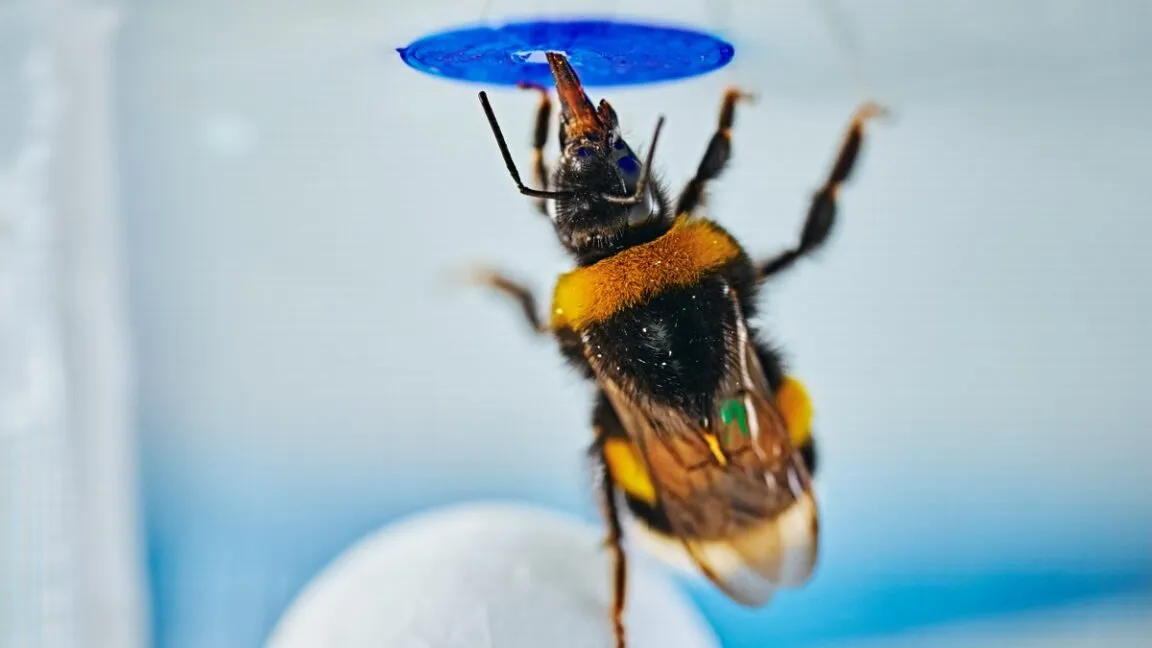
A new paper in Science says bumblebees can solve object-manipulation tasks without any previous training, and researchers say this is the first time spontaneous problem-solving of this kind has been shown in an insect. For leaders, the finding widens the map of what simple systems can do when faced with novel problems, which matters for how teams think about learning, coordination, and the limits of assumed intelligence.
Bumblebees just added a new line to their resume: they can apparently solve object-manipulation problems without any previous training. That is the core finding of a new paper published in Science, and according to the authors, it is the first time this kind of spontaneous problem-solving has been demonstrated in an insect. In plain English, these are not bees simply repeating a trick they were taught. They are facing a new setup and figuring out how to act in it, which is the kind of result that tends to make scientists, operators, and anyone who cares about intelligence sit up a little straighter.
The puzzle at the center of the study is an insect version of the classic box-and-banana problem. If you have ever seen a chimpanzee move a box to reach food that is just out of reach, you already get the basic idea: the subject has to understand that moving one object can help reach a reward. The twist here is that the subject is a bumblebee with a tiny brain, not a large-brained mammal. That contrast is exactly why the paper matters. It pushes against the old assumption that complex problem-solving requires a big brain and a lot of explicit teaching. Even in a creature as small as a bee, the ability to navigate a novel physical challenge may be more flexible than previously assumed.
This builds on earlier work from 2024 by Olli Loukola of the University of Finland, who co-authored a study showing that bumblebees could cooperate to solve complex challenges. That earlier research focused on tasks that scientists had historically only seen in large-brained mammals like humans and chimpanzees. Loukola and his team trained pairs of bees to push a Lego block to the middle of a mini-arena or push against a door at the end of a tunnel to get a reward. The setup sounds playful because it is, but the scientific question underneath is serious: can insects learn a new task, and can they do it together?
The answer, at least in that earlier work, looked like yes. The team observed that the bees were more likely to engage in the tasks if their partners also participated, compared to untrained control groups. That matters because it suggests social context changes behavior, even in a tiny-brained animal that most people probably would not associate with coordination or collaboration. The researchers concluded that bees can learn to solve novel cooperative tasks outside the hive and may even be intentionally working together. They also added an important caveat: more detailed monitoring of the behavior was needed to fully understand the partners' roles. In other words, the bees may be coordinating in a meaningful way, but the scientists were careful not to overclaim what each bee was doing moment by moment.
For executives and investors, the relevance is not that a bee is suddenly a strategic genius. It is that the study is another reminder that intelligence is often more distributed, more adaptive, and more context-sensitive than the old mental models suggest. In business, we regularly overrate visible complexity and underrate systems that perform well with limited resources. Bees, with very little hardware, can still show social learning, puzzle solving, cooperation, and now, according to this new paper, spontaneous problem-solving. That is a useful lens for thinking about teams, automation, and training: sometimes performance comes less from raw capacity and more from the ability to adapt quickly when the environment changes.
There is also a broader scientific and practical implication here. Studies like this help map the boundary between instinct, learned behavior, and flexible problem-solving. That boundary matters in fields from robotics to artificial intelligence to organizational design, because a lot of modern systems are built to handle narrow tasks well but struggle when the rules shift. Bumblebees, apparently, are not helpless when handed a new puzzle. They can figure things out. That does not mean every insect is running a startup in its head. It does mean the cognitive toolkit available in nature may be more varied than the labels we use for it. For leaders, that is a good warning against assuming that size, simplicity, or a lack of obvious sophistication tells you everything about capability.
The strategic lesson is simple: do not confuse small with limited, or untrained with incapable. The paper in Science and the earlier University of Finland work both point to a bigger pattern that decision-makers can use in their own worlds. Teams, systems, and organizations often surprise us when they are given the chance to learn in context, coordinate with others, and solve a new problem without a manual. Bumblebees are doing that in a lab. The executive version is much less cute, but the principle is the same: the real edge often goes to the group that can adapt fastest when the puzzle changes.
This story's Key Insights and Take-aways are locked.
Create a free account to unlock Executive Actions for one credit.
Register to UnlockAlways free for Executives Club members. Join the Club
More in Technology

OpenAI says 10,000 agents cracked a 90-year math problem in 88 hours
The company's claim is audacious, but one mathematician is pushing back. Here's what it means for AI-driven discovery.

Meta still serves child sexual abuse ads on Instagram in India - BBC report
A new report following the BBC Eye investigation says the ads are still there - what it signals for every platform with a self-serve ad engine.

White House yanks 'Build the Wall' game after Tetris Company copyright warning
The administration's arcade game vanished in hours - and the takedown playbook every brand can learn from.