

CERN powers down the LHC until 2030, boosting sensitivity about 10x with HiLumi upgrades
The biggest collider goes quiet for a decade-scale plan: 4 years off now, then a 10x luminosity leap in physics output.
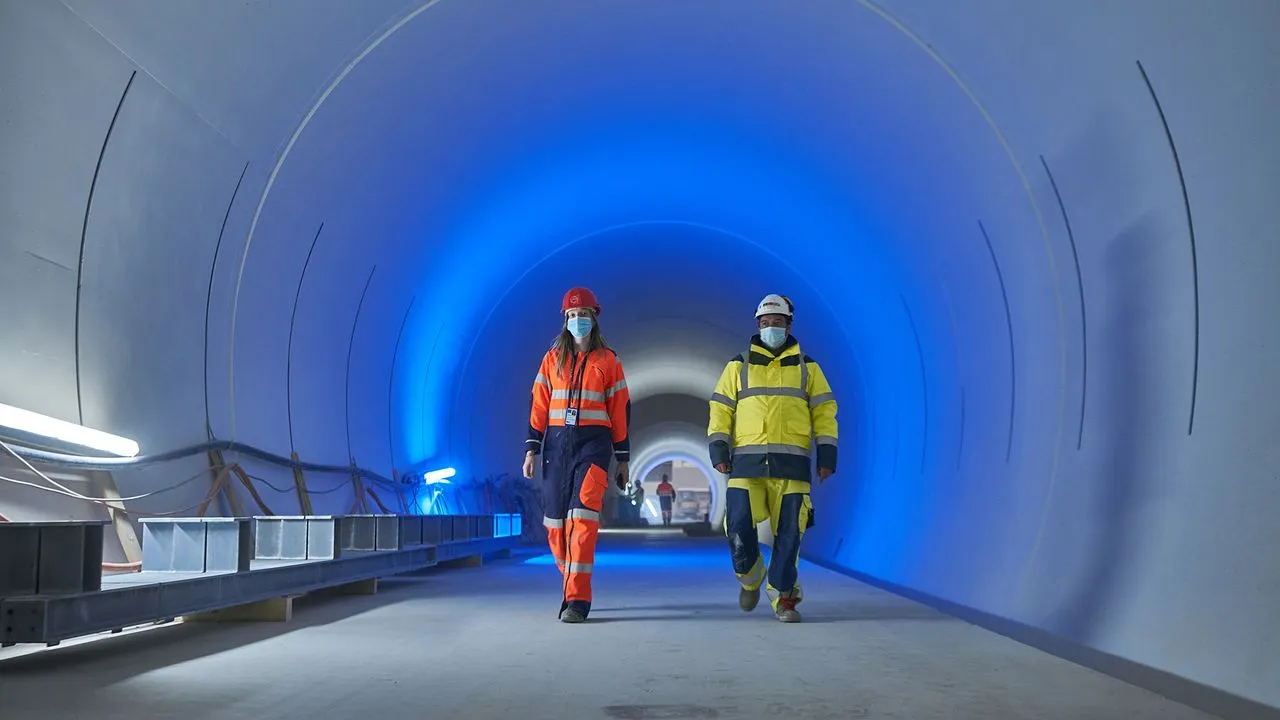
CERN has shut down the Large Hadron Collider starting Monday, June 29, for a planned four-year upgrade to the High-Luminosity Large Hadron Collider (HiLumi LHC), targeting about a 10x increase in smash-by-smash particle data. For decision-makers, it is a reminder that the schedule, not just the science, determines who gets to claim breakthroughs in fundamental physics.
The Large Hadron Collider (LHC) at CERN shut down starting Monday, June 29, and it will stay offline until 2030 for a planned four-year upgrade into the High-Luminosity Large Hadron Collider (HiLumi LHC). The payoff is big on paper: the facility is expected to become about 10 times more sensitive than its original design, letting it smash together roughly 10 times more particles than originally planned.
That matters because, in fundamental physics, “more data” is not a slogan. It is the difference between hinting at a rare process and actually studying it in detail. CERN’s upgrade is designed to increase the collider’s luminosity by a factor of 10, which should also mean more collisions and a higher chance of seeing uncommon events. CERN frames this as “a very important moment” and a new phase beginning from Monday, as HiLumi LHC project chief Markus Zerlauth told Agence France-Presse. In plain terms: the LHC is going dark so physicists can turn the dial up on how much experimental evidence they can gather once it comes back.
To understand why a shutdown until 2030 carries strategic weight beyond the lab, zoom out to what the LHC already changed. Since its first successful proton collision in 2009, the LHC has helped test theories about particle physics and the Standard Model, the best current framework for the subatomic world. Its role in the 2012 discovery of the Higgs boson is the headline most people remember, but the broader point for decision-makers is that long-horizon infrastructure can create “first mover” scientific credibility for years. Once those upgrades arrive, the next generation of experiments will have more chances to pin down known phenomena, including the Higgs boson, and to hunt for signals the Standard Model currently cannot explain, like dark matter and dark energy.
This upgrade is not happening in a vacuum. The current shutdown is the third long-term, planned pause in the collider’s operations. The first was a two-year shutdown beginning in 2013 that consolidated connections between superconducting magnets and boosted the energy of the colliding proton beams. The second pause ran from 2018 to 2022 and involved upgrades, replacements, and preventive maintenance. So HiLumi LHC is part of a repeatable playbook: scheduled downtime to retool the machine so it can produce a higher-quality stream of results rather than trying to brute-force new outcomes without changing the underlying capacity.
Technically, the scale of the work underscores why the timeline is so long. The LHC covers a 17-mile (27-kilometer) loop at the border between France and Switzerland near Geneva. During Long Shutdown 3 (LS3), which is the name for this period, specialists will install upgrades intended to boost luminosity by 10. The operational trade-off is blunt: while the LHC itself is not smashing particles during the shutdown, researchers keep working on analyses of data already collected in the prior run window. That is a key operational discipline that matters to any organization managing long outages, whether in science, semiconductor fabs, or large-scale networks.
The engineering effort is also not a tweak. CERN says that “In the LHC alone, 1.2 km [0.75 miles] of magnets and components will be removed and replaced with new equipment,” and that across the whole complex, dozens of projects are planned involving thousands of engineers, physicists, technicians, and support personnel. That is the real headline inside the headline: the collider’s upgrade is a coordination and logistics campaign as much as it is a physics one. Projects like this are also a governance test for large institutions. They require sustained funding, careful sequencing, and risk management over multiple years so that a 2030 return is not just theoretical.
Once the final configuration is online, HiLumi LHC is expected to run until the end of its operational lifespan in the 2040s. It is also earmarked for replacement by a new, higher-energy particle accelerator in the years that follow. For the scientific community, that long runway sets expectations for what future results can look like. For example, CERN reports that HiLumi LHC is expected to produce about 380 million Higgs bosons over its lifetime of a decade or so, compared with 55 million it’s made to date. More Higgs data means better measurements of a known particle, which can either tighten constraints on the Standard Model or expose deviations that point to new physics. That, in turn, is how researchers hope to address bigger gaps, including why the Standard Model does not incorporate dark matter or dark energy.
There is also a second-order story here that matters beyond academia: technology transfer. While the LHC’s primary purpose is fundamental physics research, the source notes that some instruments and techniques originally developed at CERN are now being used in medical imaging, sensors, and art restoration. So a shutdown is not only a pause in experiments; it is a phase in building upgraded systems that can later ripple into tools used elsewhere. That is why these decisions still read like real-world strategy, not just lab scheduling.
If you are an executive or board member watching complex, high-capex programs unfold, the LHC shutdown is a case study in patience with purpose. The LHC is switching off now to generate more sensitive results after 2030, and the output goal is explicitly tied to luminosity and event rates. The universe might not care about corporate calendars, but organizations do. And in any industry where the “next breakthrough” depends on infrastructure capacity, the big question is the same: will the downtime buy the scale-up you promised, on the timeline you forecast, so that when the machine turns back on, the data advantage is real?
This story's Key Insights and Take-aways are locked.
Create a free account to unlock Executive Actions for one credit.
Register to UnlockAlways free for Executives Club members. Join the Club
More in Science

Alaska's 1,580-foot tsunami had warning signs. Scientists just found them.
Rapid glacier retreat, heavy rainfall, and thousands of tiny tremors preceded Alaska's 1,580-foot tsunami, a warning for every coastal community in a warming world.

The rare mutation that lets high-risk brains dodge Alzheimer's
Scientists found a natural defense against protein buildup, opening a new path to preventive treatments.

3,000 steps a day may halve Alzheimer's decline, study finds
New research links a modest daily walk to less tau buildup and nearly half the cognitive and functional decline, even for those with early signs.