

Charlie Gruet and Kyle Gilman pulled off verité inside a scripted comedy
The cinematography and editing team built a “show within a show” where the camera never anticipates.
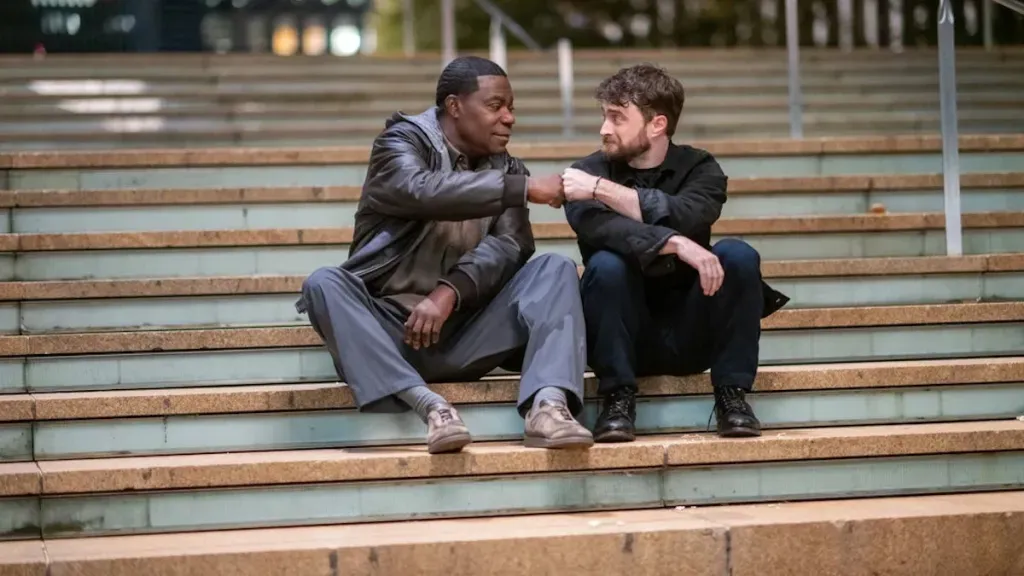
Charlie Gruet and editor Kyle Gilman describe how “The Fall and Rise of Reggie Dinkins,” created by Robert Carlock and Sam Means, uses documentary-style shooting and editing inside a scripted framework. The payoff is an in-universe verité vibe that reshapes what’s possible in timing, coverage, and punchline delivery.
“Literally every day, there was a logic check,” cinematographer Charlie Gruet tells TheWrap alongside editor Kyle Gilman. The show is “The Fall and Rise of Reggie Dinkins,” and the logic check was the team’s daily discipline for making a scripted sitcom behave like an in-universe documentary.
That daily logic is not just an aesthetic detail. It drives the most unusual constraint in the whole production: when they shoot scripted moments, they do it in a verité style where the camera cannot anticipate. Gruet explains the problem plainly. In a typical scripted setup, you can plan where the camera will go next. Here, you’re trying to keep the moment feeling real. So if someone starts talking, “you whip over and you miss that first word.” In scripted formats, missing the first word is normally a “no-no.” In “Reggie Dinkins,” the crew kept telling themselves that after the fifth take, “Bobby’s going to come in over here,” but they still could not anticipate with the camera.
This isn’t just a technical preference. It forces tradeoffs across actors, camera operators, and editing decisions. Gruet and Gilman emphasize how the crew had to coordinate so the performers could play off each other in real time, rather than chasing pre-blocked angles. The stars listed by TheWrap include Daniel Radcliffe, Tracy Morgan, Erika Alexander, Precious Way, Jalyn Hall, and Bobby Moynihan, and the key benefit is performance chemistry: the style lets them respond to each other, instead of trying to hit their marks for an invisible camera plan.
Now zoom out to the actual “show within a show” premise, because that is where the constraint really bites. “The Fall and Rise of Reggie Dinkins” is meant to be some sort of documentary assembled in-universe. That means camera and editing choices cannot look like normal sitcom mechanics. Gruet describes how the crew treated even process questions like character questions. He recounts moments on set when he would ask, even though he already knew, “Who’s editing this sequence?” The response was “Arthur,” with “Arthur” referring to Daniel Radcliffe’s in-universe role (Arthur Tobin, as referenced throughout the production). Gilman’s point reinforces what makes this hard: the crew is constantly preventing the audience (and frankly, themselves) from thinking about the distance between “a movie that they claim to be making” and “a sitcom that’s airing on NBC.”
That tension creates a special kind of production overhead. Gilman calls out that it’s easy for any of these steps to become too “thought about” for too long, because the audience can detect seams. So the team’s workflow included repeated checks across creators, writers, directors, cinematographer, and editor. The headline-worthy part here is the “logic check” being daily, which implies constant reconciliation between story intent and documentary plausibility. This is also why Gilman says it’s never just “his decision-making” as an editor. The framing is collaborative and story-first: “What’s the best way of telling the story?” And in this version of the world, the editor treats that as something Arthur would also decide.
There is another second-order constraint hiding in plain sight: the in-universe lore of the operators themselves. Gruet explains that the A-camera operator Zack Schamberg is referred to throughout the show as Marty. The B-camera operator is nicknamed Clive, even though that name never being said in the show. The crew’s big rule was about usability on the final cut. If an operator shows up on camera, the footage they shoot needs to be usable. So they debated whether they should cast someone and outfit them with a camera. The decision was emphatic. They would not do that; “if we see that camera, that camera needs to be capturing usable footage that makes it into the show.” The result, Gruet says, was a “wonderful coordinated dance” between operators and actors.
That coordination connects directly to editing workload. Gilman says the documentary format opens new comedic possibilities, but it also raises the difficulty ceiling. He notes that it’s “the most difficult show that I’ve edited because of those constraints,” and he adds that it’s because he has never edited any unscripted shows, which he calls “extremely difficult.” In other words, the format both enables and punishes. You get less coverage than a true documentary because it’s “very carefully shot.” You do not get the same amount of camera angles where you “just let it run for an hour.” Yet the payoff is that you can land certain types of jokes in a way that regular scripted editing would struggle to support.
Gilman points to a specific example audiences recognized during a For Your Consideration event, where he watched the first and fifth episodes with an audience. He observed that the first big laugh is an editing joke in the pilot when the character says, “Let me put on my producer hat,” and the cut goes to him wearing a hat. In a regular scripted scene, he says, a “jump cut wouldn’t make any sense.” Documentary-style editing, on the other hand, can justify the cut as a product of how the “in-universe” camera and assembly work. The team also tweaks an element that Carlock fans already associate with his writing style: cutaways. Gilman notes that “Reggie Dinkins” doesn’t use the whip pans for cutaways the way other shows like “30 Rock” do. Instead, it drops into jokes more cleanly and efficiently, and he links that to the practical reality of NBC runtime constraints, calling out that the show has “21 minutes and 18 seconds,” and that it is “dense.” So the edit rule becomes a kind of sprint ethic: “You do it as tight as possible,” even “take out a couple frames between the lines” when in doubt.
So what should decision-makers in media, production, and even adjacent tech teams take from this? “Reggie Dinkins” is a case study in how to operationalize a narrative conceit without letting it collapse under its own inconsistencies. It shows that authenticity isn’t a vibe you sprinkle on top. It’s a set of constraints you enforce, daily, across disciplines. When those constraints are real, they change what creators can attempt, what operators can do, and what editors can justify. That is the strategic stake here: if you want a show that feels like reality while still delivering sitcom density, the craft team has to build a production machine where realism rules are treated like non-negotiable product requirements, not optional aesthetics.
This story's Key Insights and Take-aways are locked.
Create a free account to unlock Executive Actions for one credit.
Register to UnlockAlways free for Executives Club members. Join the Club
More in Entertainment

Russell Brand's accuser 'bewildered and confused' as he denies 7 sex charges
The criminal case against the comedian is a live test of how media companies manage talent risk when serious allegations go public.

'It's a Magic Trick': Ballet Experts Say Rosalía's SNL Pose Is Impossible
Three ballet experts tell Rolling Stone Rosalía's gravity-defying SNL stillness shouldn't be possible - and why the debate is now part of the show.

Activision CMO: GTA 6 Will Boost Call of Duty, Not Bury It
Activision's top marketer says Rockstar's blockbuster will drive players back to consoles and into Modern Warfare 4, even as the company admits its recent strategy failed.