
China is training robots on shirts, and the U.S. is already behind
Cheap, local data from homes and factories is giving China a scaling advantage in humanoid robots while the U.S. leans on research and outsourcing.
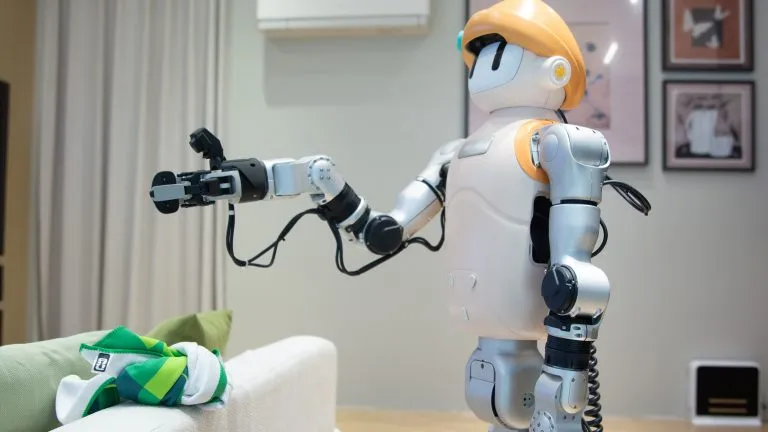
Daniel Wang returned to his Beijing apartment and found a humanoid robot waiting for him, then watched it learn by doing the sort of chores machines have long struggled with. The bigger story is that China is building robot intelligence from localized, low-cost real-world data, which could turn a training advantage into a market advantage.
Daniel Wang came home to his apartment in Beijing and found a humanoid robot waiting for him. He opened the door, and the robot got to work. In this case, that work included a deceptively ordinary task: folding a shirt. That matters because the shirt is not the story. The story is the training data behind it, and the fact that China is gathering that data in homes and factories at a speed and cost structure that looks very different from the U.S. approach.
Rest of World’s reporting frames the gap cleanly: localized, low-cost data harvested in real settings gives China a scaling edge over the research-heavy and outsourced U.S. model. Translation for anyone trying to build or back the next wave of robotics: whoever gets more useful real-world data, faster and cheaper, gets a bigger shot at making humanoid robots work outside the lab. Folding laundry may sound quaint, but it is exactly the kind of physical, repetitive, error-prone task that trains robots for actual human environments, not just polished demos. If a robot can learn to handle fabric in a Beijing apartment, that is a signal about how much hands-on practice it is getting, and how close the system may be to something commercially useful.
This is also a reminder that robotics is not just a hardware race. It is a data race, a deployment race, and a coordination race. The source points to a China strategy built around collecting localized data in homes and factories, which is cheaper than staging everything in a research environment and more grounded than outsourcing the work elsewhere. That matters because training robots in the real world is expensive, messy, and slow. Doors are awkward. Shirts wrinkle. Homes are not standardized. Factories have their own chaos. But those imperfections are exactly what make the data valuable. A robot that learns from that mess has a better chance of surviving the mess when it is shipped into the wild.
For China, the advantage is structural. If data can be harvested locally and inexpensively, each additional training run can build on the last one without the same friction that comes from highly controlled, research-heavy pipelines. The source does not say every robot succeeds, and it does not need to. The point is that China’s method appears designed to accumulate practical experience at scale. That is the kind of compounding advantage executives should care about, because once one ecosystem gets better at collecting the right data, it can attract more capital, more engineers, more deployments, and then even more data. The flywheel is the product.
The U.S. approach, by contrast, is described as research-heavy and outsourced. That does not mean it cannot produce world-class robotics. It does mean the path looks different, and likely slower to scale if the bottleneck is exposure to real-world interaction. In industries where learning curves matter, the winner is often not the company with the flashiest prototype, but the one that gets the most reps. Robotics is starting to look a lot like that. The practical question for founders, operators, and investors is no longer only whether humanoid robots can exist. It is whether they can be trained fast enough, cheaply enough, and in enough everyday settings to become useful before the market moves on.
There is also a broader market implication here. If the future of robotics depends on localized data, then geography stops being a footnote and starts being a moat. Homes and factories become training grounds. Real-world deployment becomes part of product development. That shifts the playbook for anyone building in robotics, automation, or adjacent AI systems. It also raises the bar for competitors that rely on simulations, narrow lab tests, or outsourced workflows, because those methods may not generate the same quality or quantity of data from actual use. For decision-makers, the lesson is uncomfortable but useful: in robotics, the fastest way to better products may be to put machines in more imperfect places sooner.
And that brings the story back to the apartment in Beijing, where a humanoid robot folded a shirt in front of Daniel Wang. The scene is small. The consequence may not be. If China can keep turning everyday chores and factory routines into training fuel, it could give its robotics industry a scaling advantage that is hard to copy later. For peers watching from the boardroom, the strategic question is simple: are you building robots, or are you building the data engine that teaches them how to live in the world?
This story's Key Insights and Take-aways are locked.
Create a free account to unlock Executive Actions for one credit.
Register to UnlockAlways free for Executives Club members. Join the Club
More in Technology

Fermentation turns food waste into profit, not landfill
A centuries-old process is turning processing byproducts into valuable ingredients, hinting at a cleaner, more circular supply chain for food makers.

AI hardware is bigger than Nvidia and the hyperscalers
Investors looking for the generative-AI buildout can widen the lens beyond the obvious winners and hunt for the less crowded infrastructure plays.

Google quietly trims Cloud as AI spending keeps eating the org chart
Layoffs have hit Google Cloud and Mandiant, including the Threat Intelligence Group, as the company says it is reallocating toward growth areas like AI.