
COID keeps using half the Deschutes, even as drought makes downstream farmers fallow
Oregon’s water law protects Central Oregon Irrigation District’s share, pushing scarcity costs onto other growers and ecosystems.
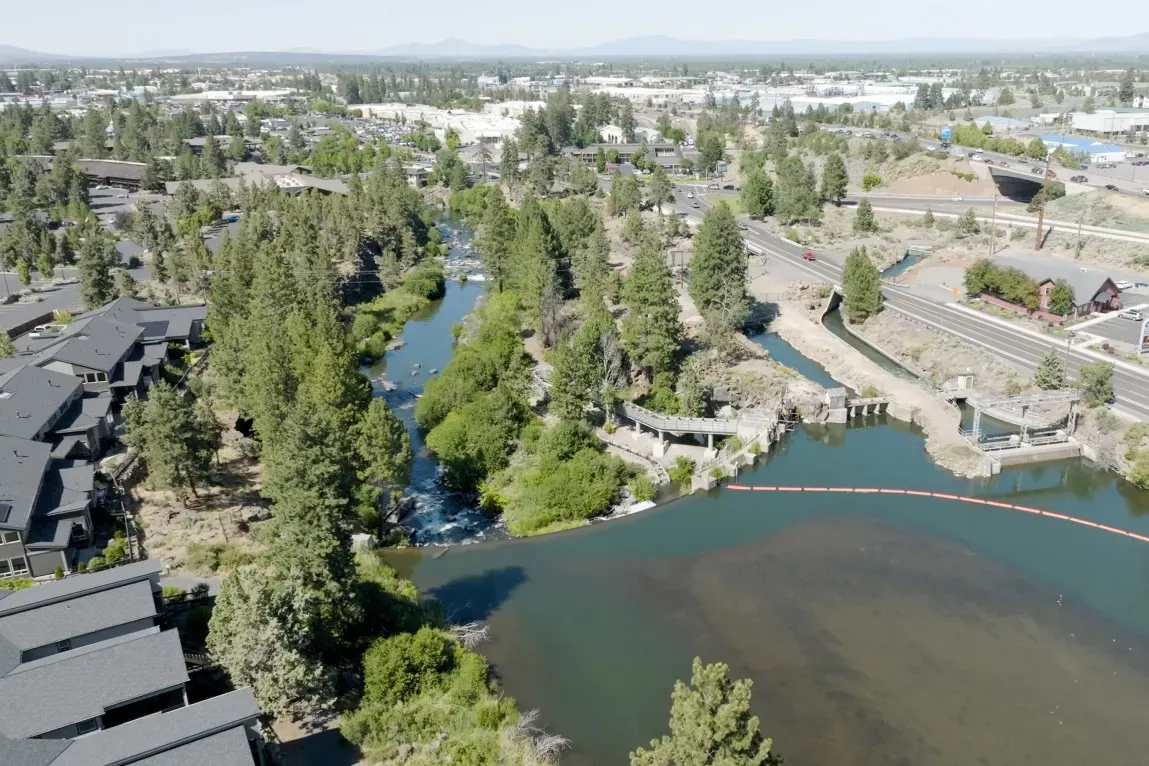
Central Oregon Irrigation District (COID) in Bend, Oregon diverts most Deschutes River water through canals and pipes, even during drought-driven cutbacks elsewhere. The result: state water law forces downstream commercial farmers to fallow while COID can divert far more than crops consume.
A dam across the Deschutes River in Bend, Oregon diverts water to irrigation district canals every year, and in 2025 it still follows the same math: about 90% of Central Oregon’s Deschutes disappears into irrigation networks during the core growing stretch. Between April and October, what’s left of a major spring-fed river can look like a creek trickling out of Bend. The Central Oregon Irrigation District, COID, sits at the center of that vanishing act.
In drought, Oregon’s water rights framework concentrates scarcity. COID has rights to use more than half of the Deschutes’ volume, more than all the other irrigation districts combined. Under state law, when water is scarce, most other districts must cut back to protect COID’s share. ProPublica and Oregon Public Broadcasting’s analysis of state data found that during the last drought, state water law forced commercial farmers downstream to fallow while COID diverted four times what its landowners’ crops consumed.
So why is COID the unavoidable bottleneck? Because irrigation districts in Oregon are quasi-public corporations that must prove their customers are using the water “beneficially” to keep their rights. In COID’s case, reporting found that more than 9 out of 10 acres were pasture, hay, or grass for grazing or landscaping, which are considered beneficial under the law. And that matters because the most obvious fix, restricting what people can grow or requiring efficiency targets, has run into a brick wall. Water rights are treated as property rights in Oregon and other Western states, so legislators face intense political pressure. Even state Rep. Ken Helm, a Democratic co-chair of the House Committee on Agriculture, Land Use, Natural Resources and Water and a land-use lawyer, framed it bluntly: if lawmakers took on bedrock water law, “we'd get crushed by the powers that be and we might even not be reelected.”
That political reality shows up in the technical solutions Oregon is pushing. There are basically three paths, and piping is the one that keeps resurfacing because it can reduce loss. COID delivers most water through open canals built 120 years ago. Those canals must be completely full for gravity to work across COID’s more than 42,000 acres, and nearly half the water evaporates or seeps into the ground under the canals before reaching its destination. Replacing canals with pressurized pipes could save a lot of water, but it’s expensive and slow: it could take 50 years and cost more than $700 million. Still, COID is in final planning for a roughly $360 million project to pipe a main artery leading to more than a thousand landowners between Bend and Redmond.
The tradeoff is where the downstream pressure comes from. Under the plan, COID has pledged in exchange for federal and state funding for piping to send saved water downstream to farmers outside the district. That sounds like a clean incentive loop, and it gets support from Oregon Sen. Jeff Merkley, who told OPB and ProPublica that “repeated severe droughts make every drop of irrigation water highly valuable” and that the best way to preserve irrigation water is to pipe it. Merkley said the push crystallized after a threatened species of frog destroyed by long-standing irrigation diversions, triggering pressure to leave more water in the river over time. The legal workaround is that as COID switches from canals to pipes, it is supposed to send saved water to a neighboring district, North Unit, which then takes less from the river as part of the restoration effort.
North Unit is famous for commercial farms, but it is already water-poor. Evan Thomas, a fifth-generation farmer and a leader of North Unit, put the stakes plainly at a March public meeting in Redmond: “This pipe has to go in the ground by 2028 or North Unit, all of Jefferson County, basically quits farming.” That’s the second-order problem executives and boards should notice: efficiency upgrades do not automatically resolve scarcity when rights, timing, and water-poor receiving districts collide. Even people who support piping also acknowledge it won’t stop COID from diverting more water than its customers need, or from sending that water to residential properties growing grass and pasture.
And COID cannot simply impose a “use less water” rule if the use is allowed. COID’s managing director, Craig Horrell, said it “can’t tell people what they can and can't farm, if it's allowed.” The district’s job, as he frames it, is to distribute water to customers and deliver it “much more efficiently and sustainably in the future.” But sustainability here is constrained by what the law counts as beneficial use and by the fact that COID can strengthen its position simply by proving its water was used according to state standards.
Oregon is also trying softer mechanisms to keep water in the river for fish and wildlife. The Deschutes River Conservancy executive director Kate Fitzpatrick said leaving water in the river for fish and wildlife wasn’t even considered a legal, beneficial use until the 1980s, which shapes today’s options. Her organization works with irrigation districts on incentives for landowners to be more efficient or share voluntarily. One program pays landowners to dry up land so COID will leave more water in the river, but COID limits participation and the program’s effectiveness has plateaued for decades, according to state data. State lawmakers created a pilot “water bank” program last year, which marks a change in the law and, potentially, the bargaining structure around who can trade water leaving-the-river value. Yet even these programs run into the same reality: when demand outstrips supply and property-based water rights dominate, every conservation win still has to fit into a legal ledger.
If you run a company, sit on a board, or allocate capital, this is a reminder that “water risk” is not just climate. It is governance. In Central Oregon, the rules decide where scarcity lands. Unless the incentives and legal definitions shift, piping projects and pilot programs may reduce losses while leaving COID’s share concentrated. The strategic takeaway is simple and uncomfortable: efficiency is not the same thing as equitable scarcity, and without a workable mechanism to share saved water, the downstream hit can remain as relentless as the drought.
This story's Key Insights and Take-aways are locked.
Create a free account to unlock Executive Actions for one credit.
Register to UnlockAlways free for Executives Club members. Join the Club
More in Business

A flaw in PHP just forced governments to pull their own sites offline
European agencies from Belgium to Germany took websites dark to patch a critical weakness in the language behind almost 70% of the web, and the blast radius extends far beyond government portals.

BioWare shuts down, Mass Effect 5 dead after $55B EA buyout
The legendary RPG studio's closure lands months after a $55 billion investment group buyout of EA, raising tough questions for gaming's biggest acquirers.

Musk barred from the room as Tesla, SpaceX boards weigh $3.5 trillion merger
The CEO of both companies is a 'conflicted party' watching independent directors negotiate a tie-up that would create a $3.5 trillion giant he would own about a third of.