

Cooler Master’s G11M targets 400W, aiming to cool Intel Nova Lake’s 52-core era
A “hybrid air cooler plus AIO” concept adds airflow right on the block, and it wants to break 350W limits.
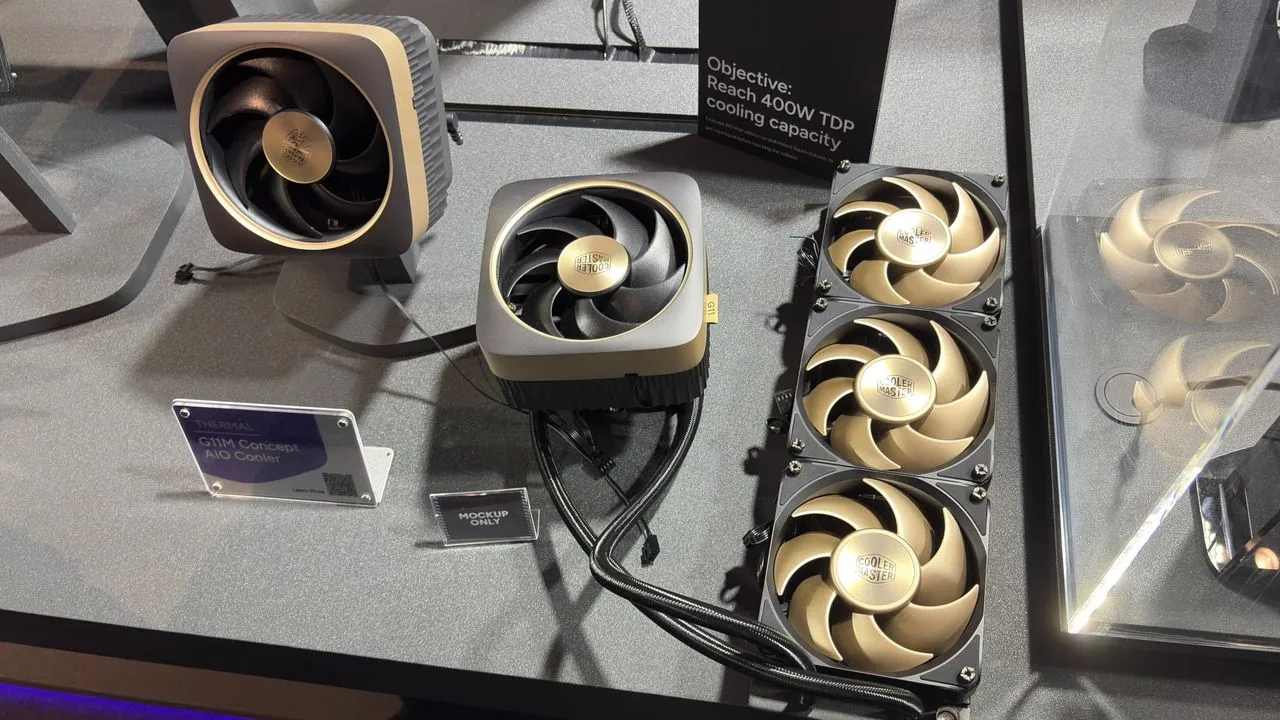
Cooler Master showed the G11M concept at Computex, described by PR manager Brett Buren as a hybrid between an air cooler and an AIO. Its thermal target is 400W, likely tied to Intel’s planned 52-core Nova Lake processor.
Cooler Master just did something mildly heretical in the AIO world: it put a big fan on the pump and CPU block. At Computex, the company’s G11M concept pairs that “air cooler on top of the water block” approach with its Atmos 2 radiator and Master Fan A Gold. The most consequential detail, though, is the one executives should actually care about: Cooler Master is targeting 400W of thermal capacity, even though the best consumer AIO coolers top out around 350W.
The thermal thesis is explicitly tied to Intel’s future. The source notes that Intel is planning a 52-core Nova Lake processor at some point in the near future, and that 400W of cooling is likely to be a must. In other words, this is not just a cosmetic redesign. Cooler Master is trying to solve the gap between today’s “big” AIOs and what a mega-core CPU could demand when power and heat output scale up.
Here is the design in plain English. If AIOs have become “so commonplace” that there is nowhere left to innovate, Cooler Master is betting there is one last meaningful lever. The G11M takes a standard all-in-one liquid CPU cooler and adds a big fan on the pump/CPU block area. Brett Buren, Cooler Master’s PR manager, described it to the outlet at the Computex stand: “[It] is kind of a hybrid between an air cooler and an AIO.” He also clarified which parts are involved in the concept: it is “currently using our Atmos 2 radiator with the Master Fan A Gold,” with “all aluminum fans” and “a gold colorway.”
What makes the concept different from the common “more fans on radiators” arms race is where the cooling effort lands. A fan on the pump block is not a totally new idea. The source specifically points to Arctic using this pattern in its Freezer III series. But Arctic, according to the article, used it primarily to provide more airflow over motherboard VRMs. Cooler Master’s logic is different. In this concept, the point is to chill the water in the loop a little more and use that extra airflow space in the way a traditional air cooler does.
Buren explains the core mechanical idea this way: “What’s special about this part is there’s basically an air cooler on top of the water block itself, so the water is being cooled in two places, one directly on top of the pump and one in the radiator.” Then he adds a second, more marketing and usability-focused rationale: when you have an AIO, it can look “kind of empty in your case.” The concept tries to address that by visually and physically adding an air-cooling element directly at the block.
For decision-makers, the interesting part is the thermal target and what it implies for platform power. The article notes that even the “very biggest and best” AIO coolers available now top out at around 350W, depending on fan speed. So 400W is not a rounding error. It is a step change. And even if most current AMD and Intel CPUs run below that range, the roadmap matters because cooling is one of those components that ships before the new heat profile is fully understood.
The “why now” is also about expectation management. The source frames this as a concept at Computex, which often signals that product cycles will accelerate once the industry decides the demand is real. It even suggests there will be “copy-cat designs” soon. If Intel truly brings forward a 52-core Nova Lake processor, cooling vendors and OEM PC builders will be under pressure to deliver headroom that reviewers can test, not just theoretical capability.
There is also a broader secondary effect boards and procurement teams tend to see. Thermal performance is linked to stability, sustained boost behavior, and system longevity, which in turn affects warranty risk and support load. Even when the CPU itself is within spec, borderline cooling can create performance drops that look like software issues. A 400W-target cooler, if it makes it to market, is the kind of spec that lets an executive confidently reduce ambiguity in the build: fewer “it depends on case airflow” arguments, fewer frantic RMAs when power-hungry configurations arrive.
None of this guarantees that the G11M will become a mass-market product on a specific date. But the direction is clear, and it is grounded in the source facts. Cooler Master’s G11M is a hybrid air cooler plus AIO concept with an Atmos 2 radiator and Master Fan A Gold, designed to cool water in two places, and targeting 400W to be ready for Intel’s likely Nova Lake era, including a planned 52-core processor. If you lead a PC hardware company, investor in prebuilt systems, or operator managing high-performance deployments, the stake is straightforward: when the next wave of mega-core CPUs arrives, “good enough” cooling will stop being good enough. And the companies that pre-empt that gap will own the narrative when the heat finally shows up.
This story's Key Insights and Take-aways are locked.
Create a free account to unlock Executive Actions for one credit.
Register to UnlockAlways free for Executives Club members. Join the Club
More in Business

Anthropic’s Levant Alpöge cracks the Jacobian conjecture after 87 years
A Harvard valedictorian used Claude to hit a 1939 breakthrough, but the missing “why” is the real problem.

Uber buys Delivery Hero for nearly $15B, vaulting to top food delivery outside China
The deal doubles Uber's dual-services footprint and pushes a ride-and-eats bundling play into 50 more markets.

Epic and Google drop settlement bid, forcing rival Android app stores by July 22
Google told the court it is ready to carry third-party app stores starting Wednesday, July 22.