
Dark matter may be tuned to a fifth dimension, via a dark matter resonance
A new theory connects dark matter’s “ghost-like” behavior to the geometry of hidden dimensions, sharpening search targets.
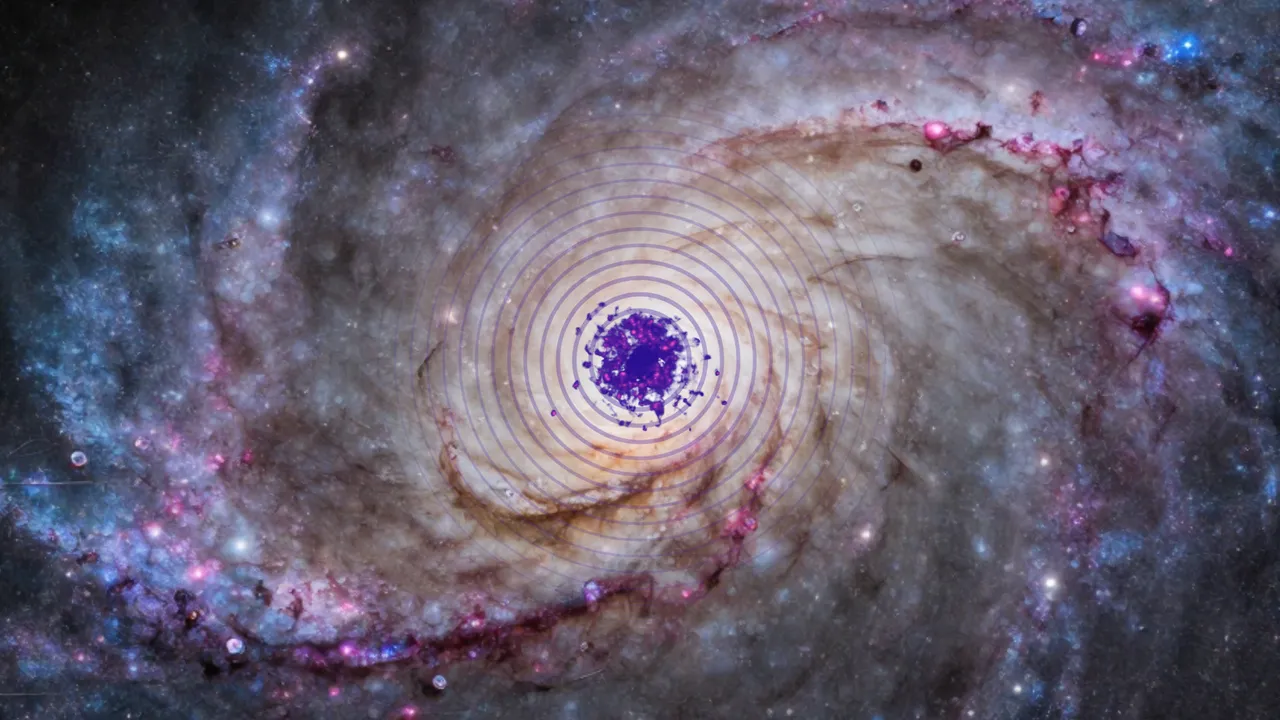
Physicist Yu-Dai Tsai of the University of Sheffield and a research team propose that dark matter’s elusive nature could come from being “in tune” with a fifth dimension. Their work suggests the geometry of hidden dimensions could generate a “dark matter resonance,” published in Physical Review D.
Dark matter has a credibility problem. It holds galaxies together with gravity, yet it barely interacts with light and “simply ghosts through ordinary matter.” Now, new research led by Yu-Dai Tsai of the University of Sheffield argues the reason might be even stranger than being unseen: dark matter could be “tuned in” to a fifth dimension.
The core claim is specific. The team proposes that the unique geometry of the fifth dimension shapes how dark matter particles acquire masses, producing a “dark matter resonance.” The resonance is described as analogous to intense vibrations at certain musical notes, except here the “notes” come from hidden-dimensional geometry, not coincidence. The result matters because the resonance is already known as a powerful idea, potentially affecting how dark matter was produced in the early universe and how we search for it today. The new contribution is meant to replace an assumption with a deeper origin: the resonance emerges directly from the geometry of hidden dimensions.
To understand why this is a big deal, you need the setup. When scientists talk about “extra dimensions,” they are not imagining alternate universes with another evil version of you in a parallel timeline. Instead, extra dimensions would be curled up with reality alongside the standard four-dimensional spacetime, made of three dimensions of space and one dimension of time. These extra dimensions are highly speculative. Still, they’re not random speculation, because string theory, one of the most popular extensions to standard physics, relies on the existence of at least 11 dimensions. So the idea that higher dimensions could leave observable fingerprints is a recurring theme in theoretical physics.
Dark matter, meanwhile, is the more empirically grounded mystery. Scientists are more sure it exists because its gravity outweighs ordinary matter by around five to one and helps explain the structure of galaxies. But proving what it is has been difficult precisely because it does not behave like the particles we know. It doesn’t interact with light, so it is hard to detect directly. That is why Tsai’s statement is framed around “targets.” In the statement, Tsai says the research gives physicists clear new targets in the search for dark matter, while connecting two of the biggest ideas in fundamental physics: the mystery of dark matter and the existence of hidden dimensions.
The mechanism the team proposes builds on another hypothetical: “dark photons.” Standard photons are the constituent particles of electromagnetic radiation, meaning light. The theory suggests dark photons would be similar, except they are tied to a hypothetical “dark force” rather than electromagnetism. In this scenario, dark matter would exist alongside this force-carrying particle in the fifth dimension. Then, due to the geometry of that fifth dimension, the masses of dark matter particles would arrange themselves in a way that generates the dark matter resonance.
There is also a temporal advantage baked into the model. The team suggests the resonance can make dark matter interactions much stronger at crucial epochs in cosmic history, such as in the early universe. That directly addresses a paradox that runs through many dark matter models: you need dark matter to do something significant early on, yet explain why it appears so inert and hard to detect today. Tsai adds that the model allows for strong interactions in the past while still explaining why dark matter is ghost-like now.
In more plain terms, the theory tries to square two requirements. Early universe, dark matter needs to interact strongly enough to matter for the story of cosmic evolution. Later universe, it needs to calm down and become effectively invisible. The “resonance” concept is already known to have this potential. What’s different in this paper is the proposed deeper origin. Many previous resonant dark matter models, according to Tsai’s statement, treated the resonance as an assumption. Here, the team argues the resonance may come directly from the geometry of hidden dimensions, meaning the hidden-dimensional structure does the heavy lifting.
Of course, it is very early days. This is a theoretical proposal, and the source notes the work’s excitement alongside its youth. Still, even early theories can shift the landscape in a way that looks a lot like product-market fit for research programs. When you can point to a specific “resonance” mechanism and a hidden-dimensional geometry as its origin, you can sharpen what you look for and when. That is the kind of clarity decision-makers in science funding and large collaborations tend to reward: not certainty, but narrowed scope and testable implications.
For executives and investors who pay attention to science as a long-horizon technology pipeline, the second-order point is that the dark matter search ecosystem is not purely about building bigger detectors. It is also about matching instrumentation to the right theory space. Tsai’s framing explicitly offers “clear new targets” and a connecting story across two fundamental physics mysteries, which can influence how researchers prioritize experimental strategies and which signals they treat as most meaningful. The paper was published in Physical Review D, which signals it has landed in the formal channel where the community will pressure-test the assumptions and the math.
The strategic stakes are simple. If hidden dimensions can imprint themselves through a dark matter resonance, the path from “we think dark matter exists” to “we know what it is” becomes less of a blind hunt and more like tuning an instrument. And unlike most tuning, the notes here are supposed to come from the geometry of a fifth dimension, not guesswork.
This story's Key Insights and Take-aways are locked.
Create a free account to unlock Executive Actions for one credit.
Register to UnlockAlways free for Executives Club members. Join the Club
More in Science

Alaska's 1,580-foot tsunami had warning signs. Scientists just found them.
Rapid glacier retreat, heavy rainfall, and thousands of tiny tremors preceded Alaska's 1,580-foot tsunami, a warning for every coastal community in a warming world.

The rare mutation that lets high-risk brains dodge Alzheimer's
Scientists found a natural defense against protein buildup, opening a new path to preventive treatments.

3,000 steps a day may halve Alzheimer's decline, study finds
New research links a modest daily walk to less tau buildup and nearly half the cognitive and functional decline, even for those with early signs.