
Dell discounts Alienware Area-51 RTX 5090 PC by $2,500 to $5,999.99 shipped
The deal still prices a flagship system as a luxury asset, but it meaningfully changes the upgrade math.
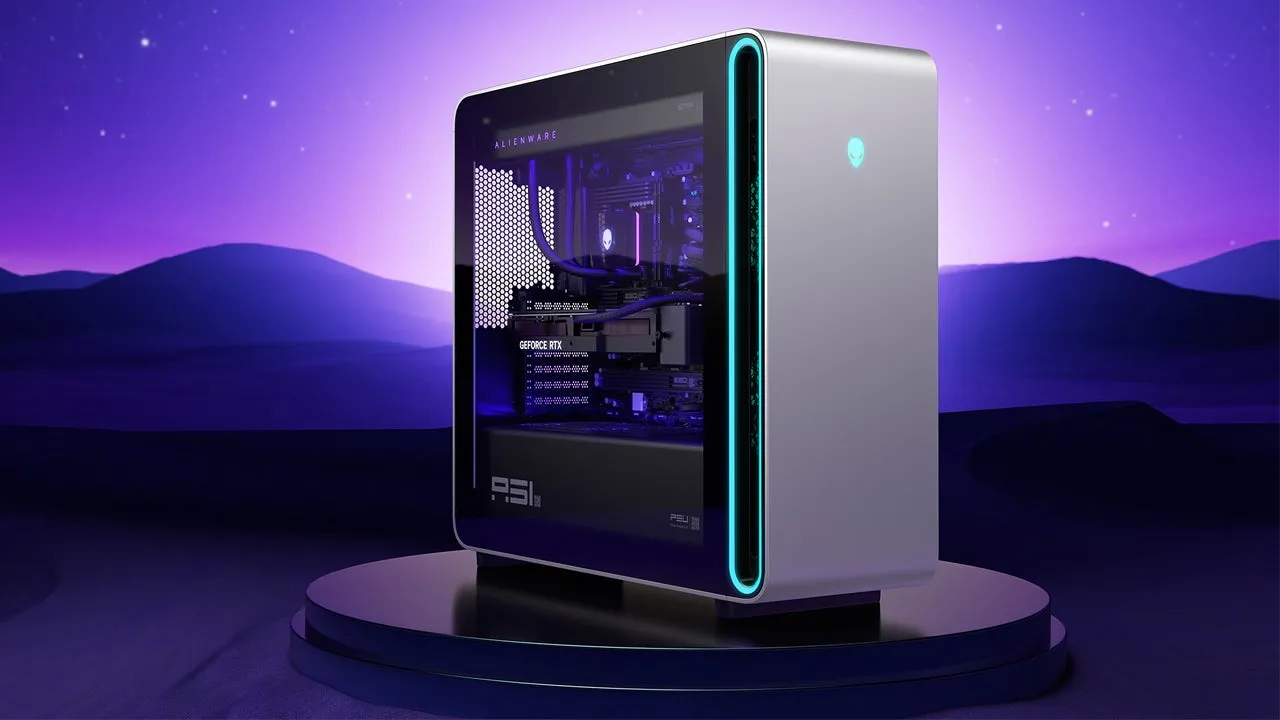
Dell is running a one-week discount on its Alienware Area-51 gaming desktop, cutting an RTX 5090-equipped configuration by $2,500 to $5,999.99 shipped. For decision-makers tracking tech spend, the promotion mainly matters because it compresses the total cost of bundling top-tier parts.
For this week only, Dell is knocking $2,500 off its flagship Alienware Area-51 desktop with a GeForce RTX 5090 GPU, dropping the shipped price to $5,999.99 after the instant discount. That number is big enough to stop scrolls, but the interesting part is what the deal does to the economics of buying the parts separately.
IGN’s breakdown puts the configuration at Alienware Area-51 RTX 5090 Gaming PC With 64GB RAM and a 4TB SSD, and details the CPU and power stack that make this a “high floor” machine: an Intel Core Ultra 9 285K CPU, a GeForce RTX 5090 32GB GPU, 64GB of DDR5-6400MHz RAM, and a 4TB SSD. Under the hood, it also includes a 360mm all-in-one liquid cooling system for the CPU and a 1,500W 80Plus Platinum power supply, designed to give “plenty of headroom for future upgrades.” In other words, this is not a thin-margin discount on a low-end box. It is Dell pulling a lever on a complete, top-tier platform.
The deal still is not “affordable for most people.” But from a budgeting and procurement lens, the reason the discount lands matters: IGN notes that if you price the individual components in today’s market, the sticker shock becomes less ridiculous than it initially looks. Specifically, a check on Amazon and Newegg suggests 64GB of DDR5-6400MHz RAM sells for at least $800, with most options closer to $900-$1,000. Meanwhile, a 4TB PCIe Gen 4x4 NVMe SSD starts at $600. Add those two upgrades together and you are already at roughly $1,400 for the RAM and SSD components alone, before you even talk about the GPU, CPU, chassis, cooling, or power supply. So the $2,500 instant discount is doing more than shaving a number. It is partially offsetting the cost of the “easy-to-underestimate” parts.
Where the economics get even more real is the GPU. The IGN piece is blunt: the RTX 5090 is not getting cheaper in a way that would make these systems feel like a bargain. It says the cost to acquire one of these standalone is now north of $4,000. That matters because it frames the entire deal as a bundle discount, not a market reset. The RTX 5090 is positioned as the most powerful consumer GPU on the market, and the article claims it still delivers a 25%-30% uplift over the RTX 4090 in hardware-based raster performance. At the same time, it notes that Nvidia has prioritized software updates, AI features, and DLSS 4 technology to improve gameplay performance. For executives and operators, the second-order effect is simple: when the “center of cost” in the system is a premium GPU that stays premium, discounts on the rest of the platform do not change the underlying tier. They mainly improve the value proposition for buyers who were already going to pay that tier price.
This is also a reminder of how workstation and gaming-pc buying works in practice. Desktop platforms like Alienware’s flagship often bundle a complete thermal solution, a high-wattage PSU (here, a 1,500W 80Plus Platinum unit), and a chassis designed around airflow. Those are not interchangeable line items in most casual shopping carts. Even if you can price parts independently, you still have to account for integration, cooling performance, and whether you are building around the power and thermals needed for a high-end GPU and CPU combination.
Second-order implications land at the organizational level, even if this story is a consumer deal. If you are an IT leader, finance partner, or procurement owner evaluating budgets for high-performance systems, the key takeaway is that promotions like this tend to function like temporary “bundle relief” on components that otherwise look expensive. Here, the RAM and SSD math alone is highlighted as a meaningful portion of value, with 64GB DDR5-6400MHz and a 4TB PCIe Gen 4x4 NVMe SSD each carrying notable standalone price points in the current market. But the GPU cost remaining above $4,000 means the flagship tier remains anchored. Translation: you can reduce the total outlay for buyers who need a system now, but you should not expect the ceiling to fall.
Finally, there is the strategic framing for anyone tracking tech cycles. IGN presents the Alienware Area-51 as Dell’s flagship desktop, calling out a “big chassis that towers over the Aurora R16 model” and a redesigned cooling system with greater airflow. The market context around the RTX 5090 is also clear: while some mid-range cards on the AMD side may have seen discounts, the RTX 5090 is “actually even more expensive than it was at the beginning of the year.” In that environment, a $2,500 instant discount on a $5,999.99 shipped build is notable because it is a temporary pricing move against stubborn component pricing, not a broad collapse of high-end hardware costs.
If you are in charge of buying decisions, the headline stakes are straightforward. This week’s discount changes the cost of assembling a top-tier platform, particularly because the RAM and SSD upgrade math is already shown to be around the $1,400 range. But the GPU’s continued “north of $4,000” standalone pricing means the system’s power tier is still premium. The deal is best understood as a value improvement for buyers willing to pay for flagship performance, not as a sign that luxury hardware is suddenly turning into a bargain basement purchase.
This story's Key Insights and Take-aways are locked.
Create a free account to unlock Executive Actions for one credit.
Register to UnlockAlways free for Executives Club members. Join the Club
More in Technology

Nvidia's $89B data center quarter: the 9 companies cashing in
The AI buildout is minting fortunes beyond GPUs, and memory, cloud, and cooling suppliers are riding the same wave.

Google quietly links your phone number to every Android account on your SIM
Adding a SIM now ties your phone number to all Google accounts - and future accounts inherit it. Here's the security and privacy stakes.

Hijacker AI 'Skynet mode' runs 100,000 attack steps against exposed models
Symantec caught a criminal AI agent that borrows other models, steals data, and mines crypto; the only relief is no confirmed victims yet.