
Dhaka police spent $50,000 on AI cameras. Two months later, jams are easing
A semi-automatic system detects five violations, builds case files, and is pushing drivers to slow down.
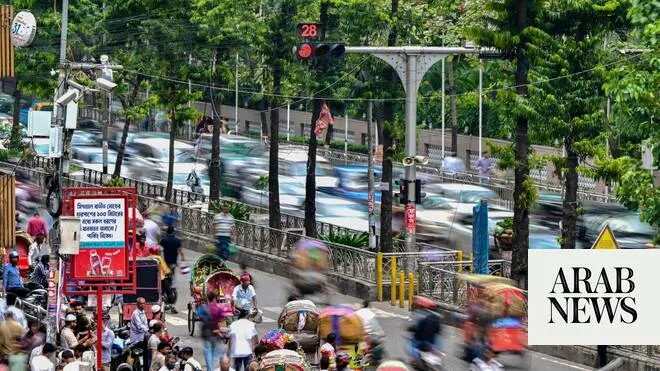
Dhaka Metropolitan Police linked traffic cameras to AI software designed to automatically detect violations, with pilot rollout beginning in April. After about two months, police say the system both targets road-rule offences and helps decongest some of Dhaka's busiest intersections.
Dhaka police say they spent only around $50,000 to stand up an AI traffic pilot, and after two months, the results are no longer just about ticketing. According to Dhaka Metropolitan Police, the system is also unclogging some of the city’s busiest intersections, where chronic road-rule offences, chaotic driving, and frequent red-light disobedience have long fed jams and fatalities.
The core move is simple: since April, Dhaka police have linked traffic cameras to homegrown AI software that detects five types of violations. Additional police commissioner for traffic, Anisur Rahman, told Arab News the software can spot running red lights, blocking the left lane, driving on the wrong side of the road, stopping in non-designated areas, and picking up or dropping off passengers in random places. From there, the pilot does two things at once: it builds digital case files using footage as evidence, and it is also being used to help control vehicle flows to decongest traffic.
That second part matters because Dhaka’s traffic problem is not new, and it is not just an inconvenience. For decades, the city’s jams, chaotic driving, and road fatalities have sparked mass protests and challenged successive administrations. With a population of more than 22 million people, Dhaka’s road enforcement has historically leaned on traffic officers who often have to stop vehicles with ropes or their own bodies when traffic lights turn red. The pilot is aimed at replacing some of that manual chaos with automated detection, so enforcement does not have to depend on the constant physical presence of officers at the exact right moment.
In practice, the system is semi-automatic rather than fully automatic. As part of the pilot program, ANPR (Automatic Number Plate Recognition) and PTZ (Pan-Tilt-Zoom) cameras have been installed at seven main intersections. When an offence is detected, digital case files are created using footage as evidence, and notices are sent directly to the registered owner via SMS and by post, though not yet automatically. Rahman also flagged an important operational detail: sometimes the AI can wrongly accuse a driver who is facilitating the movement of a pedestrian or an auto-rickshaw. He said road engineering was not designed with future AI systems in mind, so these kinds of mistakes can occur.
That is why Dhaka police are handling case filings manually, and drivers who face charges still have access to a review process. For decision-makers watching this, it is a reminder that enforcement tech does not just raise questions about accuracy. It also increases the workload and risk management burden, at least at the start, because someone has to validate what the AI thinks it saw. In other words, the pilot is not “automation replaces people.” It is “automation changes what people do,” shifting human effort into review and handling rather than constant street-level intervention.
Police also tied the pilot’s congestion benefits to how the system interacts with traffic-light dynamics. Dhaka has been widely regarded as one of the world’s most traffic-congested cities, and it has also been called “slowest” according to a 2023 study by the US National Bureau of Economic Research. Rahman said AI is helping by analyzing pressure from each direction at traffic lights. In 2024, he said, the average speed of vehicles was 4.2 km per hour. After the introduction of this AI system, the average speed has increased significantly, “as can be seen with the naked eye.” He added that the system can be switched to manual mode, with timing adjustable up or down when needed.
Then there is the cultural part, which may be the real long pole. Police say one of the main positive results observed so far is a shift in drivers’ mindset. Rahman said earlier people had a tendency to violate traffic signals whenever they got the opportunity or if there were no traffic police nearby, but now they are noticing signals, pedestrian crossings, and road signs. Drivers, he said, think twice or even three times before running red lights or violating traffic rules.
This behavioral change is supported by what drivers told Arab News. Abul Bashar, a professional driver, said he and others were used to “free-style driving,” not caring about signals or designated lanes. Since the installation of the AI cameras, he said drivers have become more cautious because the AI tools record vehicle movements and may file cases without informing them, and because the previous opportunity to bargain with traffic officials on the streets has changed. Karimul Mawla, a ride-share driver, described the jam pain in earnings terms: if a 10 km ride takes two hours, it reduces income. He said that after AI camera installation at some signal points, waiting times at signals dropped from four to five minutes to two to three minutes, increasing vehicle mobility, decreasing ride completion time, and enabling slightly better earnings.
Looking ahead, Dhaka police plan to install 60 camera systems across the city this year and double the number next year, with police saying the goal is to bring the entire city under the new traffic management system. For executives and board members in mobility, public tech, or any regulated environment, this pilot offers a clean case study: low upfront spend (around $50,000) can still drive measurable operational and behavioral effects, but only if the enforcement loop includes human review and a realistic approach to edge cases like pedestrians and auto-rickshaws.
This story's Key Insights and Take-aways are locked.
Create a free account to unlock Executive Actions for one credit.
Register to UnlockAlways free for Executives Club members. Join the Club
More in Business

Bungie cuts most Destiny 2 staff as Sony says Marathon still matters
Herman Hulst confirms layoffs affecting most Destiny and some Marathon teams after Bungie admits Destiny fell short.

SK Hynix jumps 11% after seeking up to $29.4B in Nasdaq listing
The chip giant filed for a Nasdaq listing plan that could raise $29.4 billion, instantly reshaping investor expectations.
Micron revenue hits nearly $42B as AI memory lifts gross margins above 81%
Fiscal Q3 results crush estimates, prove AI memory is rewriting Micron's margins, and change the momentum math for the whole chip stack.