
Dubai's airport traffic collapsed 31%. Its CEO says the war won't change its $35B bet
Paul Griffiths insists Dubai's global hub ambitions are intact after the Iran war cut passenger traffic by nearly a third. Here is why he is doubling down.
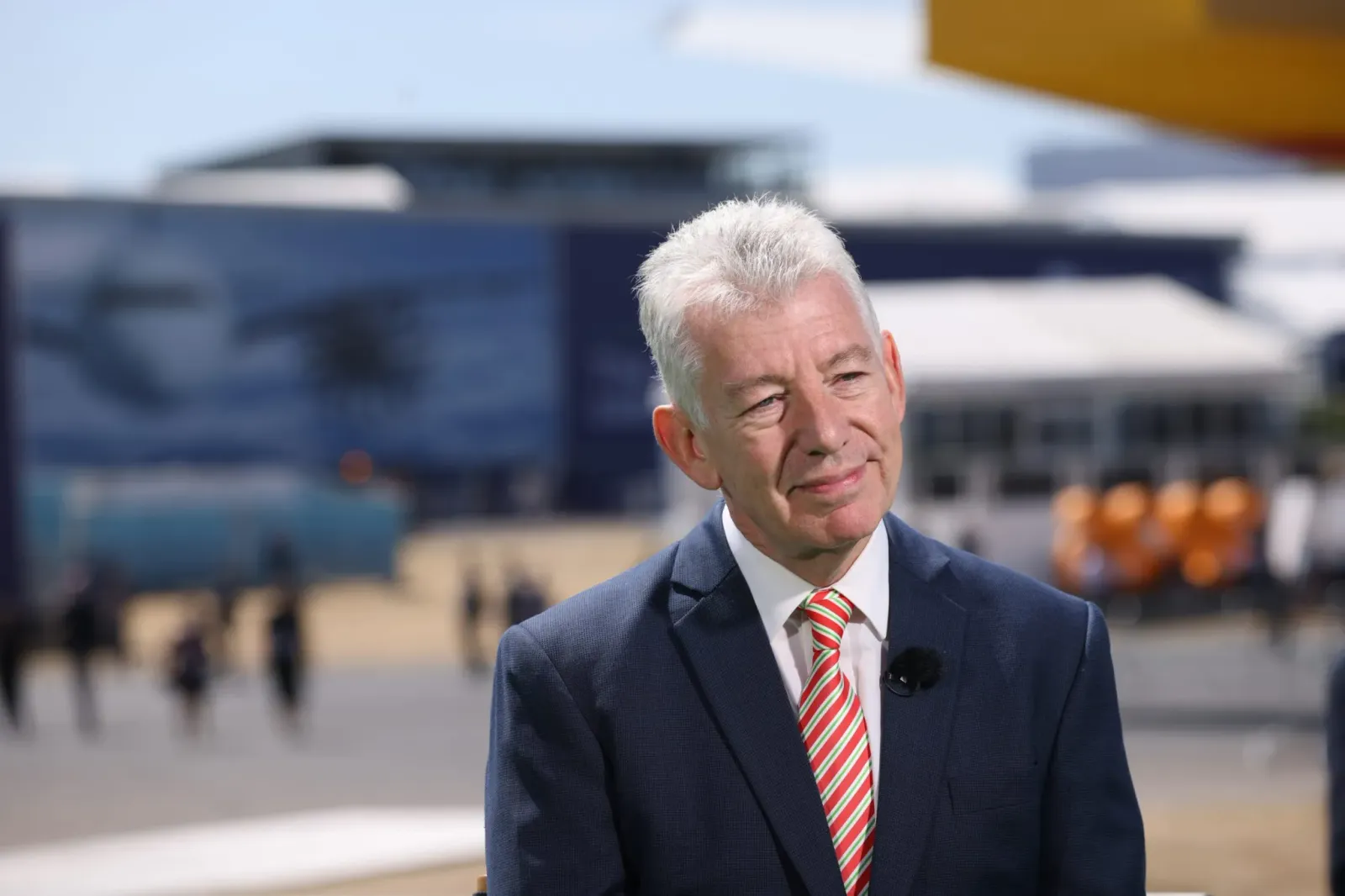
Dubai Airports CEO Paul Griffiths says the Iran war knocked Dubai International's first-half passenger traffic down 31.3%, but the emirate is pressing ahead with its $35 billion Al Maktoum expansion. For executives, the signal is that Dubai is treating the shock as temporary and expects to return to full operations by year-end.
Dubai International Airport, the world's busiest hub for international passengers in 2025, saw first-half 2026 traffic collapse 31.3% to 31.5 million passengers after the Iran war triggered ballistic missile alerts across the Gulf. CEO Paul Griffiths, who said the airport fielded roughly 111 separate ballistic activity alerts during the crisis, is not flinching: "My confidence level is not misplaced that we should be back to 100% of our operation by about the end of the year." The recovery is already visible in the monthly numbers, with traffic climbing from 3.5 million in April to 4.5 million in May and 5 million in June, putting the airport at about 80% of last year's level while Emirates and flydubai operate at roughly 90% of their 2025 capacity. Griffiths' message to the market is that the war was a shock, not a structural shift, and Dubai's long-term aviation ambitions remain intact.
The stakes are enormous. Dubai International ended 2025 with a record 95.2 million passengers, the highest annual international traffic ever recorded by any airport, and had been aiming to cross 100 million passengers in 2026. That target is now out of reach, with Dubai Airports expecting full-year traffic to finish "in the 70 millions." Aircraft movements fell 32.1% to 150,600 in the first half, and cargo volumes dropped 28.7% to 751,340 tons. The decline was not just a Dubai problem: Middle Eastern transfer traffic on Asia-Western Europe routes fell 47% year over year by April, according to Alton Aviation Consultancy, as travelers rerouted through Seoul, Singapore, Hong Kong and Istanbul. Incheon International Airport said its transfer traffic rose 18% in the first half, helping it surpass Dubai and Heathrow in preliminary international passenger data. For global carriers and investors, the question is whether this rerouting becomes permanent or reverses as quickly as it began.
Griffiths argues the shift will prove temporary. Resumed services into Dubai are returning with load factors in the 80% to 90% range, and airlines that moved aircraft onto busy European summer routes are likely to restore Gulf capacity as winter schedules begin. But several major foreign carriers have not yet resumed service: British Airways has suspended flights to Dubai until the end of October, while Lufthansa and Singapore Airlines are also holding off until late October. Griffiths also questioned why some government travel advisories had not caught up with conditions on the ground, arguing that "it is safe" to travel to the UAE. That gap between on-the-ground operations and official advisories is a reminder that perception, not just physics, drives international aviation demand.
The war also forced Dubai Airports to improvise in ways that will shape its operations for years. During alerts, passengers were moved to safe areas and aircraft could be landed quickly when threats emerged. When the airport was temporarily unable to fuel aircraft, Griffiths said it used a "splash and dash" contingency: planes departed Dubai International, landed at Al Maktoum International Airport, 40 kilometers southwest of the city center, to refuel, then continued their journeys. The crisis also became an opportunity to accelerate infrastructure upgrades, including expanded self-service, biometric systems, smarter operational technology and passenger-flow improvements. Griffiths said the priority is to make the airport more efficient rather than to rethink its strategy in light of a crisis he considers temporary.
That strategy is anchored by the $35 billion expansion of Al Maktoum International Airport, which remains on track to begin operations in 2032. The project is expected to become the world's largest airport, eventually accommodating 260 million passengers and 12 million tons of cargo per year. Griffiths said 10 million work hours have been logged on the project over the past 15 months, alongside 17,000 concrete piles and 45 million cubic meters of earth moved. The scale of that investment is the clearest signal that Dubai's leadership sees the war as a temporary disruption, not a reason to change course. When Griffiths asked Dubai Airports' chairman whether the war changed the emirate's aviation plans, he said, "It was the shortest conversation, and the answer was 'absolutely not.'"
For executives watching from outside aviation, the lesson is about how to read a demand shock. Griffiths explicitly compared this moment to previous shocks, from the financial crisis to the Covid pandemic, arguing that the mistake is to confuse short-term disruption with a long-term structural shift. That framing is easy to dismiss as corporate optimism, but the capital commitment behind it is real: 10 million work hours, 17,000 concrete piles and 45 million cubic meters of earth moved in 15 months is not a hedge. The bet is that Gulf geography, airline economics and the region's role as a connector between Europe, Asia and Australia will reassert themselves once the security environment stabilizes.
The competitive window, however, is real. Gulf carriers historically accounted for roughly a third of traffic between Europe and Asia and about half of travel between Europe and Australia. A 47% drop in Middle Eastern transfer traffic on Asia-Western Europe routes is a massive opening for Seoul, Singapore, Hong Kong and Istanbul to win loyal passengers and airline partnerships. Incheon's 18% rise in transfer traffic shows that hubs can gain share quickly when a rival is disrupted. Whether those gains hold depends on how fast Dubai returns to full capacity and whether government advisories align with safety conditions on the ground. For now, Griffiths is betting on speed: full operations by year-end, load factors in the 80% to 90% range, and a $35 billion expansion that will not wait for the war to end.
This story's Key Insights and Take-aways are locked.
Create a free account to unlock Executive Actions for one credit.
Register to UnlockAlways free for Executives Club members. Join the Club
More in Business

Tim Cook steps down as Apple CEO, stays on as chair with $45M equity
The 'Trump whisperer' keeps his White House and Beijing access as Apple navigates tariffs and a $4.6 trillion market cap.

Snowflake shares surge as AI data demand crushes estimates, lifting full-year forecast
Stocks jumped on stronger-than-expected guidance, signaling enterprise AI workloads are accelerating faster than Wall Street priced in.

Tim Cook's 15-year Apple CEO run ends: 3 lessons for any successor
After 15 years, Tim Cook hands Apple to John Ternus - here's how he turned a $350B company into a $4.6T juggernaut.