

Düsseldorf court gives Fender “broad” Strat copyright, and competitors fight back with lawyers
Fender’s 2025 German ruling sparked cease-and-desist letters across the guitar market, but opponents argue it is too broad.
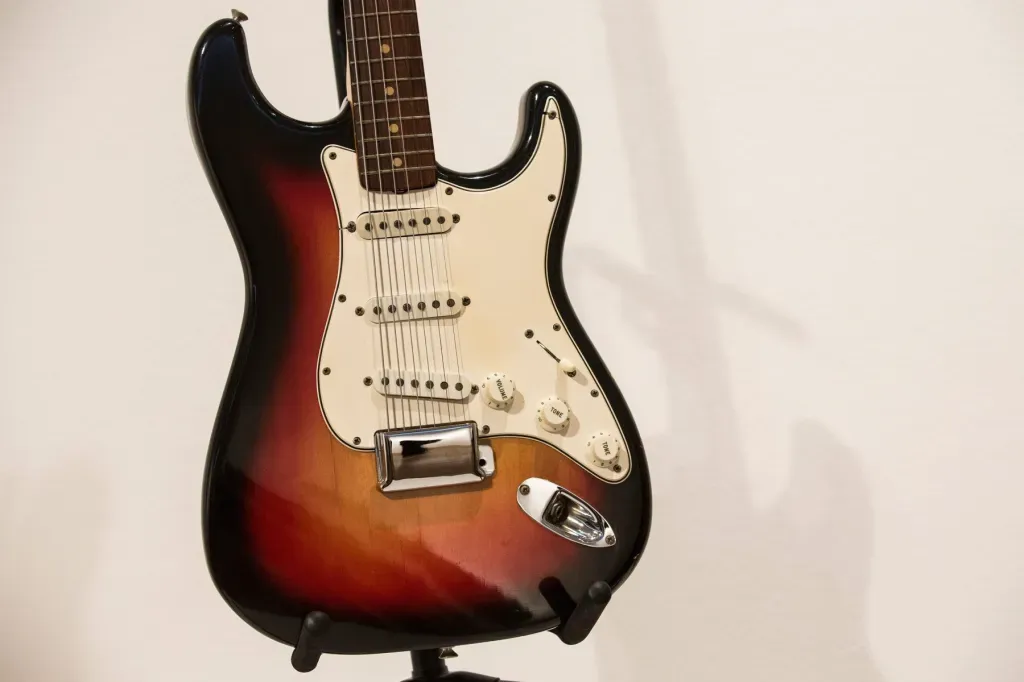
Fender Musical Instruments used a December 2025 default judgment from Düsseldorf Regional Court to claim broad copyright protection over the Stratocaster guitar body. The move triggered May cease-and-desist letters to major makers like Yamaha and PRS, setting up litigation that could reshape how the EU protects guitar designs.
This past May, worldwide musical instrument companies including Yamaha and PRS Guitars received cease-and-desist letters from Munich. The letters, authored by German lawyers, say Fender Musical Instruments has newly acquired copyright protection over the iconic Stratocaster electric guitar design, and they demand that non-Fender-produced Strat-shaped guitars be immediately pulled from the European market.
The legal pivot is not subtle: Fender is trying to move the Strat battle from trademark fights to copyright enforcement, and it starts with a Düsseldorf court decision entered in December 2025 after a key defendant did not respond. That default judgment is now being used as the backbone for a much wider claim than many industry players think copyright law should allow.
To understand why this is such a high-stakes escalation, you have to rewind nearly 20 years, because the Strat is not just an instrument. It is a fight over who gets to control a shape that became global standard equipment for musicians. Fender first began selling the Stratocaster, a model of double cutaway, S-shaped electric guitars, in the 1950s. The design was a huge success, and scores of other guitar manufacturers soon began pumping out their own instruments based on the same double cutaway approach.
In 2003, Fender tried to stop those copycats by filing to federally trademark the Strat shape in the United States. Seventeen guitar manufacturers and distributors opposed the application, and the companies were mired in litigation for years. The case was decided against Fender in 2009 when the U.S. Trademark Trial and Appeal Board (TTAB) rejected the trademark registration. TTAB said Fender forfeited its right to claim trademark protection by waiting 50 years to police alleged infringement, and it also concluded the Strat shape had become so ubiquitous that consumers did not view it as connected to Fender. In other words, the shape was “generic” and “non-distinctive,” legal statuses that bar trademark protection in the U.S.
Things were quiet on the legal front for more than 15 years after that 2009 ruling, even as Fender and competitors kept selling guitars in the Strat shape. Then, in 2025, Fender initiated a new intellectual property lawsuit over the Strat. This time, the forum was Germany, specifically the Düsseldorf Regional Court, and the legal theory was copyright infringement rather than trademark infringement. Fender accused a Chinese guitar seller named Yiwu Philharmonic Musical Instruments of selling knockoff Fender Strats on AliExpress. Yiwu did not respond, and the Düsseldorf court entered a default judgment in Fender’s favor in December.
That December 2025 ruling is what Fender is now using to expand leverage across the European guitar market. Relying on new German case law around the copyrightability of objects like guitars, the court held that the shape designed by Leo Fender is entitled to protection as an “outstanding intellectual creation that reflects his personality.” The decision also characterizes the guitar body’s design as creating soft curves and evokes associations with a female torso, plus a futuristic, elegant, timeless design with an asymmetrically curved shape and a fretboard that accentuates that silhouette.
Fender moved quickly after winning. The company celebrated the Düsseldorf court’s ruling not just because it won an injunction against Yiwu, but because it believes the case establishes “broad legal protection” for the Strat. Fender’s press release in March says Fender acquired an enforceable copyright on the design that can be invoked to bar the manufacture of third-party Strat guitars within the European Union, or the importation of such instruments into the continent, even if sellers are based elsewhere. That apparent breadth then shows up in the cease-and-desist letters sent May 11, which targeted scores of instrument makers.
Those letters demanded that recipients “immediately stop manufacturing, selling, marketing or producing such infringing products.” Billboard obtained an example letter that cites the German default ruling and asserts that Fender has a copyright to the shape of the Stratocaster guitar body, and that copies of these guitar body constitute copyright infringement. In the example letter, German attorney Richard Dissmann of Bird & Bird wrote that the recipients’ clients appreciated copies had been in the market before, but now “with the judgment of the Court of Düsseldorf,” it was clear Fender has the copyright and infringement follows.
And then, predictably, opponents lawyered up. Several companies hired Ronald Bienstock, a New Jersey-based attorney with Fox Rothschild who previously represented Fender’s opponents in the 2009 trademark case. On May 21, Bienstock sent response letters to Dissmann obtained by Billboard, challenging whether Fender can claim such broad copyright protection. The central thrust: the Düsseldorf ruling was a default judgment based on an undeveloped record because Yiwu did not respond, provide evidence, or go to trial. Bienstock’s letters argue that if Fender’s claims were fully litigated in Germany, courts would reject copyright protection for the Strat.
Bienstock also raised a chain-of-title and authorship problem, citing questions about the chain of title for Leo Fender’s original design and evidence that the Strat had multiple creators who may have been more interested in instrumental function than artistic design. He also pointed back to the 2009 TTAB conclusions about the shape’s “generic” nature, underscoring how the same silhouette can be treated differently depending on the legal lens and the evidentiary record.
For executives and boards, the strategic stakes are obvious even if you do not play guitar. If Fender’s “broad” copyright claim survives, it could change the compliance calculus across the EU. The letters are already forcing major makers such as Yamaha and PRS to decide between settlement risk, redesign costs, or the expense of litigating the scope of protection. And second order, the case could make IP strategy look less like a single-provision legal question and more like a market-wide enforcement campaign that starts with one court ruling and then tests how far it can travel.
This story's Key Insights and Take-aways are locked.
Create a free account to unlock Executive Actions for one credit.
Register to UnlockAlways free for Executives Club members. Join the Club
More in Business

Anthropic’s Levant Alpöge cracks the Jacobian conjecture after 87 years
A Harvard valedictorian used Claude to hit a 1939 breakthrough, but the missing “why” is the real problem.

Uber buys Delivery Hero for nearly $15B, vaulting to top food delivery outside China
The deal doubles Uber's dual-services footprint and pushes a ride-and-eats bundling play into 50 more markets.

Epic and Google drop settlement bid, forcing rival Android app stores by July 22
Google told the court it is ready to carry third-party app stores starting Wednesday, July 22.