
Epic's vibe-coded launcher claims Steam-beating speed, with bugs to match
Epic rebuilt its Games Launcher from scratch with AI, betting speed can dent Valve's grip - and it warns users to expect bugs.
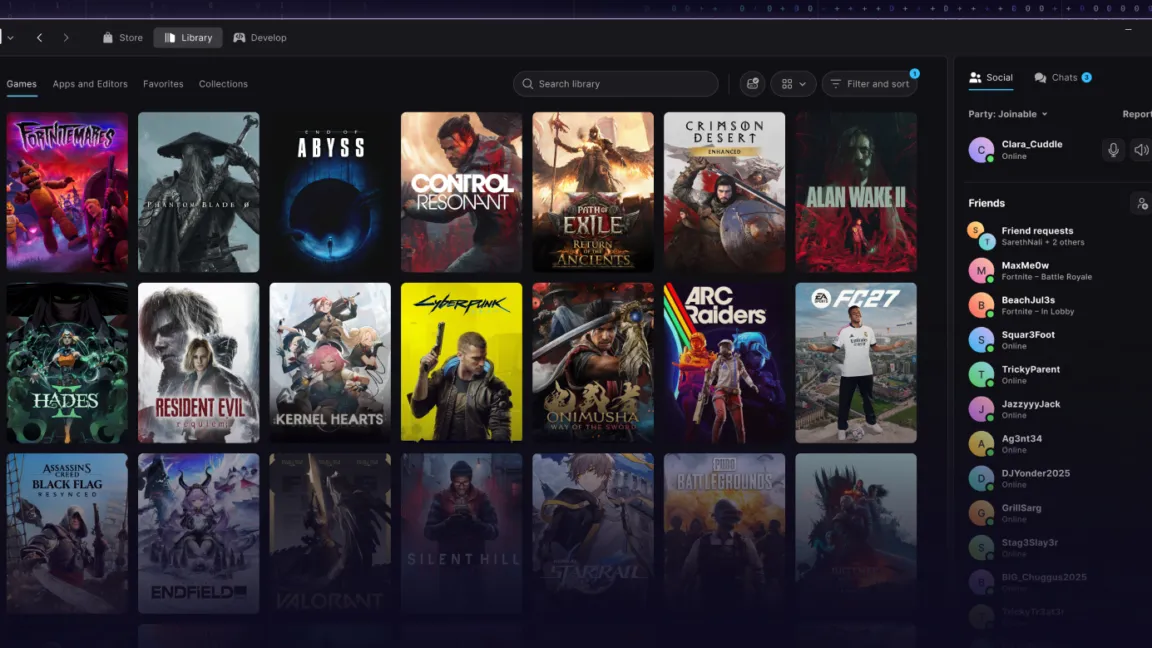
Epic Games Store General Manager and VP Martin Keely says a small team used AI to rewrite the Epic Games Launcher from scratch, producing a faster Preview build now available to the public. For software leaders, the move signals that AI-assisted rewrites can compress timelines and shrink teams, but shift bug risk onto users.
Epic Games Store General Manager and VP Martin Keely is betting that AI-assisted "vibe coding" can do what nearly eight years of storefront rivalry could not: give Epic a speed advantage over Steam. The new publicly available "Preview" build of the Epic Games Launcher was written from scratch, and Epic says it is "way faster and more responsive" than the current launcher, with a new look. There is a catch, and Epic itself flagged it: the Preview "will have some bugs."
The "vibe-coded" label isn't just a joke. Keely told PC Gamer the team "started from scratch" and used AI as "a tool to write and review new features and new capabilities from the ground up in a different tech stack than what we had previously." The goal, he said, was to "look at functionality that existed [in the current Epic Games Launcher] and [say] we want to replicate that, but not the code itself." Speaking to IGN, Keely said AI "made us more efficient and allowed a small team to rewrite the code base and be able to launch it faster across platforms, support Windows and Mac, and we're going to have a Linux version as well."
Nearly eight years ago, Epic took on Steam with its own Game Store and launcher, and it has spent that time chasing Valve's dominant PC platform. The new Preview is the company's latest attempt to gain an edge over Valve, and the weapon is not a bigger catalog or a cheaper cut, but a faster, AI-written client. Epic's announcement leans into the irony: "programming is hard. So, instead of doing that, we vibe coded a new Epic Games Launcher that's way faster and more responsive than the current one, and has a new look."
The phrase "vibe coding" has become shorthand for describing what you want and letting an AI model generate the code. In Epic's case, Keely says AI was used both to write and to review new features, and the team deliberately avoided carrying over the old code. That is a meaningful departure from the usual approach of optimizing an existing, battle-tested codebase. It also explains how a small team could rebuild a launcher from the ground up, support Windows and Mac, and promise a Linux version in the same cycle.
The bet carries real risk. A launcher handles logins, downloads, libraries, and storefront transactions, so it is critical infrastructure for Epic's PC business. Shipping a vibe-coded Preview with known bugs means Epic is effectively asking its most engaged users to test AI-written code in the open. For executives, this is a case study in how AI changes the cost structure of software: a small team can rewrite a codebase and ship cross-platform faster than before, but the trade-off is public debugging and the possibility that early adopters hit friction.
For Valve, the strategic signal is less about speed and more about how Epic is now building. If a small team using AI can rebuild a launcher and add a Linux version, the cost of competing in game distribution changes. Steam remains the PC platform to beat, but Epic is signaling it can iterate more quickly and on more platforms than it could before. For decision-makers in any software business, the pattern is worth watching: AI-assisted rewrites can shrink teams, compress timelines, and expand platform reach, but they move risk from internal testing to users.
There is also a cultural layer. Epic's announcement is openly playful, but the underlying message is serious: the company is willing to throw out its own codebase and rebuild with AI rather than incrementally improve what exists. That is a different muscle from typical maintenance work. Boards and CTOs watching Epic's experiment should pay attention to whether the Preview wins on speed and stability, because it is one of the highest-profile real-world tests of AI-written software in a mainstream consumer product.
This story's Key Insights and Take-aways are locked.
Create a free account to unlock Executive Actions for one credit.
Register to UnlockAlways free for Executives Club members. Join the Club
More in Technology

Cop fired after sharing Flock login with ICE husband: 983 searches
A Savannah officer's shared credential let an ICE agent run hundreds of plate searches on Hispanic drivers, exposing a surveillance backdoor.

Elizabeth Holmes doc 'You Can See Everything' posts second-biggest doc debut ever
The true-crime draw shows fraud narratives still sell - a signal for media execs and a caution for founders.

She blocked an Uber delivery robot to save jobs. Police arrested her.
Carolyn Marvin's disorderly conduct arrest turns a sidewalk standoff into a test case for how cities police the automation-versus-workforce debate.