

Erythrulose sugar is found near the Milky Way’s center, first detection outside our solar system
A raspberry sugar, detected with Spanish and French telescopes, strengthens the case that life’s ingredients are widespread in space.
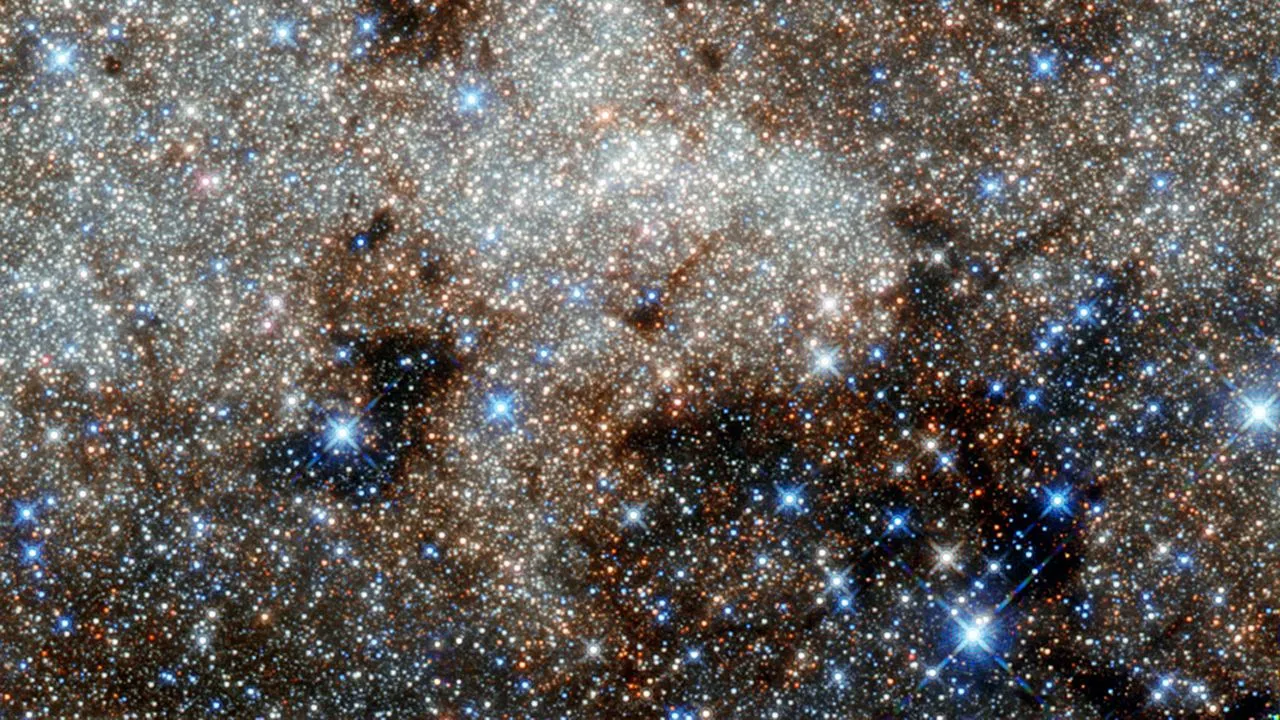
Researchers report erythrulose, a sugar found in raspberries, detected in interstellar gas and dust near the Milky Way’s center. The finding, confirmed with Yebes 40-meter and IRAM 30-meter radio telescopes and laboratory spectroscopic data, adds new evidence that life-relevant chemistry is common before planets form.
A sugar you can find in raspberries has been detected near the Milky Way’s center, and this time it is not from a meteorite or a lab experiment. In a new study published Monday, July 13, in Nature Astronomy, researchers report finding erythrulose in the interstellar gas and dust cloud G+0.693-0.027. It is the first time this specific sugar has been found outside the solar system.
The detection matters because it was confirmed the hard way: with sensitive observations from the Yebes 40-meter and IRAM 30-meter radio telescopes in Spain, plus confirmation of the signal patterns using laboratory spectroscopic data. In other words, this is not a “maybe we saw something” moment. The chemical inventory of the region is one of the richest in the galaxy, which increases the odds of catching rarer molecules, and the team used exceptionally sensitive observations, extensive frequency coverage, and highly accurate lab data to pull erythrulose out of the noise.
Now zoom out. Space chemistry is already the background radiation of the origins-of-life debate, and researchers often start with the big headline ingredients: water and carbon. But sugars deserve a seat at the table too. According to the researchers, sugars are important molecules in living systems because they help provide energy, build biological structures, and form parts of genetic material. Erythrulose is not just “a sugar.” It is made up of four carbon atoms, and it is relevant to prebiotic chemistry because it can change the configuration of threose.
Threose is another sugar believed to be a precursor of the first nucleic acids that evolved into RNA and DNA. That chain of logic is the payoff: if erythrulose is available in space, then the chemistry that feeds into biologically meaningful molecules may have access to more starting points than scientists previously assumed. The researchers emphasize that erythrulose is particularly relevant for the field of origins of life for exactly this reason. And just like with water and carbon, the strategic question for the field is whether the ingredients are local miracles or widespread realities.
This finding also corrects a previous bottleneck in a very specific way. Before, scientists could not figure out how erythrulose could be made in conditions simulating the early Earth. The problem, as the researchers explained, was that lab experiments “yield insufficient concentrations” of erythrulose on the surface of prebiotic (pre-life) Earth. That led to doubt about whether the sugar could realistically appear in meaningful quantities on young planetary surfaces.
But interstellar space plays by different rules. In the new study, the interstellar presence of erythrulose suggests it could be found in the interstellar medium for incorporation into rocky planets like Earth earlier, when those planets are first forming and evolving. The researchers say this implies erythrulose could be part of a broader “sugar inventory” that Earth inherited before fully forming. They also suggest a route from simpler molecules: erythrulose can be made from simpler molecules on dust grains in space, then become part of more complex chemical systems.
If you have been following the broader storyline of life’s components, this will feel like another confirming datapoint rather than a wild left turn. Sugars have been seen before in space-related samples. The source notes that sugars have been spotted in meteorites and asteroid samples, particularly ribose, an RNA building block, and glucose, a product of photosynthesis on Earth. It also points to OSIRIS-REx asteroid Bennu samples, which returned data suggesting both ribose and glucose were present. So, the new piece is specificity and location: erythrulose is now detected directly in an interstellar gas and dust cloud, not only inferred from Solar System debris.
What should decision-makers and operators outside astrophysics care about? Two things. First, the research direction is explicit and actionable, even if it is not a “product.” The researchers say one of the most exciting next steps is to search for even more complex sugars and molecules that are direct precursors of RNA and other biologically important compounds. Translation: the hunting list is getting longer, and the chemical inventory of young systems is becoming a more measurable target.
Second-order, that changes the risk profile of the “where do life’s inputs come from” question. If essential ingredients are plentiful in space, then the distribution of starting materials for prebiotic chemistry looks less like a lottery ticket and more like a baseline condition. That does not solve biology, but it does shift the emphasis toward planetary formation timing, delivery mechanisms, and how quickly chemistry can progress once a system starts assembling.
The central strategic stake is that this detection strengthens the idea that prebiotic chemistry can advance before planets are even formed, and that young planetary systems inherit chemical inventories from interstellar space. For scientists, it is a map for what to search next. For everyone else, it is a reminder that the raw materials of life may not be rare. They may already be everywhere, waiting for the right conditions to do their work.
This story's Key Insights and Take-aways are locked.
Create a free account to unlock Executive Actions for one credit.
Register to UnlockAlways free for Executives Club members. Join the Club
More in Science

Alaska's 1,580-foot tsunami had warning signs. Scientists just found them.
Rapid glacier retreat, heavy rainfall, and thousands of tiny tremors preceded Alaska's 1,580-foot tsunami, a warning for every coastal community in a warming world.

The rare mutation that lets high-risk brains dodge Alzheimer's
Scientists found a natural defense against protein buildup, opening a new path to preventive treatments.

3,000 steps a day may halve Alzheimer's decline, study finds
New research links a modest daily walk to less tau buildup and nearly half the cognitive and functional decline, even for those with early signs.