

Experimental archaeologists turned a donated body into a 1994 “Ramses” to test mummification
Sam Kean’s book follows Bob Brier and Ronn Wade as they recreate Egyptian embalming step-by-step, even the weird parts.
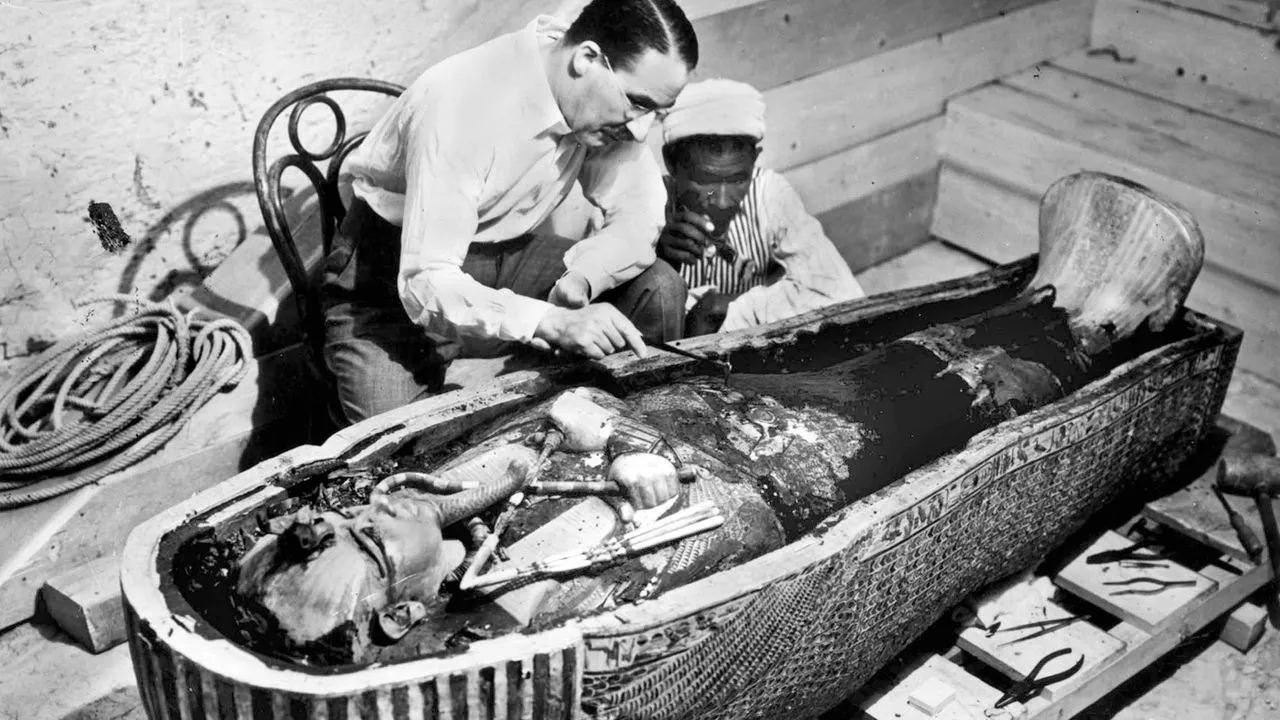
In “Dinner with King Tut,” science writer Sam Kean describes how experimental archaeologists Bob Brier and Ronn Wade recreated ancient Egyptian mummification using replicas and modern anatomy training. Their 1994 human-mummy experiment turned an anonymous donor into something they say looked like Ramses the Great.
Archaeologists usually learn the past by digging it up. Bob Brier and Ronn Wade learned it by rebuilding it, on a real human body, in May 1994, using techniques they reconstructed from archaeological information and modern knowledge.
Kean’s account is the rare one where the payoff is visible and specific: after five weeks of dehydration with natron, Brier says the donor looked “just like Ramses the Great,” with “leathery skin, a beaky nose, and wispy hair sticking up.” That’s the point of the experiment, and it answers a fundamental question modern observers can’t settle from texts that practically don’t exist: Egyptian embalmers wrote down virtually nothing about their embalming process.
Most of archaeology is slow and precise. Excavators dig layer by layer, then lab teams pore over the resulting remains, from charred seeds and broken bones to microscopic grains of pollen. Experimental archaeology flips the workflow. Instead of treating the past as something to infer only from traces, it treats the past as something you can pressure-test. If you reproduce the steps faithfully enough, the body itself becomes the evidence. In the book, Kean frames this as the “experimental side” of archaeology, with vignettes that include how Stone Age city dwellers kept houses cool 9,000 years ago, how Romans used needle and thread to style hair, and how bog bodies were formed in Iron Age Europe.
Why go to this trouble? Because mummification is iconic, but opaque. Cultures across history have mummified their dead, and some still do. Yet Egyptian mummies remain the most recognizable, and the documentation gap is huge: embalmers left behind virtually nothing about their process. That’s why, in Kean’s telling, experimental archaeology becomes one of the few avenues for understanding how it worked in practice. Sometimes these recreations use animals, but Kean points out that a few intrepid teams have mummified human beings, most famously in 1994 when Brier and Wade did it.
The human part of the story matters for how you read the experiment. Wade grew up wanting to be a mortician like his father. After a stint as a medic in the Vietnam War, he became an anatomist and eventually the head of Maryland's state anatomy board. Brier also trained in anatomy, but he’s an Egyptologist by training and passion, accumulating so many books on Egypt that he rents a second apartment just to accommodate them. Brier and Wade selected their mummy from people in Baltimore who donated their bodies to science, eventually settling on a seventy-six-year-old Caucasian man who died of a heart attack. His identity remains secret. Wade nicknamed him E. M. Balm, a detail Kean includes because it shows how pragmatic the work had to be even when the goal was historically faithful.
They used replicas of pharaonic-era tools and materials, including linen wraps, a notably wide wooden embalming table, and copper and obsidian blades. They abandoned the copper ones quickly because they couldn’t cut flesh well. Before starting on their mummy, they practiced one critical step on other cadavers: extracting the brain. This first learning loop is where the modern scientific method shows up inside the ancient ritual. Brier knew Egyptian embalmers removed the brain by inserting a hooked rod through the nostrils, but the details were vague. Their first attempt involved scooping with such a rod, but the tissue proved too soft. They shifted to squirting water up the cadaver’s nose, then using the rod to whisk the brain into a slurry, which they describe as pouring out “like a milkshake,” specifically “a strawberry milkshake.”
Making the mummy began in May 1994. The first step involved removing organs. The account then walks through the logic of Egyptian priorities in a way executives, researchers, and boards should recognize: you don’t just follow a recipe, you follow a theory of what matters. The heart was left in situ, considered the seat of all thinking, emotion, and intelligence. The abdominal organs were extracted and preserved. Brier and Wade made a 3 1/2-inch (9 centimeter) incision, removed the spleen, liver, gallbladder, lungs, and twenty-two feet (6.7 meters) of intestines, then dealt with the difficult geometry of extracting the lungs from the heart while working blind inside the cavity.
After organ removal, they cleaned the abdomen with palm wine and myrrh, stuffed frankincense into the skull, and then dehydrated the body using natron, a naturally occurring mineral of equal parts salt and baking soda that forms in Egyptian wadis, or dry gullies. Natron works like a sponge for moisture: it sucks water out of flesh, leaving conditions that do not support bacteria, maggots, beetles, and other agents of putrefaction. Brier dug the natron himself in Egypt, and Kean notes the “ticklish” logistics of sneaking hundreds of pounds of unidentified white powder through customs at JFK Airport, hidden in suitcases among equipment.
The process gets even more concrete. In the lab, they placed the spleen, lungs, liver, and intestines into bowls and covered them with natron. They packed 29 linen bags of natron into the body’s empty torso, laid the body on top of 211 more pounds (96 kilograms), then dumped 583 additional pounds (264 kg) over it. They kept the body in Wade’s old office, heat cranked to 104 degrees F (40 degrees Celsius) and dehumidifiers running night and day to simulate Egyptian air. Over five weeks, natron turned crusty and brown from absorbing bodily juices, forcing them to crack through it with an iron rod. Brier recalls the odor as acrid but not unpleasant, while news reports at the time say they wore surgical masks.
This is the moment Kean uses to settle the “appearance vs. time” debate. As mummification proceeds, the skin tightens and shrivels, especially on the face and scalp. Lips retract to reveal teeth. Skin with less melanin turns brown-yellow. Brier always wondered whether those changes resulted from the immediate mummification process or from several thousand years of weathering in Egypt’s arid climate. Kean’s account says that one glance at their mummy answered it: even after five weeks, the donor “looked just like Ramses the Great,” with leathery skin, a beaky nose, and wispy hair sticking up. Beyond appearance, dehydration left limbs stiff, like tree branches, and dropped weight from 188 pounds (85 kg) to 79 (36 kg), with 31 pounds (14 kg) of that from organ removal.
For executives and boards, the second-order lesson is broader than antiquity. When documentation is missing, organizations face a familiar choice: rely on models and assumptions, or build experiments that turn uncertainty into measurable outcomes. Experimental archaeology is doing that with natron, linen, and scalp-first realities. In a world of regulatory and technical constraints, it’s a reminder that credible knowledge often requires controlled “reconstruction,” not just observation. And it’s also a caution: if you get the steps wrong, you don’t just get inaccurate results, you miss what the process actually produces.
This story's Key Insights and Take-aways are locked.
Create a free account to unlock Executive Actions for one credit.
Register to UnlockAlways free for Executives Club members. Join the Club
More in Science

Alaska's 1,580-foot tsunami had warning signs. Scientists just found them.
Rapid glacier retreat, heavy rainfall, and thousands of tiny tremors preceded Alaska's 1,580-foot tsunami, a warning for every coastal community in a warming world.

The rare mutation that lets high-risk brains dodge Alzheimer's
Scientists found a natural defense against protein buildup, opening a new path to preventive treatments.

3,000 steps a day may halve Alzheimer's decline, study finds
New research links a modest daily walk to less tau buildup and nearly half the cognitive and functional decline, even for those with early signs.