
FIFA says “market rates” justify World Cup prices as 30% resale fees fuel scrutiny
Economists argue FIFA’s design extracts revenue at every step, while New York and New Jersey investigate possible misrepresentation.
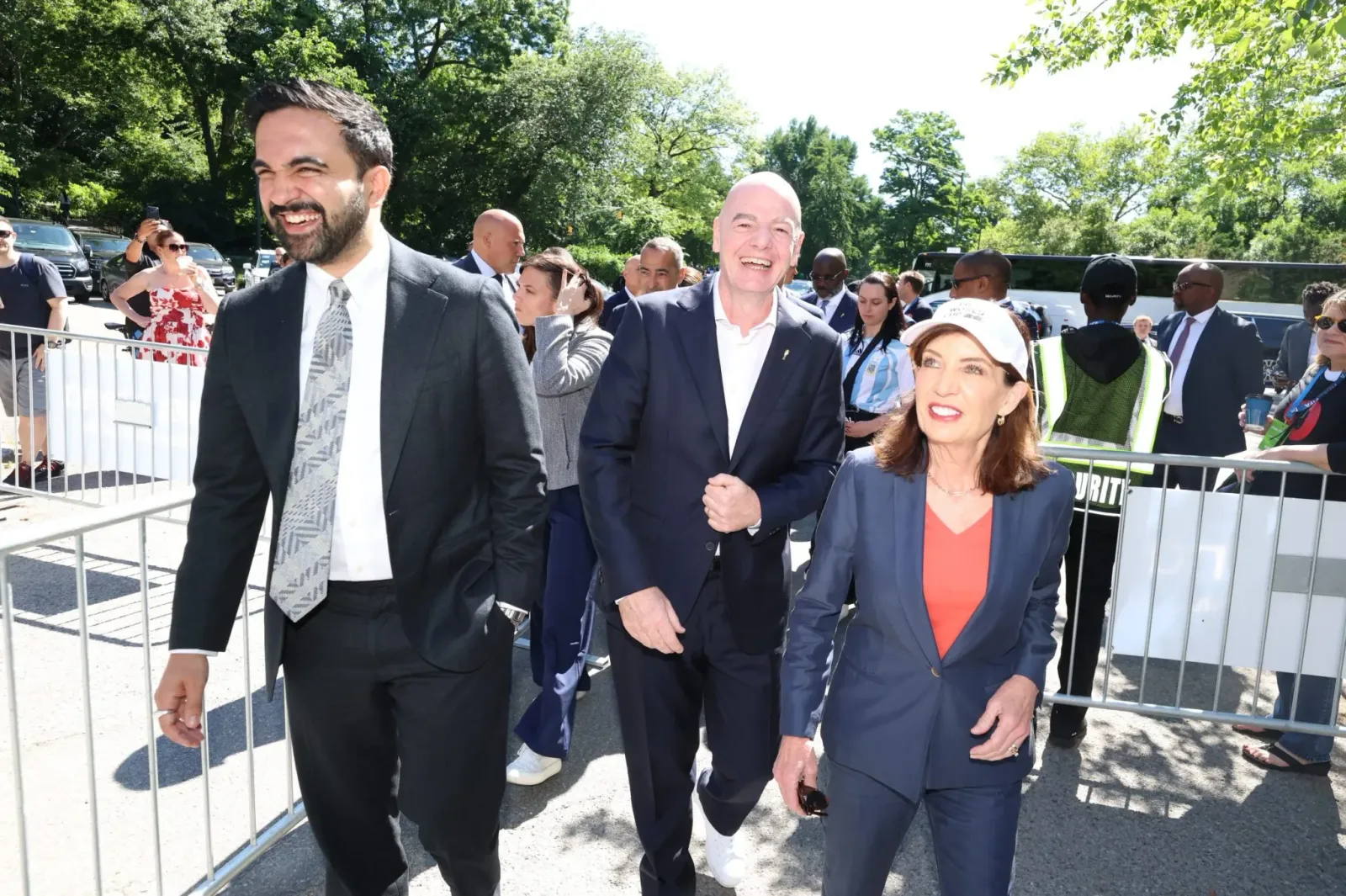
FIFA President Gianni Infantino defended World Cup pricing at the Milken conference as “market rates,” while economists say FIFA deliberately structured pricing to generate revenue at every stage through its resale marketplace and 30% combined resale fees. The resulting price escalation and platform control have triggered subpoenas by the New York and New Jersey attorneys general and raised new regulatory and reputational risks for decision-makers.
On Monday, New York Gov. Kathy Hochul and Mayor Zohran Mamdani announced a free watch party for 50,000 New Yorkers in Central Park for the World Cup final, with New York State spending $6 million so residents who cannot afford the most-watched sporting event can watch together at the Great Lawn. Standing nearby was FIFA President Gianni Infantino, whose last-month defense of World Cup ticket costs blamed “market rates” that apply in the U.S.
That “market rates” argument is now colliding with economists who say the pricing crisis was not an accident, but a design choice. Economists point to FIFA launching its own resale marketplace and collecting 30% on every ticket resold, creating incentives to extract revenue not just from original sales, but from the fan’s entire journey to a seat. The consequence, per those economists, is that governments end up paying to patch affordability gaps governments did not create, while FIFA monetizes the gap it allegedly designed.
The numbers that economists cite look like they should raise eyebrows in any industry built on customer trust. Face-value tickets for the July 19 final at MetLife Stadium reportedly started at $2,030 and ran to $6,730 for Category 1 seats, but under FIFA’s dynamic pricing model they didn’t stay there. By early May, FIFA had tripled its best available final tickets to $32,970, up from a previous high of $10,990, on the same day members of Congress pressed FIFA for transparency on pricing.
On FIFA’s own resale exchange, final tickets were listed at about $9,000. Each transaction, according to the source, generated 30% in combined fees that flow back to FIFA. For context, the most expensive seat at the final four years ago in Qatar cost roughly $1,600. Football Supporters Europe estimates that a fan following a single team from its opening match through the final would spend a minimum of $6,900 on tickets alone.
Economist Judd Kessler, a professor of business economics and public policy at the Wharton School of the University of Pennsylvania and author of Lucky by Design, frames the issue as fees that “move” rather than disappear. Kessler’s point is straightforward: when limited supply meets lots of demand, markets can produce very high prices. But when sellers price tickets below what the market would bear, he says the surplus typically doesn’t vanish. It moves into queues, bots, and resale platforms, and the total cost to a real fan can end up similar or worse, just funneled to other parties. He uses a Bruce Springsteen example in the source: if a $60 ticket gets bought by bots and resold at $4,000, that money goes to speculators, not the production.
Kessler argues FIFA’s shift this year made the incentives sharper. For most of its history, FIFA ran a more conventional version of this system with face-value tickets, price caps on resale, and resale fees of 10% or less. But this year FIFA abandoned price caps for matches in the United States and Canada. FIFA defended the decision by claiming that resale restrictions would drive sellers to third-party platforms like StubHub. In their place, FIFA launched its own official resale marketplace and charged both buyers and sellers a 15% fee, effectively collecting $30 for every $100 in resale transactions on its platform.
The optics of how revenue is taken matter, and the source makes that distinction clear. Kessler told Fortune, per the source, that FIFA may be worried about backlash from raising prices upfront. But collecting 30% on the secondary market allows FIFA to “collect without as much backlash,” because fans experience a $700 ticket feel differently than a $500 ticket plus a $200 fee collected later.
Meanwhile, other governments negotiated different consumer protections. Mexico, where ticket resale laws are stricter and the government lobbied for consumer protections, got a different deal: FIFA agreed to limit resale prices to face value for matches held there. For American fans, the source says, the arrangement is 30% fees and no cap.
The secondary-market story got even stranger in the source’s reporting. In late May, the number of tickets available on FIFA’s official portal reportedly dropped by 44,000 to under 30,000. Then the inventory reappeared on StubHub and SeatGeek at prices well below FIFA’s official site. Florian Ederer, a professor of economics at Boston University’s Questrom School of Business, reportedly noticed that seat maps contained large, contiguous blocks of seats that appeared on the secondary market. He told Newsweek that this pattern is inconsistent with ordinary fan or commercial scalper behavior, which typically produces scattered pairs and small clusters. Ederer theorized that FIFA might have been dumping inventory in bulk onto secondary markets at below-official prices to clear unsold tickets, while keeping official prices high, while avoiding refund demands and consumer-protection liability from an official price cut.
Both SeatGeek and StubHub denied any partnership or distribution agreement with FIFA. The source says FIFA has not commented publicly about these claims, and it did not respond to Fortune’s request for comment.
Regulators are taking the “design” and “delivery” angle seriously. The source says New York and New Jersey attorneys general subpoenaed FIFA in late May, framing their investigation around two tracks: alleged seat-location misrepresentation and whether FIFA’s phased release schedule was designed to artificially inflate prices. Victor Matheson, a professor of economics at the College of the Holy Cross, is quoted in the source predicting the scenario: he said he wouldn’t be surprised if FIFA tries to dump excess inventory secretly by disguising it as secondary ticket markets. His sharper warning is that seeing tickets on the secondary market does not guarantee that the seller is a true independent market participant. “Lots of venues place tickets they still have in their possession on those secondary markets,” the source reports. He adds that, in many cases, the secondary market can literally be the team in the first place.
For executives watching from adjacent industries, the second-order lesson is brutal. FIFA’s 30% fee places it in the company of platforms it once positioned itself against, with the added caveat that it controls the primary market and the rules of access. Kessler estimates that platforms take between 25 and 35% of secondary market sales, split between buyer and seller fees, which also means incentives can align for “hidden market” activity. The strategic stake is clear: when the party controlling both pricing rules and resale rails can capture value at multiple steps, regulators may see not just a pricing problem, but a market structure designed to keep value out of reach for everyone else.
This story's Key Insights and Take-aways are locked.
Create a free account to unlock Executive Actions for one credit.
Register to UnlockAlways free for Executives Club members. Join the Club
More in Business

Anthropic’s Levant Alpöge cracks the Jacobian conjecture after 87 years
A Harvard valedictorian used Claude to hit a 1939 breakthrough, but the missing “why” is the real problem.

Uber buys Delivery Hero for nearly $15B, vaulting to top food delivery outside China
The deal doubles Uber's dual-services footprint and pushes a ride-and-eats bundling play into 50 more markets.

Epic and Google drop settlement bid, forcing rival Android app stores by July 22
Google told the court it is ready to carry third-party app stores starting Wednesday, July 22.