
Fuse Games CEO Matt Webster says “rewind” steals racing consequence in Star Wars: Galactic Racer
His team built a Star Wars racer on N64 and PS2 DNA, arguing crashes should teach you, not get erased.
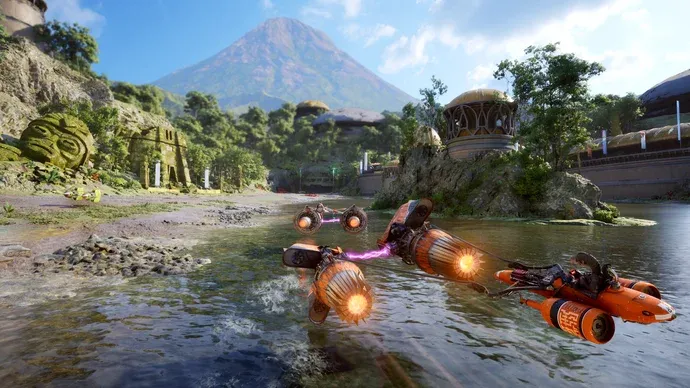
Matt Webster, founder and CEO of Fuse Games and former general manager at Criterion for Burnout and Need for Speed, says racing needs consequence that a rewind button undermines. With Star Wars: Galactic Racer, Fuse Games aims to channel “N64 and PS2 classics” into a reboot of driver learning through failure.
Matt Webster, founder and CEO of Fuse Games and former general manager at Criterion for Burnout and Need for Speed, has a simple rant that doubles as a design thesis for his studio's new project. In the Eurogamer interview, Webster argues that “Racing is crying out for a bit of consequence.” His key point is specific: “Crashing is consequence - not just the visual and the audio spectacle of it; we learn something from it.” Then he lands the punchline that explains the philosophy behind Star Wars: Galactic Racer: “It's tough to have consequence when you've got a rewind button.”
That matters because it reframes what players are actually buying when they race. If the game lets you undo mistakes instantly, crashes stop being a feedback loop and turn into a suggestion box. Webster's contention is that consequence is the mechanism that turns failure into learning, not a cinematic flourish you watch and immediately reset. Fuse Games, working on Star Wars: Galactic Racer, is leaning into that idea by building on older racing sensibilities, “on N64 and PS2 classics,” rather than chasing the modern tendency to smooth out player error.
From an operator and investor lens, this is not just a creative preference. It is a bet on how difficulty, skill expression, and player retention interact in racing games. Racing typically lives on tiny moments: the exact brake point, the line you commit to mid-corner, the decision to accept a slide or recover. When a title includes strong rewind mechanics, it can reduce the emotional cost of those micro-decisions. The result, in practice, is that players can take risk without fully paying for it, which changes how mastery is felt. Webster is basically saying: if you want players to “learn something” from crashes, you need failure to matter, at least mechanically.
The studio is explicitly framing its approach as a return to a particular era and a particular kind of game feel. Eurogamer notes that Fuse Games built Star Wars: Galactic Racer by drawing from “N64 and PS2 classics” and that the team calls the result “the purest expression of gaming.” Whether or not you care about the slogan, the direction is clear: build a racing experience that prioritizes lived-through consequences rather than correction-by-undo. For decision-makers, that implies the project is aiming at a specific player segment: people who enjoy the tension of committing to a line and improving because the game refuses to let you magically rewrite the last ten seconds.
There is also a broader industry incentive underneath the argument. Modern games compete on immediacy and polish, and designers often add quality-of-life features to reduce churn from frustration. Rewind buttons and similar systems are part of that logic. But Webster is pointing out a trade-off that developers and publishers wrestle with constantly: the more you protect players from mistakes, the less you can confidently claim that the game is teaching mastery through risk. If racing is “crying out” for consequence, then the product strategy is to differentiate on the part other titles may smooth over.
Regulatory background is not the story here in the legal sense, but the theme maps to how platforms and ratings are shaped. Difficulty knobs and failure states can influence user experience and accessibility considerations, especially on consoles and storefronts where players expect reliable controls and predictable session lengths. A design that leans harder on irreversible crash consequence can raise internal questions about fairness, onboarding, and how to keep new players from bouncing off. That is the second-order implication for boards: when a CEO frames consequence as the core of the fun, the team will also need to demonstrate it can still support onboarding and engagement across skill levels, without undermining the principle.
Second-order, this also affects content and community economics. Racing games often generate replay value through shared knowledge: the fastest line, the best braking technique, the tuning strategy. If crashes are meaningful and not simply resettable spectacle, players can become better competitors and creators faster, because the game is consistent about how mistakes translate into outcomes. That can help streaming and social proof. But it also means the game must be consistent about physics, collision behavior, and feedback. If players cannot trust that a crash means the same thing every time, consequence becomes frustration rather than learning. Webster's quote is a design philosophy statement, but it is also a QA burden with real delivery risk.
The strategic stake for peers is straightforward. Star Wars: Galactic Racer is trying to compete not just as “a racing game,” but as a racing game with a specific moral: crash, learn, improve. If Fuse Games executes that loop successfully, it signals that there is still demand for restraint in player forgiveness, even inside a franchise context where expectations are high. If it misses, the rewind versus consequence debate becomes a cautionary tale about chasing nostalgia without earning modern buy-in. Either way, Webster's message is hard to ignore: in racing, consequences are not decoration. They are the curriculum.
This story's Key Insights and Take-aways are locked.
Create a free account to unlock Executive Actions for one credit.
Register to UnlockAlways free for Executives Club members. Join the Club
More in Entertainment

Russell Brand's accuser 'bewildered and confused' as he denies 7 sex charges
The criminal case against the comedian is a live test of how media companies manage talent risk when serious allegations go public.

'It's a Magic Trick': Ballet Experts Say Rosalía's SNL Pose Is Impossible
Three ballet experts tell Rolling Stone Rosalía's gravity-defying SNL stillness shouldn't be possible - and why the debate is now part of the show.

Activision CMO: GTA 6 Will Boost Call of Duty, Not Bury It
Activision's top marketer says Rockstar's blockbuster will drive players back to consoles and into Modern Warfare 4, even as the company admits its recent strategy failed.