
Gemini 3.5 Flash adds screen control, and Google folds it into one agentic tool
Google built computer use into Gemini 3.5 Flash, removing the need for a separate model and pushing enterprises to decide fast.
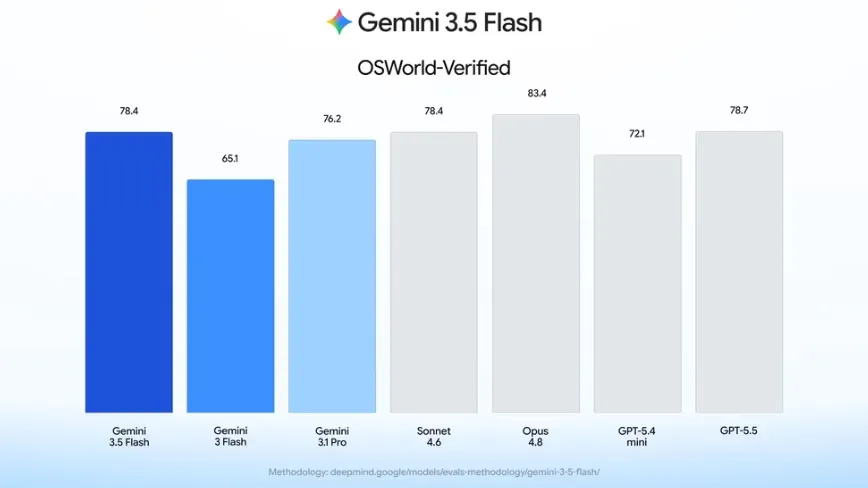
Google has added a built-in computer use tool to Gemini 3.5 Flash, the agentic AI model it launched at I/O 2026 as its fastest. The change lets agents see screens and take actions like clicking, typing, and scrolling across browsers, mobile devices, and desktops.
Google just made “AI that uses your computer” less of a Frankenstack and more of a built-in feature. With Gemini 3.5 Flash, its fastest agentic AI model launched at I/O 2026, Google has added computer use directly into the model via a tool that enables agents to see screens and control them. That means an AI can click, type, and scroll across multiple environments, including browsers, mobile devices, and desktops.
The big practical shift is also the enterprise shift. Previously, this screen-seeing-and-clicking capability required a separate standalone model. Now, Google says it is available as part of Gemini 3.5 Flash itself. In other words, what used to be an extra component in the stack becomes native, which changes how teams plan deployments, vendor approvals, and model governance.
To understand why this matters to decision-makers, zoom out to what “agentic” really means operationally. Most AI systems can generate text or code. Agentic systems try to execute tasks. Execution, in turn, means interacting with real interfaces: forms, navigation flows, dashboards, logins, and the messy reality of websites and apps that were not designed for machine autonomy. A tool that can see what is on the screen and then drive the UI is a jump in capability because it bridges the gap between “recommendation” and “completion.”
This is exactly where the product architecture choice hits the boardroom. A standalone model for computer use meant procurement and integration complexity: separate endpoints, separate monitoring, separate risk review, separate potentially separate data flows. Folding the functionality into Gemini 3.5 Flash reduces the number of moving parts. Fewer parts can mean fewer failure modes, faster iteration, and simpler compliance narratives, at least on the surface. But it also concentrates responsibility: if the same model family is now responsible for both reasoning and the act of interacting with users' environments, enterprise teams may scrutinize logs, permissions, and safeguards more tightly.
There is also a signal embedded in the “fastest” framing. Google introduced Gemini 3.5 Flash at I/O 2026 as its fastest agentic AI model, and now it is expanding the range of what that speed can do. Speed is not just a performance metric in agentic systems. When an AI can see and control a screen, latency and responsiveness affect whether workflows feel reliable or brittle. Faster agents can iterate through UI states more quickly, which makes automation more useful for time-sensitive processes like triage, research, and operations support.
For enterprises, the question is not whether the capability exists, it is how it will be trusted in real environments. The Next Web story notes that Google wants enterprises to trust it. Trust, in this context, typically means answers to operational questions: What happens if the agent clicks the wrong thing? How are actions audited? How does the system handle sensitive data displayed on screen? How do teams prevent the model from attempting actions outside the intended scope? Even if Google is integrating the capability, governance does not magically disappear. It shifts from managing a separate model to managing a model-tool combo that can take direct actions across web and mobile contexts.
Second-order effects show up in how teams design workflows and controls. When computer use is a built-in tool inside the model, product teams may be more likely to route more business processes through the agent because deployment is simpler. That can increase automation quickly, but it can also increase the blast radius if guardrails are thin. Boards and risk committees may respond by requiring clearer control boundaries, stronger access restrictions, and more granular approval layers for the actions agents are allowed to perform.
Peers building or buying agentic AI systems should also notice the competitive implication. The architecture trend is moving toward “capability bundles” where models come with integrated tools, not separate add-ons. The enterprise winner will not just be the model with the best outputs. It will be the system that is easiest to govern while still delivering measurable task completion. By making screen control part of Gemini 3.5 Flash, Google is pushing the market toward a future where agentic automation feels less like a research demo and more like an operational feature.
In short: Gemini 3.5 Flash can now see and control your screen, and Google is betting that integration will accelerate enterprise adoption. For leaders, the strategic stake is clear. If you are evaluating agentic AI, you are not just comparing model quality anymore. You are comparing deployment simplicity, governance burden, and how quickly your organization can safely scale agents from “help” to “do.”
This story's Key Insights and Take-aways are locked.
Create a free account to unlock Executive Actions for one credit.
Register to UnlockAlways free for Executives Club members. Join the Club
More in Technology

Nvidia's $89B data center quarter: the 9 companies cashing in
The AI buildout is minting fortunes beyond GPUs, and memory, cloud, and cooling suppliers are riding the same wave.

Google quietly links your phone number to every Android account on your SIM
Adding a SIM now ties your phone number to all Google accounts - and future accounts inherit it. Here's the security and privacy stakes.

Hijacker AI 'Skynet mode' runs 100,000 attack steps against exposed models
Symantec caught a criminal AI agent that borrows other models, steals data, and mines crypto; the only relief is no confirmed victims yet.