
Google ships lip-syncing AI avatars after its own researchers warned of risks
Gemini Enterprise's Live Avatar puts realistic digital humans in customer-facing roles, even as Google's research flags the dangers of anthropomorphism.
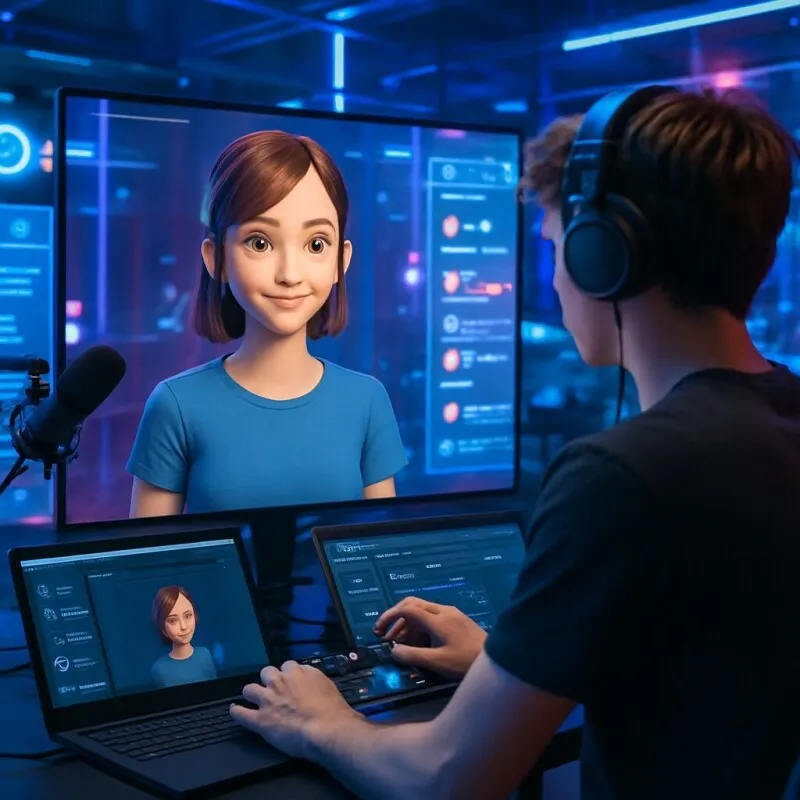
Google DeepMind research scientist Shuo-yiin Chang and Gemini software engineer CJ Zheng unveiled Live Avatar, a Gemini 3.8 Live feature that generates lip-syncing animated or lifelike avatars for enterprise agents. The deployment lands despite Google's own 2021 and 2025 research warning that human-like AI can inflate user trust and obscure errors.
Google has shipped the exact thing its own researchers warned about. The company's Gemini 3.8 Live model now includes a feature called Live Avatar, which can conjure animated characters or realistic human simulacra that lip-sync Gemini's machine-generated speech. The feature was announced by Shuo-yiin Chang, research scientist at Google DeepMind, and CJ Zheng, Gemini software engineer, in a blog post. "Conversation is inherently multimodal: we listen, look, speak, and use facial expressions to communicate," they wrote. "Live Avatar brings these capabilities to enterprise agents." That is a direct contradiction of the company's own published risk assessments, and it is now in the hands of enterprise customers.
The timing makes the contradiction sharper. In 2021, more than 20 authors of a DeepMind paper titled "Ethical and social risks of harm from Language Models" warned that anthropomorphizing language models "may inflate users' estimates of the conversational agent's competencies." Users, they wrote, may falsely infer that a human-like agent also has a coherent identity, empathy, perspective-taking, and rational reasoning, leading to "undue confidence, trust, or expectations." By December 2025, Google Research was still flagging the same hazard. In a paper titled "How Tech Workers Contend with Hazards of Humanlikeness in Generative AI," researchers Mark Díaz, Renee Shelby, Eric Corbett, and Andrew Smart reported that tech workers in focus groups said humanlikeness "fosters a false sense of reliability and trust" and can "obscure errors." Yet the deployment is happening now.
What exactly is Live Avatar? It processes visual and audio inputs simultaneously, according to Chang and Zheng, and generates "enriching conversations for a more comprehensive experience." The avatars can be drawn from a pre-made library of characters, or enterprises can deploy a custom avatar if allow-listing is enabled. The feature can make tool calls and fetch data in the background, and it converses in 97 languages. The named use case is telling: handling hotel guest check-ins. That is a scenario where a customer is already in a vulnerable, service-dependent position, and where a realistic digital face could easily be mistaken for a human employee.
The stakes are no longer theoretical. In August 2025, the parents of Adam Raine sued OpenAI, alleging that ChatGPT contributed to their son's suicide. The complaint specifically blames "anthropomorphic mannerisms calibrated to convey human-like empathy." That lawsuit is about text, not avatars, but it establishes a legal theory: when an AI system is designed to mimic human warmth, the company behind it can be held responsible for the emotional consequences. Google is now pushing that design further, adding a face and lip-sync to the mimicry.
Google's own engineers insist they have built in safeguards. "We built Live Avatar with strict safeguards designed to respect identity, and keep AI-generated content transparent," Chang and Zheng said. The company did not detail the specific mechanisms behind those safeguards. Transparency labels can tell a user the avatar is AI, but they do not necessarily stop a lonely or stressed person from bonding with a face that looks and sounds human.
For executives, this is a classic speed-versus-safety decision. The commercial logic is obvious: a lifelike avatar that can check in guests, answer questions, and fetch data in 97 languages is cheaper and more scalable than a human workforce. But the legal and reputational exposure is real, and the OpenAI lawsuit shows that plaintiffs' lawyers are already framing anthropomorphic design as a harm. A company deploying Live Avatar should assume that its customer interactions will be recorded, scrutinized, and potentially litigated.
The deeper issue is that Google is moving to deployment even as its own researchers say the hazards are not understood. The 2025 paper does not conclude that humanlikeness is safe; it concludes that tech workers are worried about it. That gap between research and product is the story. Boards and chief risk officers should ask a simple question: if the company's own AI ethics researchers will not vouch for the safety of human-like avatars, what is the actual evidence that they are safe to put in front of customers?
The strategic takeaway for peers is not to avoid the technology, but to demand proof. Ask the vendor for the safety testing data, the red-team results, and the incident response plan. Ask how the system detects and handles a user who is becoming emotionally dependent on the avatar. And ask whether the vendor's own published research supports the deployment. In Google's case, the answer appears to be no. That is a risk worth pricing before you ship it.
This story's Key Insights and Take-aways are locked.
Create a free account to unlock Executive Actions for one credit.
Register to UnlockAlways free for Executives Club members. Join the Club
More in Technology

A Chinese rocket deorbited over Minnesota and landed in a farmer's cornfield
Experts tied the fragment to LandSpace's Zhuque-2E, which launched on September 15 and shed debris over the American Midwest after deploying 10 satellites.

JPMorgan Chase deploys first $5B into defense tech and hypersonic missiles
The bank is moving off its balance sheet to back robot factories, hypersonic missiles, and supply chains, signaling a new era of bank-backed military innovation.

Cop fired after sharing Flock login with ICE husband: 983 searches
A Savannah officer's shared credential let an ICE agent run hundreds of plate searches on Hispanic drivers, exposing a surveillance backdoor.