
Hall and Woodford win Nobel economics prize for crisis-smoothing models
Stanford's Robert Hall and Columbia's Michael Woodford built the microeconomic foundations that help central banks avoid long recessions and runaway inflation.
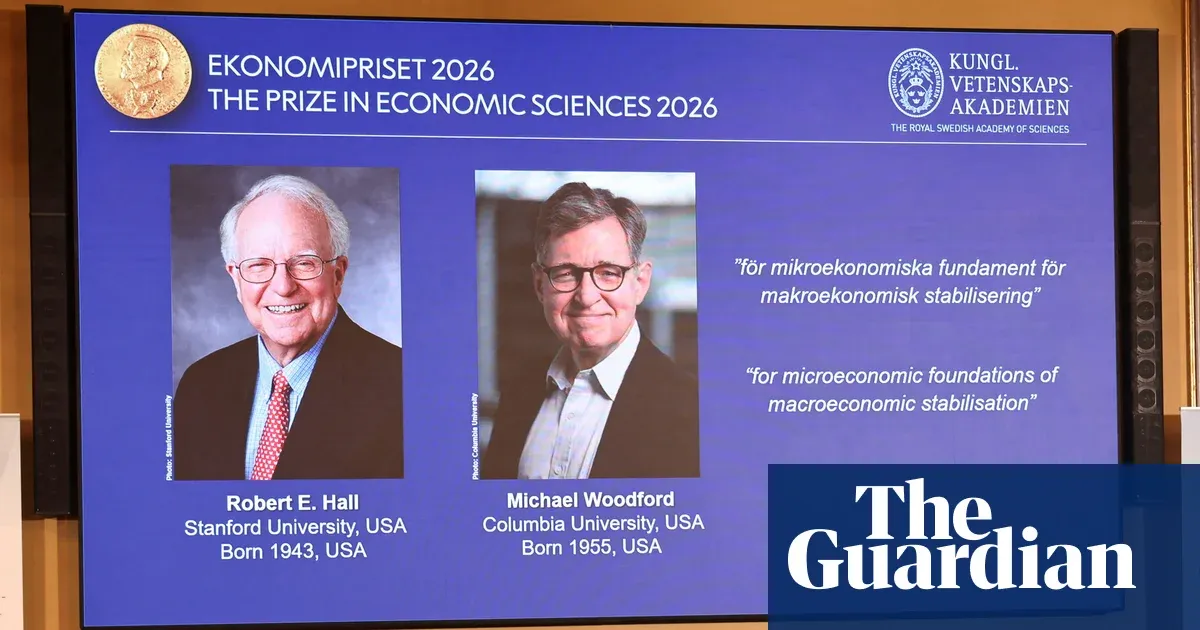
Robert Hall of Stanford University and Michael Woodford of Columbia University won the 2026 Nobel economics prize for developing the microeconomic foundations of macroeconomic stabilisation. Their models give central bankers and finance ministers tools to smooth economic peaks and troughs, reducing the severity of recessions and inflation.
The 2026 Nobel economics prize has gone to Robert Hall of Stanford University and Michael Woodford of Columbia University for developing the microeconomic foundations of macroeconomic stabilisation. The Royal Swedish Academy of Sciences recognized their work building models that help central bankers and finance ministers smooth out the peaks and troughs of their economies, avoiding long recessions and runaway inflation. The award puts a spotlight on the intellectual framework that underpins modern monetary policy, and it arrives at a moment when central banks are still wrestling with the aftermath of the fastest inflation surge in a generation.
Hall and Woodford's models treat the economy not as a single aggregate machine but as the sum of millions of individual decisions by households and firms, then trace how those decisions interact with interest rates, wages, and prices. That micro-to-macro bridge is what allows policymakers to anticipate how an economy will respond to a rate hike or a fiscal stimulus. For context, Hall's research has long been associated with consumption behavior, while Woodford is widely credited with formalizing the New Keynesian framework that now anchors the models used by the Federal Reserve, the European Central Bank, and the Bank of England. Their work gave policymakers a rigorous account of how expectations form, replacing the looser heuristics that guided earlier decades.
The practical payoff is visible in how central banks responded to the 2008 financial crisis and the Covid-19 pandemic. Rather than relying on intuition, policymakers could run simulations showing how lower interest rates would ripple through household spending, business investment, and inflation expectations. The models are not perfect - they failed to predict the 2008 crash - but they give officials a shared language and a systematic way to test policy before committing trillions of dollars. That is why the Nobel committee's citation matters beyond academic circles: it is an endorsement of the very tools that have shaped every major monetary decision of the past two decades.
The prize also carries a message for today's inflation fight. After a decade of low inflation, central banks were caught off guard by the post-pandemic price surge. Hall and Woodford's emphasis on expectations suggests that credibility matters as much as any single rate move. If households and firms believe inflation will return to target, they will adjust their behavior accordingly, making the central bank's job easier. That is why the Federal Reserve and its peers talk so much about forward guidance - a tool that flows directly from the microfoundations work the Nobel committee just honored. For finance ministers, the models offer a framework for fiscal policy as a stabilizer. Hall's work on consumption implies that temporary tax rebates may be saved rather than spent if households expect future taxes to rise, a finding that has shaped debates over stimulus checks and automatic stabilizers.
The award is also a reminder of how academic economics shapes the real economy. The models Hall and Woodford built are not abstract exercises; they are embedded in the software and spreadsheets of every major central bank. When the Federal Reserve raises rates by 25 basis points, the decision is informed by a framework that traces its lineage to their work. That gives the prize a practical edge that some Nobel awards lack. For executives and investors, the takeaway is straightforward: the next time a central bank signals a rate path or a government announces a fiscal package, the underlying logic comes from these models. Understanding the microfoundations - how households and firms respond to policy - is a competitive advantage. It helps CFOs decide when to refinance debt, when to hold cash, and how to price products in an environment where inflation expectations are the real anchor.
Hall and Woodford's win is a quiet one, but its consequences are loud. Every recession avoided, every inflation spiral contained, is a testament to the idea that good policy is built on a rigorous understanding of how people actually behave. For the rest of us, the prize is a reminder that economics is not just a spectator sport - it is the operating system of the modern economy. The models may not be perfect, but they are the best map we have for navigating the peaks and troughs that define the business cycle.
This story's Key Insights and Take-aways are locked.
Create a free account to unlock Executive Actions for one credit.
Register to UnlockAlways free for Executives Club members. Join the Club
More in Business

Elon Musk unveils a flying car, and SpaceX helped build it
The Tesla CEO's showcase at a SpaceX facility signals a future where road and rocket engineering converge.

Apple's $2,000 iPhone Duo opens preorders, taking on Samsung and Google
Apple's first foldable hits the market at a premium price, reshaping a category Samsung and Google have led.

Pope Leo XIV, first American pope, diagnosed with lung cancer
The 71-year-old Chicago-born pontiff underwent successful surgery on his right lung, and his diagnosis raises new questions about his AI-focused papacy and the Vatican's future.