
Huang rules out Nvidia backstop as CoreWeave default odds hit 60%
Nvidia's CEO says the AI cloud giant can stand alone, but credit markets just priced a record chance it won't.
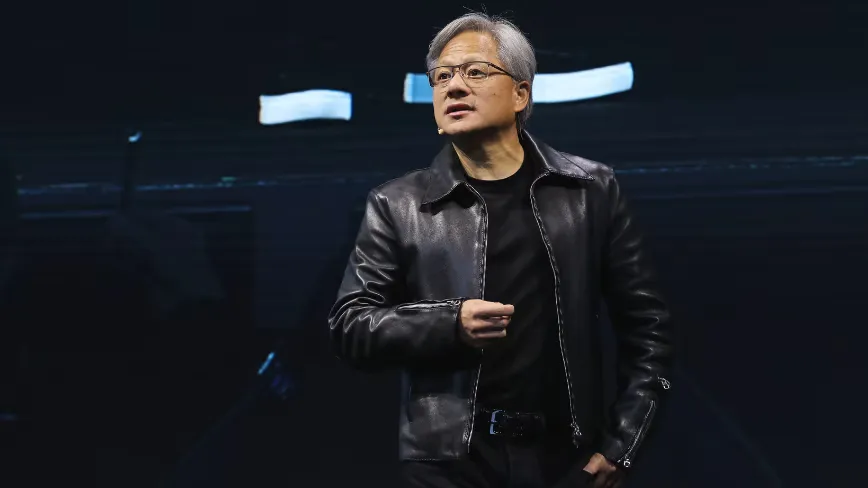
Nvidia CEO Jensen Huang told Bloomberg in Stockholm that CoreWeave's cost of capital is falling and that Nvidia will not backstop the AI cloud provider. The same day, CoreWeave's five-year credit default swaps hit a record 1,194.5 basis points, pricing a more than 60% chance of default within five years and signaling that bond traders disagree with Huang's confidence.
Jensen Huang, Nvidia's CEO, told Bloomberg in Stockholm that CoreWeave's cost of capital is decreasing and that Nvidia does not need to backstop the AI cloud provider. The market disagrees, loudly. On the same day, CoreWeave's five-year credit default swaps hit a record 1,194.5 basis points, a level that prices in a more than 60% chance of default within five years.
For the uninitiated, a credit default swap is essentially insurance on a company's debt. At 1,194.5 basis points, protecting $10 million of CoreWeave bonds for five years costs roughly $1.19 million per year, a price that screams distress. The gap between Huang's confidence and the CDS market is the real story: the CEO of the company that is both CoreWeave's biggest supplier and a major investor says the AI cloud firm can stand on its own, while bond traders are pricing it like a company that might not make it.
CoreWeave is one of the most aggressive players in the AI infrastructure gold rush. It builds and operates data centers packed with Nvidia GPUs, then rents that compute to AI companies. The model requires enormous upfront capital, billions in debt raised to build facilities before the revenue arrives. That leverage is why credit markets watch it so closely, and why the CDS spike matters well beyond one company. CoreWeave went public in March 2025, but its balance sheet still carries the scars of a debt-fueled expansion. The company's pitch to investors has always been that AI compute demand is so strong that the debt will be repaid from future contracts. That bet is now being tested in public markets.
Nvidia's relationship with CoreWeave is unusually entangled. Nvidia has invested in the company, and CoreWeave is one of the largest buyers of Nvidia's chips. That creates a circular dependency: CoreWeave borrows money to buy Nvidia GPUs, Nvidia books the revenue, and the AI cloud provider pays down debt with contracts from AI startups. If CoreWeave's customers slow their spending or its debt costs climb, the whole loop tightens. Huang's comments in Stockholm appear designed to draw a line. By saying Nvidia does not need to backstop CoreWeave, he is signaling that Nvidia will not be the lender of last resort if the cloud provider stumbles.
His claim that CoreWeave's cost of capital is decreasing runs directly against the CDS data, which shows the opposite: the borrowing costs implied by the market are at record highs. For context, a CDS spread above 1,000 basis points is rare for a public company; it is the kind of level usually reserved for distressed credits in restructuring talks. This tension sits inside a broader debate about the AI buildout. Hyperscalers and AI startups have been spending at historic levels on compute, and CoreWeave is one of the purest plays on that spending. But when a key player's credit markets flash red, it feeds the narrative that some of the AI infrastructure boom is financed by debt that may not be repaid.
For executives across tech, the CoreWeave situation is a live case study in how quickly confidence can diverge from market pricing. The lesson is about concentration risk. CoreWeave's model depends on a single dominant supplier, Nvidia, and a customer base that is itself dependent on venture funding. Any company with similar dynamics, heavy capex, one key supplier, or customers with uncertain funding, should read the CDS move as a warning about how the market prices leverage when sentiment turns.
The immediate question is whether CoreWeave's cost of capital actually improves, as Huang claims, or whether the CDS market is right. If the swaps stay elevated, CoreWeave's next debt raise will be expensive, and that cost eventually flows through to the price of AI compute. For now, the record CDS level is the most honest signal available: the market is not buying the reassurance. The next few quarters will show whether Huang's confidence was foresight or wishful thinking, and whether Nvidia's biggest AI cloud customer can survive the math of its own leverage.
This story's Key Insights and Take-aways are locked.
Create a free account to unlock Executive Actions for one credit.
Register to UnlockAlways free for Executives Club members. Join the Club
More in Business

Elon Musk unveils a flying car, and SpaceX helped build it
The Tesla CEO's showcase at a SpaceX facility signals a future where road and rocket engineering converge.

Apple's $2,000 iPhone Duo opens preorders, taking on Samsung and Google
Apple's first foldable hits the market at a premium price, reshaping a category Samsung and Google have led.

Pope Leo XIV, first American pope, diagnosed with lung cancer
The 71-year-old Chicago-born pontiff underwent successful surgery on his right lung, and his diagnosis raises new questions about his AI-focused papacy and the Vatican's future.