
Hubble and Webb uncover oMEGACat BH-2, Omega Centauri’s first stellar-mass black hole
A 20-plus-year Hubble stare plus Webb data finally finds a black hole system long hiding in plain sight.
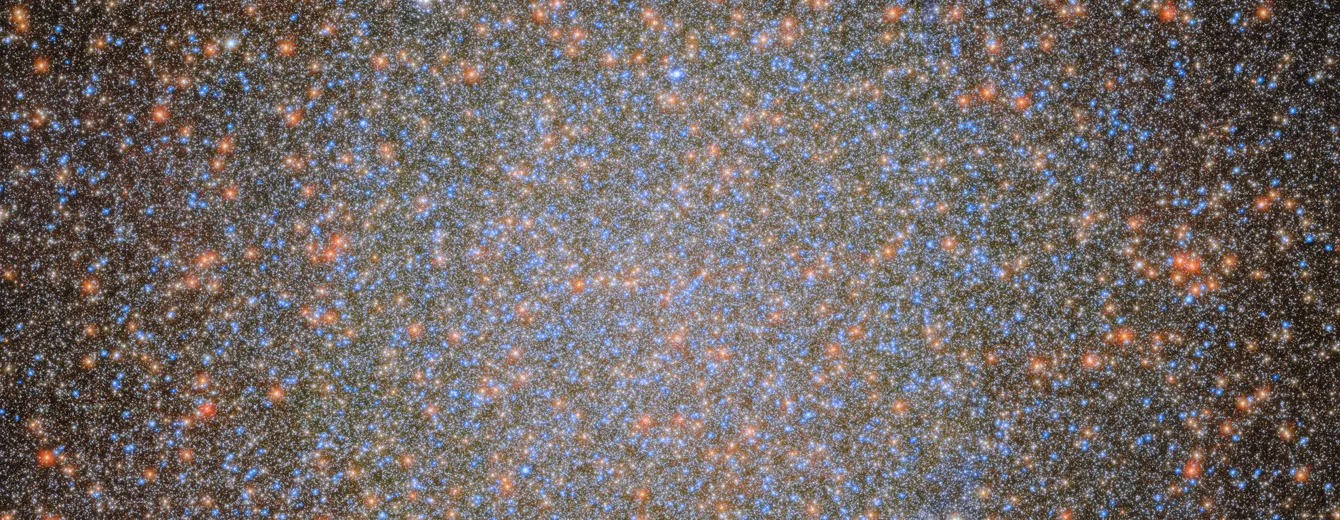
NASA’s Hubble Space Telescope archival data, combined with supportive observations from NASA’s James Webb Space Telescope, led astronomers to detect the first stellar-mass black hole in the globular cluster Omega Centauri. The find refines black hole formation models and improves how researchers interpret future gravitational wave events.
Omega Centauri has puzzled astronomers for decades. With about 10 million gravitationally bound stars, the cluster “should be filled” with black holes left behind by exploding stars, but the evidence was scarce. Now, using archival data from NASA’s Hubble Space Telescope and supportive observations from NASA’s James Webb Space Telescope, astronomers have located their first stellar-mass black hole in the cluster: oMEGACat BH-2.
The stakes in this discovery are bigger than a single dot of light, because the search has been repeatedly “missing the population.” Models suggested Omega Centauri should contain about 10,000 smaller, stellar-mass black holes, yet earlier observational studies evaded them. This new detection changes the game by using astrometry, which tracks very small movements of stars over time. The team sifted through more than 20 years of Hubble archival data and added recent Webb data to refine the measurements enough to spot a star orbiting an invisible object so massive it has to be a black hole.
What makes oMEGACat BH-2 especially important is what it does to expectations. The discovery found a black hole with a lower-than-expected mass. Its visible star companion makes the black hole-star duo the longest orbital period of any known black hole binary system, with the visible star orbiting oMEGACat BH-2 once every 94 years. The system is about 18,000 light-years away, and it sits in the dense environment of Omega Centauri.
Astrophysically, the timing and precision are everything. According to the lead author Matthew Whitaker of the University of Utah, Salt Lake City, the team could see the motion of the visible main sequence star that is part of this binary using the Hubble and Webb dataset. He emphasized that the precision is “down to a fraction of a pixel” on Hubble and Webb’s detectors, and that the detection “would not have been possible” without both telescopes. That is a striking reminder for anyone who builds systems for complex measurement: you rarely win with one sensor. You win by stacking time, resolution, and methodology.
The discovery also resolves a specific earlier uncertainty. The team’s findings published Monday in The Astrophysical Journal Letters refine a past study by a different group of scientists that suggested this binary system included a neutron star. Here, the University of Utah-led team expanded Hubble data from the earlier investigation by using archival Hubble astrometric measurements from 2002 to 2023 and pulling in Webb near-infrared data to improve precision. They already knew the star’s mass was 0.78 solar masses. Now they calculated the black hole’s mass as 4.46 solar masses, which is too heavy to be a neutron star.
But the “too heavy” result still raises a bigger puzzle. The source says the black hole’s mass is much lower than expected in a metal-poor environment like Omega Centauri. That is both surprising and exciting, because it implies metal-poor stars can form black holes like this, and researchers now need to figure out how that happens. Anil Seth of the University of Utah, a coauthor, connected it to modeling: understanding black hole formation and then dynamically forming binaries is vital because it affects the ability to interpret and understand gravitational wave events. In other words, this is not just an astronomy win. It is an input into the assumptions behind how gravitational wave signals get translated into what the universe is doing.
There is also a “how did it get there” angle. Based on the precise data from Hubble and Webb, the team could chart the star’s path over 20-plus years and determine what the system’s orbit looks like, including its closest approach when it moved the fastest across the sky. The researchers say the long orbital period offers a clue about origin: it was probably dynamically formed. That means the star and black hole companion likely did not start out as a pair; instead, they found each other in the cluster. The team also estimated that a system like oMEGACat BH-2 will survive for less than a billion years before it is torn apart by encounters with nearby stars, which is much shorter than the cluster’s age (approximately 12 billion years old). If you are thinking in terms of decision timelines, this is the cosmic version of a short runway. Long-lived clusters can still host transient pairs.
For executives and board-level thinkers, the second-order lesson is about measurement strategy and roadmap discipline. This detection was enabled by a specific combo: Hubble’s long time baseline plus Webb’s data to improve precision, and a method shift from radial velocity and radio or X-ray emission searches to astrometry. The “evaded population” story is also a risk management story. If you rely on the wrong detection pathway, you can be confidently blind. The source points to what comes next: the team says they can continue to look at Omega Centauri and expand the search for similar systems in other clusters using Hubble and Webb.
They are also excited for the Nancy Grace Roman Space Telescope, expected to launch, because it will image the crowded galactic bulge, including the galactic center, very regularly with Hubble-like resolution and a much wider field of view. The hope is that Roman’s regular cadence will help find black hole binary systems like this one because it can observe crowded regions repeatedly. For leaders tracking scientific programs, that is a governance signal: future capability is less about one breakthrough instrument and more about how often you can observe, how wide your view is, and how efficiently you can turn repeated data into detection and classification.
Finally, this discovery sits within a long institutional engine. The Hubble Space Telescope has been operating for over three decades and continues to make ground-breaking discoveries. Hubble is a project of international cooperation between NASA and ESA (European Space Agency). NASA’s Goddard Space Flight Center in Greenbelt, Maryland, manages the telescope and mission operations. Lockheed Martin Space, based in Denver, supports mission operations at Goddard. The Space Telescope Science Institute in Baltimore, which is operated by the Association of Universities for Research in Astronomy, conducts Hubble science operations for NASA. That partnership architecture matters, because it is exactly what allows 20-plus-year archives to remain useful, not obsolete.
So the strategic stake is simple: if black hole populations in globular clusters were “missing” because of detection limits, that means our models and our gravitational wave interpretations may have been working with incomplete inputs. With oMEGACat BH-2 now identified as Omega Centauri’s first stellar-mass black hole, astronomers have one more anchor point for theory. And for anyone in a decision role where measurement and modeling drive outcomes, that is the kind of data that changes the next plan.
This story's Key Insights and Take-aways are locked.
Create a free account to unlock Executive Actions for one credit.
Register to UnlockAlways free for Executives Club members. Join the Club
More in Science

Alaska's 1,580-foot tsunami had warning signs. Scientists just found them.
Rapid glacier retreat, heavy rainfall, and thousands of tiny tremors preceded Alaska's 1,580-foot tsunami, a warning for every coastal community in a warming world.

The rare mutation that lets high-risk brains dodge Alzheimer's
Scientists found a natural defense against protein buildup, opening a new path to preventive treatments.

3,000 steps a day may halve Alzheimer's decline, study finds
New research links a modest daily walk to less tau buildup and nearly half the cognitive and functional decline, even for those with early signs.