
Hubble finds ionizing photons from galaxy MXDFz4.4, 250 million years after reionization
An “impossible” early-universe signal suggests some galaxies cleared hydrogen fog much faster than models assumed.
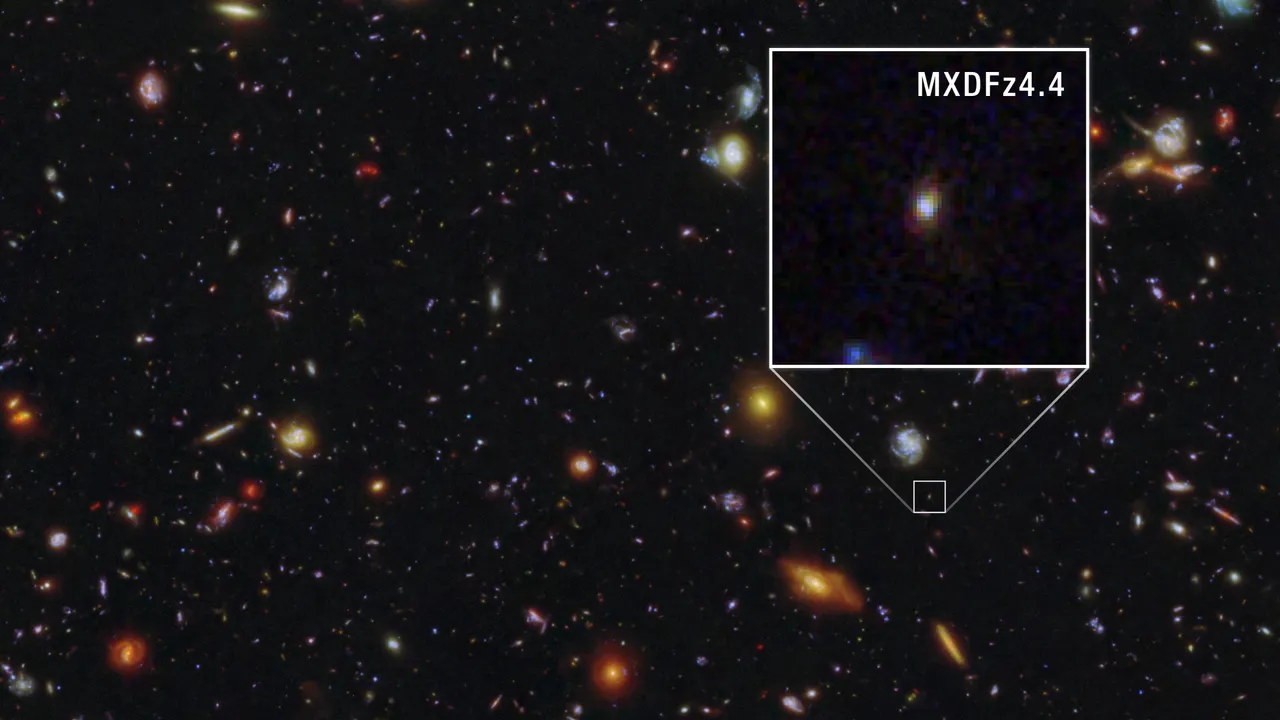
Researchers using NASA's Hubble Space Telescope, plus data from the James Webb Space Telescope (JWST) and the European Southern Observatory's Very Large Telescope (VLT), detected ionizing ultraviolet photons from the faraway galaxy MXDFz4.4. The team reports the result in a study published June 23 in The Astrophysical Journal.
Astronomers have detected ionizing ultraviolet photons coming from the faraway galaxy MXDFz4.4, and the timing is the part that makes astrophysicists sit up. The signal arrives only around 250 million years after the end of the Epoch of Reionization, when the universe is expected to have still been full of neutral hydrogen “fog.” Researchers say this is the earliest such detection on record, and they argue it helps explain how the cosmos went from opaque to transparent billions of years ago.
The detection matters because space was not always transparent to the kind of light MXDFz4.4 emits. For hundreds of millions of years after the Big Bang, the intergalactic medium was filled with neutral hydrogen gas that blocked ionizing ultraviolet photons, the energetic light capable of stripping electrons from hydrogen atoms. Over time, radiation from the first stars and galaxies ionized that gas, clearing the fog and letting light travel freely. In the researchers' words, the core observation was “thought to be impossible.”
In a June 23 paper in The Astrophysical Journal, the team describes how they spotted this early leakage using an unusually stacked observational lineup. They relied on a very deep Hubble image taken from 40 hours of observations. They then used JWST imaging across many wavelengths to characterize the galaxy's stars and star-formation history. Finally, they used the VLT's Multi-Unit Spectroscopic Explorer instrument to obtain one of the deepest spectra ever taken of a single patch of sky, gathered over roughly six days. That spectrum confirmed the galaxy's distance using its Lyman-alpha emission line, which acts like a “hydrogen fingerprint,” a glow given off by excited hydrogen gas that astronomers use to measure cosmic distance and time.
Now for the “how could it get through?” part. What makes MXDFz4.4 unusual is not just that it is far away, but the combination of size and star-formation rate. The galaxy is roughly 100 times smaller by area than the Milky Way, yet it forms stars around 10 times faster. In plain terms: it packs a lot of young, massive stars into a very compact space. According to Ilias Goovaerts, a postdoctoral fellow at the Space Telescope Science Institute (STScI) in Baltimore and first author of the study, that crowding effect may help the galaxy “punch clear channels” through surrounding gas. If those channels form, ionizing light can escape both the galaxy and, eventually, the murky space between galaxies.
The researchers estimate that somewhere between half and all of the galaxy's ionizing light is escaping. And this is where “earliest” becomes more than a trivia label. No other galaxy from this early period had previously shown detectable ionizing light, making MXDFz4.4 “one of a kind so far,” according to co-author Marc Rafelski, deputy mission head for the Hubble Space Telescope at STScI, in the study statement. For teams trying to explain when and how quickly reionization happened, a lone, verified signal is a starting gun, not the whole war. But it is a big deal because it suggests at least some galaxies were efficient at clearing a path for ionizing photons much earlier than expected.
There is also a human and process angle that should interest anyone running high-stakes research or product-like pipelines. The discovery, made in October, came about somewhat by chance. Goovaerts was preparing an unrelated funding proposal just days before a major deadline. During that scramble, he examined an existing, deep Hubble image to check whether anyone had looked for this kind of signal there before. Within a couple of hours, he had a promising signal. “We were excited from day one,” he said, but then it took months to mature the result and extract all the properties about the galaxy. In other words: a quick spark, a long grind, and then a payoff that changes the storyline.
The broader second-order implication is that vigorous star formation bursts like MXDFz4.4's may have played an important role in clearing the early universe's hydrogen fog. More galaxies like it may still be waiting to be found, the team suggests. For decision-makers in adjacent fields, the translation is simple: models of opacity and transparency over cosmic time are only as good as the observational constraints that feed them. Add one early, high-confidence datapoint from a “blocked” era, and you force a rethink of the timeline and mechanisms. That is the real stakes here. When the universe surprises you, the funding, the instrumentation priorities, and the scientific roadmaps tend to follow.
For executives and investors watching the edge of science and tech, this is a reminder that observational astronomy has become a high-velocity, multi-instrument system. Hubble provides the deep baseline; JWST adds multi-wavelength context; VLT spectroscopy anchors the distance with a hydrogen fingerprint. When those pieces snap together to produce something that was previously “thought to be impossible,” it is not just a cool discovery. It is a new constraint on how the earliest cosmic lights were able to travel, and that can reshape what comes next for the people trying to understand how our universe became transparent.
This story's Key Insights and Take-aways are locked.
Create a free account to unlock Executive Actions for one credit.
Register to UnlockAlways free for Executives Club members. Join the Club
More in Science

Alaska's 1,580-foot tsunami had warning signs. Scientists just found them.
Rapid glacier retreat, heavy rainfall, and thousands of tiny tremors preceded Alaska's 1,580-foot tsunami, a warning for every coastal community in a warming world.

The rare mutation that lets high-risk brains dodge Alzheimer's
Scientists found a natural defense against protein buildup, opening a new path to preventive treatments.

3,000 steps a day may halve Alzheimer's decline, study finds
New research links a modest daily walk to less tau buildup and nearly half the cognitive and functional decline, even for those with early signs.