

Humanoid raises $152M Series A, valuation tops $1B as Bosch gears up to manufacture
A London robotics startup just banked $152 million, and industrial partners like Bosch are lining up to scale hardware manufacturing.
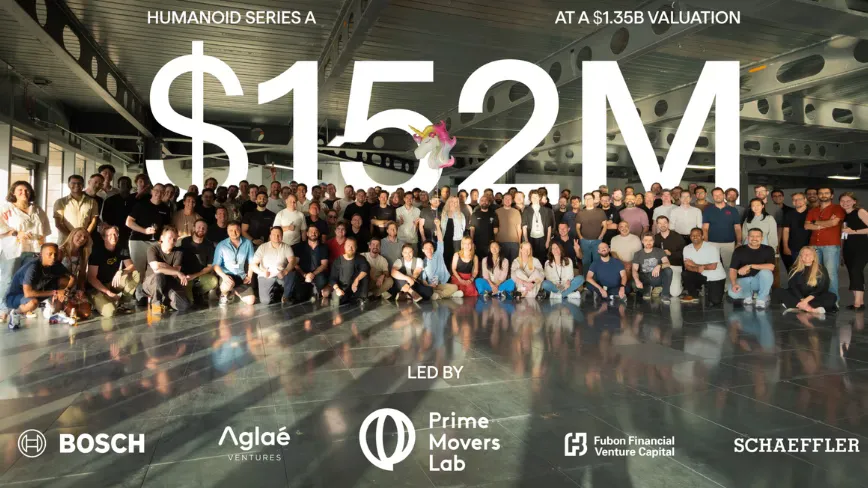
London-based robotics startup Humanoid raised a $152 million Series A led by Prime Movers Lab. The round, including Bosch and other strategic investors, pushes Humanoid's valuation above $1 billion and signals an acceleration in wheeled robot manufacturing.
Humanoid, a London-based robotics startup, just raised $152 million in a Series A led by Prime Movers Lab. The deal also pushes Humanoid's valuation above $1 billion. That valuation jump is not just celebration music for investors. In robotics, it is a statement that someone believes the hard part is moving from prototypes toward repeatable, scalable production.
The list of participants matters as much as the check size. Bosch will manufacture Humanoid's wheeled robots at scale, while Schaeffler, Aglae Ventures, the investment arm of LVMH chairman Bernard Arnault, and Taiwan’s Fubon Financial also participated. When an industrial heavyweight like Bosch commits to manufacturing, it usually signals that the company is not only trying to win headlines, but trying to win supply chain reality. The bar for reliability, cost, and uptime is different when production is on the horizon.
To understand why this round is a big deal, zoom out for a second. Humanoid is operating in the category of robotics where the “last mile” is brutally unforgiving. Investors can fund engineering for a while. But scaling robots is a different grind: you need components that can be sourced consistently, assembly processes that do not fall apart at volume, and designs that survive the messy world outside the lab. That is why manufacturing partners are so valuable in these rounds. They effectively compress timelines from “it works” to “it can be shipped, supported, and maintained.”
Prime Movers Lab is the lead, and it brings a track record that is hard to ignore. The article notes Prime Movers Lab is the venture firm behind Figure AI’s $39 billion valuation. That detail matters because it tells you the lead investor is comfortable backing ambitious AI-adjacent or robotics-adjacent bets. It also frames the round as more than a local fundraising event. When a venture firm associated with a wildly scaled valuation leads a robotics Series A, it signals that capital is pooling behind an outcome that markets usually treat as uncertain.
Humanoid’s valuation moving above $1 billion also changes how different groups inside the company will think. Boards tend to push for milestones that translate capital into defensibility. Strategic investors like Bosch and Schaeffler often care about what the partnership enables: manufacturing readiness, product standardization, and long-term commercial viability. Financial investors like Fubon Financial and Aglae Ventures can still focus on growth and returns, but they will likely want clarity on timelines, unit economics, and how quickly the company can move from early deployments to scalable systems.
There is also a subtle governance implication. With multiple strategic and financial participants, the capital structure tends to create more overlapping incentives. Bosch and Schaeffler are not just writing checks, they are manufacturing stakeholders. That typically increases the need for alignment across engineering, procurement, and quality assurance. Meanwhile, a lead investor like Prime Movers Lab will often want momentum that justifies the valuation. That combination can speed decisions, but it can also force tradeoffs. In other words, the money is not the end of the story. It is the start of more disciplined execution.
Regulatory framing is not directly mentioned in the source, but the industry context still matters for how boards interpret scale. Robots that operate in physical environments implicate safety standards, operational reliability, and compliance requirements that vary by deployment geography. The moment manufacturing is planned at scale, the compliance burden shifts from “prototype safety” to “production-grade safety.” That is a real-world obstacle course, and it is one reason industrial manufacturing partners become more than optional. They help bring the project into a framework where quality and repeatability are enforceable.
For peers and competitors, this round is a signal. Humanoid has attracted both venture leadership and industrial manufacturing capability, and it has done so at a valuation above $1 billion. That can raise expectations across the robotics funding market, especially for wheeled robot platforms. If Bosch is set to manufacture at scale, the competitive question shifts from who can demonstrate capabilities to who can ship them reliably, priced competitively, and supported continuously.
This story's Key Insights and Take-aways are locked.
Create a free account to unlock Executive Actions for one credit.
Register to UnlockAlways free for Executives Club members. Join the Club
More in Business

Anthropic’s Levant Alpöge cracks the Jacobian conjecture after 87 years
A Harvard valedictorian used Claude to hit a 1939 breakthrough, but the missing “why” is the real problem.

Uber buys Delivery Hero for nearly $15B, vaulting to top food delivery outside China
The deal doubles Uber's dual-services footprint and pushes a ride-and-eats bundling play into 50 more markets.

Epic and Google drop settlement bid, forcing rival Android app stores by July 22
Google told the court it is ready to carry third-party app stores starting Wednesday, July 22.