
Indonesia’s Borneo capital project sparks a race to record rainforest sound and knowledge
Scientists and indigenous collaborators are racing to capture what construction is about to change, before it vanishes.
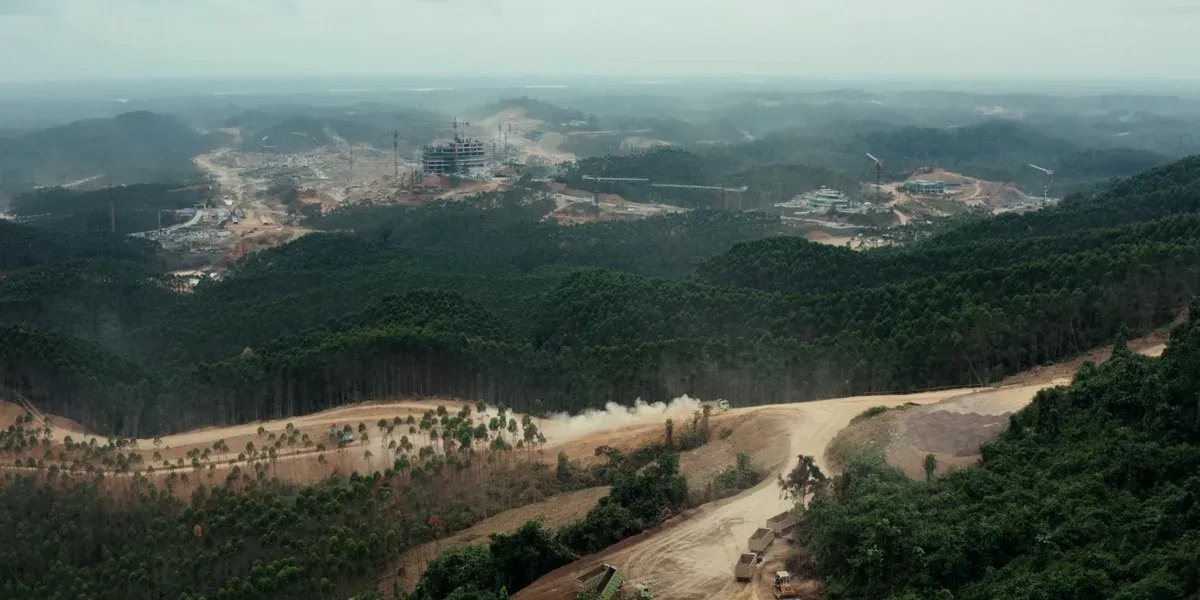
Indonesia is building a new capital city in the heart of Borneo to replace sinking Jakarta. As construction transforms a top-tier biodiversity hotspot, scientists and indigenous collaborators are racing to record forest sounds and preserve ecological knowledge.
Indonesia is building a new capital city in the heart of Borneo to replace sinking Jakarta. And as cranes start reshaping one of the world’s most biodiverse rainforests, the scientific response is moving just as fast: researchers and indigenous collaborators are racing to record the sounds of the forest and preserve generations of ecological knowledge before it is lost.
The urgency here is not abstract. Rainforest “soundscapes” are a live record of which species are present, how active they are, and how the ecosystem is functioning day to day. Once construction noise, habitat disturbance, and land conversion begin to permanently alter the environment, that baseline can become impossible to reconstruct. So the effort described in Scientific American is essentially time-sensitive documentation, paired with cultural and practical memory, because the knowledge holders are not interchangeable. In this framing, the rainforest is not just scenery. It is data, history, and a way of knowing that has to be captured while it still exists.
For executives, founders, and investors, this is a reminder that infrastructure projects do not just move dirt. They trigger operational knock-on effects across science, policy, and risk management. When a country relocates a national capital, you get a cascade: land use changes, new settlement patterns, road and utility networks, and a shift in governance capacity. Those changes can accelerate economic development, but they can also create ecological tradeoffs that show up later, in ways that are hard to quantify if you are not measuring them early.
Borneo matters because it is globally significant biodiversity territory, and the stakes rise with speed. The article’s core point is that construction is already transforming the rainforest. That means the window for systematic observation is shrinking. Recording forest sounds becomes a practical proxy for ecological change because it can capture signals across time. It is also a way to include indigenous collaborators in the work: people who have spent lifetimes listening, interpreting, and living with the ecosystem can help frame what matters, what patterns to look for, and which forms of ecological knowledge need to be preserved alongside the recordings.
This is also about incentives and ownership of information. Scientists typically focus on measurements that can be compared across time and space. Indigenous collaborators hold knowledge that can be detailed, context-rich, and tied to specific places, seasons, species behavior, and land management practices. When development accelerates, those knowledge systems can be disrupted through relocation, access limits, or simply the loss of conditions under which the knowledge is used. The “before it is lost” language is doing heavy lifting: it implies irreversible loss risk, not just a temporary inconvenience.
There is a second-order implication for governance. Capital relocation is a high-profile national endeavor, which means decisions will be scrutinized on multiple fronts: environmental compliance, land rights, and the credibility of mitigation strategies. In many cases, public narratives emphasize progress. But Scientific American’s description highlights a parallel track of documentation. That dual track can influence regulatory expectations, because it suggests that monitoring and knowledge preservation are not optional add-ons; they are part of how you can responsibly understand what changed.
Think about how this could affect decision-making in adjacent sectors. If the rainforest becomes a measured, recorded baseline, it can feed future conservation planning, habitat restoration design, and scientific studies about how ecosystems respond to fragmentation and disturbance. If the baseline is not captured, later interventions can become guesswork. In executive terms, that is the difference between building with evidence versus rebuilding without it.
Finally, the story lands with a strategic stake for any leader involved in large, land-intensive projects. The ecosystem is not static while you plan. It changes while you permit, while you mobilize contractors, and while you finalize infrastructure phases. The Scientific American piece portrays Indonesia’s capital project as the kind of moment where “science is listening” in real time. For peers, the lesson is blunt: if you wait until after the transformation, you may lose both the ecological signatures you cannot recreate and the ecological knowledge that cannot be rushed into existence later.
This story's Key Insights and Take-aways are locked.
Create a free account to unlock Executive Actions for one credit.
Register to UnlockAlways free for Executives Club members. Join the Club
More in Science
Alaska's 1,580-foot tsunami had warning signs. Scientists just found them.
Rapid glacier retreat, heavy rainfall, and thousands of tiny tremors preceded Alaska's 1,580-foot tsunami, a warning for every coastal community in a warming world.

The rare mutation that lets high-risk brains dodge Alzheimer's
Scientists found a natural defense against protein buildup, opening a new path to preventive treatments.

3,000 steps a day may halve Alzheimer's decline, study finds
New research links a modest daily walk to less tau buildup and nearly half the cognitive and functional decline, even for those with early signs.