
IXPE maps PSR J1101-6101’s Milky Way magnetic highway, and finds it far calmer than expected
NASA’s Imaging X-ray Polarimetry Explorer confirms particles escape along magnetic field lines and reveals a twist in turbulence.
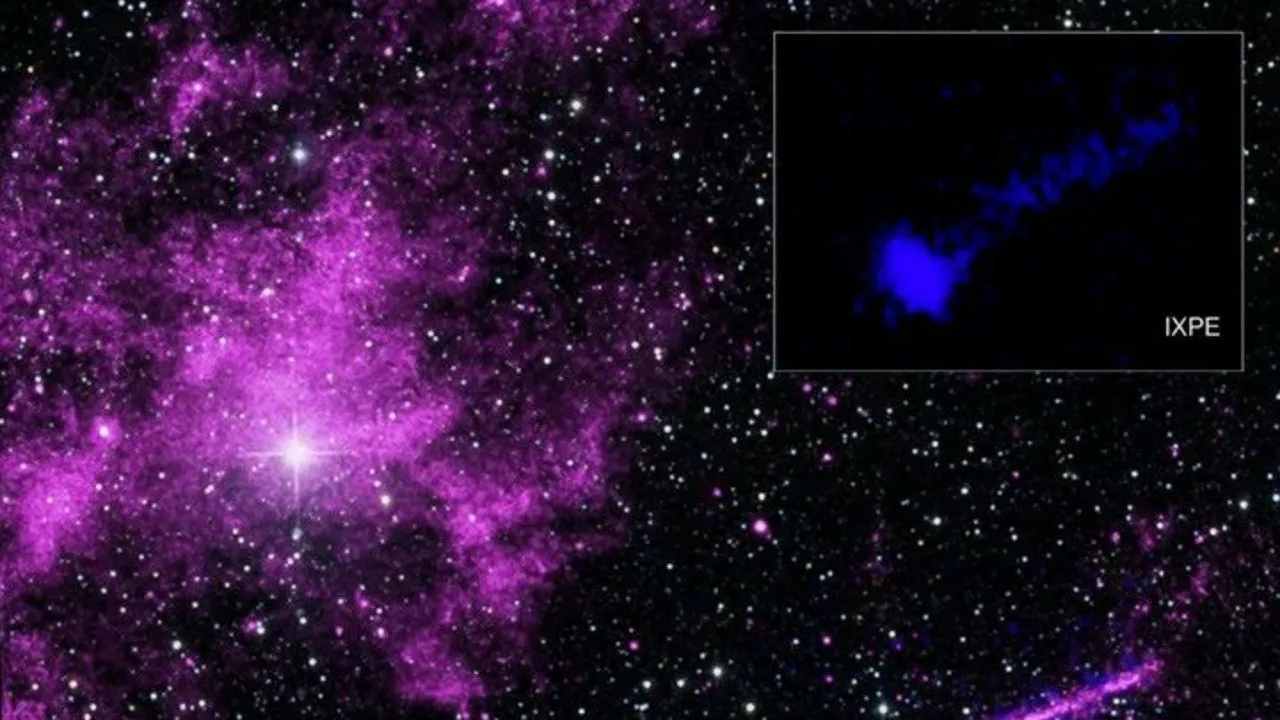
NASA used IXPE to directly map the magnetic field around pulsar PSR J1101-6101, nicknamed the Lighthouse, confirming decades-old predictions. For decision-makers, the result sharpens how extreme particle acceleration works in our galaxy, and it also upgrades the science toolkit for probing otherwise invisible fields.
Astronomers have, for the first time, directly mapped the magnetic field around the unusual pulsar PSR J1101-6101, nicknamed the “Lighthouse,” using NASA’s Imaging X-ray Polarimetry Explorer (IXPE). The mapping shows an invisible “cosmic highway” that channels high-energy particles away along magnetic field lines extending through the Milky Way. The headline stake is simple: a long-standing theoretical idea about where the particles go is now backed by direct geometry, not just inference.
The team’s target is not a random pin on the sky. PSR J1101-6101 sits at the center of the Lighthouse Nebula and spins about 16 times every second. It is also traveling at supersonic speeds after receiving a powerful kick from the supernova that created it. As it tears through interstellar gas, it produces a bright X-ray tail and a narrow filament that juts out almost perpendicular to its direction of travel. The core question researchers wanted to answer is whether that filament marks the path of energetic electrons escaping the system along the Milky Way’s magnetic field.
To do this, the researchers leaned on a capability that conventional X-ray telescopes generally do not offer: IXPE measures the polarization of X-rays. Polarization is essentially the preferred orientation of the electric field in the light, and because of that it lets scientists reconstruct the direction of otherwise invisible magnetic fields. In the team’s words from the statement, “The ‘smoking gun’ would come by measuring the polarization of the light, which indicates the magnetic field direction.” The logic follows: if the magnetic field points along the filament, that confirms that the filament’s particles are flowing along the field. Jack Dinsmore, lead author of the study and an undergraduate student at Stanford University, was the one who framed that as the test of the theory.
There was a practical problem to solve first. The Lighthouse Nebula is relatively faint in X-rays, so the researchers developed new analysis techniques to extract as much information as possible from the IXPE observations. That matters beyond astronomy trivia. When targets are faint, your margins get squeezed and your conclusions become more sensitive to how you handle noise, backgrounds, and calibration. Here, the work paid off: IXPE enabled the team to measure the nebula’s magnetic field for the first time, confirming that high-energy particles escape the pulsar by traveling along Milky Way magnetic field lines.
The results did not stop at confirmation. The observations uncovered an unexpected twist: the magnetic field is far more orderly than scientists anticipated. The unusually strong polarization signal suggests the filament contains much less magnetic turbulence than current models predict. In plain English, the “flowing particles” path is not just traced by a field, it is traced by a field that behaves more like a structured guide than a chaotic blender.
This is where the physics connects to the broader decision-maker mindset. Extreme objects like pulsars are factories for energetic particles, and those particles influence the surrounding space environment. The findings offer new insight into how fast-moving pulsars inject energetic particles into the surrounding galaxy. They also suggest that different particle energies may inhabit different regions within the system, hinting at multiple, potentially very different, acceleration mechanisms at work. In a statement, co-author Niccolò Bucciantini of the Italian National Institute for Astrophysics pointed to “the striking divergence in magnetic field orientations observed between radio and X-ray wavelengths” as evidence for the highly structured nature of these objects, and emphasized that this marks “the first clear indication” of energy-dependent spatial separation.
So what’s the strategic stake for peers watching this category of science? Even though this story is not about markets in the traditional sense, it is about measurement power: being able to map invisible structures changes what theories can claim as settled. For research organizations and technology stakeholders, IXPE’s polarization-first approach is a reminder that the next leap often comes from better observables, not louder hypotheses. The study was published July 9 in The Astrophysical Journal, and it turns a decades-old prediction into something you can point to on a map, then refine with a second surprise: calmer-than-expected magnetic turbulence along the filament.
This story's Key Insights and Take-aways are locked.
Create a free account to unlock Executive Actions for one credit.
Register to UnlockAlways free for Executives Club members. Join the Club
More in Science

Alaska's 1,580-foot tsunami had warning signs. Scientists just found them.
Rapid glacier retreat, heavy rainfall, and thousands of tiny tremors preceded Alaska's 1,580-foot tsunami, a warning for every coastal community in a warming world.

The rare mutation that lets high-risk brains dodge Alzheimer's
Scientists found a natural defense against protein buildup, opening a new path to preventive treatments.

3,000 steps a day may halve Alzheimer's decline, study finds
New research links a modest daily walk to less tau buildup and nearly half the cognitive and functional decline, even for those with early signs.