

Jackery Explorer 240D hits $102 at AliExpress for 80,000mAh, $129 Amazon alternative
A 256Wh power bank drops to a new low with LiFePO4 safety, fast USB-C charging, and shipping from the US.
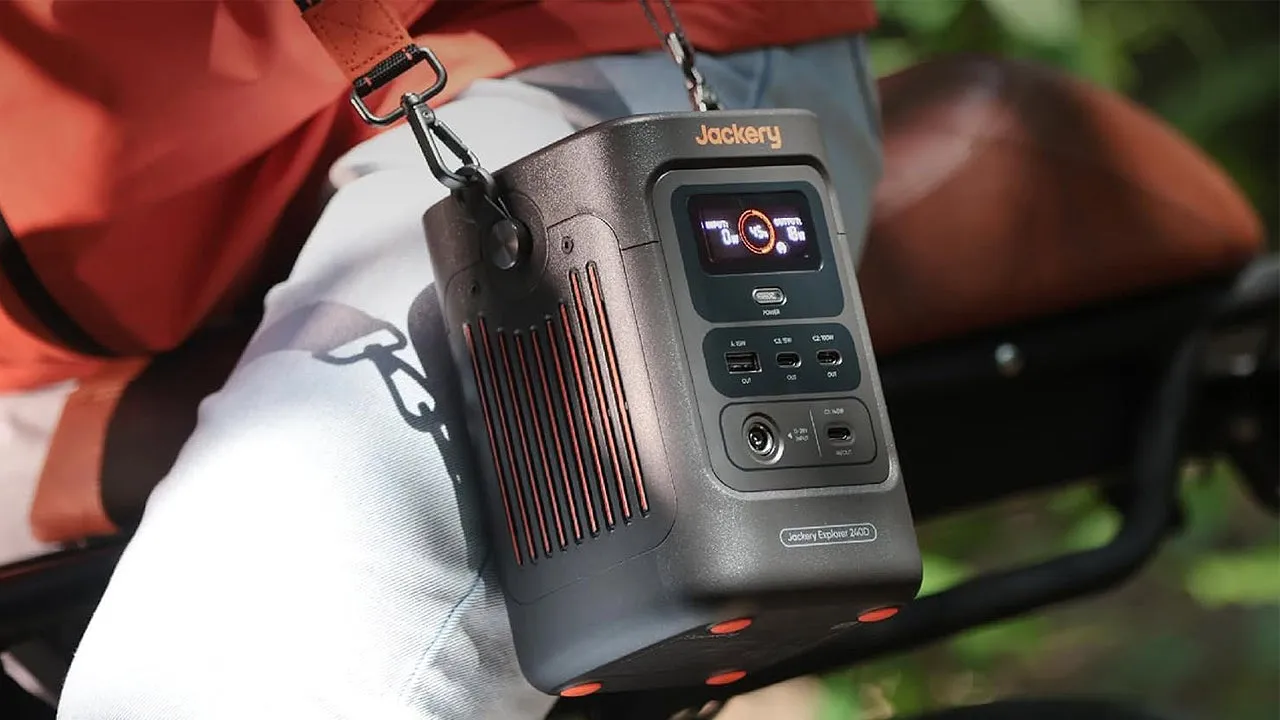
Jackerys Explorer 240D 80,000mAh (256Wh) power bank is listed on AliExpress for $102.21 with free shipping after coupon code "18USAFFSS". For decision-makers, that price gap to Amazon ($129) raises a simple question: is the specs-and-chemistry combo worth stocking before the deal disappears?
Right now, the Jackery Explorer 240D 80,000mAh power bank is selling for $102.21 on AliExpress with free shipping, but only after you apply coupon code "18USAFFSS". IGN also notes that the exact same power station sells for $129 on Amazon. That $26-plus spread matters because this is not a tiny accessory battery, it is a compact “mini power station” class device with enough capacity to meaningfully cover outages, travel, or work-from-the-road.
So what are you actually buying for that $102.21? The Explorer 240D packs an 80,000mAh 256Wh battery capacity and weighs under 5 pounds, which is positioned as lighter than dedicated power stations. It is not meant to be a casual pocket charger. IGN explicitly flags that you cannot bring it on an airplane as a carry-on, citing a 27,000mAh carry-on limit. If your internal planning assumes “backpack-ready power,” this is one of the few products that tries to be both compact and high-output, while still staying grounded in the reality of battery travel rules.
From an operator and procurement lens, the chemistry is the quieter, more strategic part. The Explorer 240D uses LiFePO4 cells instead of the lithium-ion cells used in most power banks. IGN points out that LiFePO4 chemistry is inherently safer, tends to deliver a longer lifespan, and experiences slower calendar aging. Put plainly: it is the kind of battery profile that can lower the chance your “backup plan” degrades early, which is exactly what you want if you are buying for long-term readiness rather than short-term convenience.
The ports tell you how this unit is meant to slot into a real device ecosystem. IGN lists four ports total: three USB Type-C ports rated at 140W, 100W, and 15W, plus a single 15W USB Type-A port. That split is important because many teams and travelers end up with a mix of laptops, tablets, phones, and accessories. The availability of multiple USB-C wattages also reduces the need to keep rearranging cables and chargers to match whatever device you are powering at the moment.
Charging itself has two pathways. IGN says the power station can be recharged in two ways: typical AC charging or solar charging through the DC input. For business travelers, field work, and anyone running “power logistics” off-site, solar input is less about replacing the grid and more about extending options when outlets are scarce. IGN also provides a concrete recharge benchmark: from fully depleted to 80% takes about one hour. That kind of time-to-partial-recovery is often what turns a “we might be in trouble” scenario into “we have a buffer.” It is also paired with the included 140W USB-C cable, so you are not starting from a half-kit.
Now, about durability and governance. The Explorer 240D comes with a three year warranty that can be extended to 5 years with product registration, according to IGN. And IGN adds a market validation point: this line of power stations has a cumulative total of 11,000 reviews on Amazon with a 4.6 star average. For decision-makers, reviews do not replace engineering, but they do provide a window into failure modes, expectations, and real-world usage patterns. If you are comparing inventory risk or justifying a purchase, those signals are not nothing.
There is also the retail mechanics and regulatory reality underneath the deal. IGN says the unit is sold by Jackery direct and ships from a local US warehouse. In practice, that can reduce the uncertainty people associate with cross-border fulfillment, compared with deals that ship from overseas with longer delivery windows. Separately, the airplane carry-on note reinforces that even if the device is compact for its capacity, it still sits in a battery-weight class where transportation rules apply. That matters for anyone buying for employees who travel or for families who move between home and remote locations.
Finally, the broader implication is not just “buy cheap now.” It is about choosing a power strategy that survives the messiness of real life: outages, roadtrips, backpacking expeditions, and daily device churn. IGN positions this as an excellent compact option for situations where a traditional power station is too big to lug around. If you are a founder, operator, or investor evaluating consumer tech, the lesson is that “spec sheets” are only half the story. The other half is whether the product chemistry, charging flexibility, and warranty posture align with how people actually use power when the grid is unreliable.
This story's Key Insights and Take-aways are locked.
Create a free account to unlock Executive Actions for one credit.
Register to UnlockAlways free for Executives Club members. Join the Club
More in Entertainment

Russell Brand's accuser 'bewildered and confused' as he denies 7 sex charges
The criminal case against the comedian is a live test of how media companies manage talent risk when serious allegations go public.

'It's a Magic Trick': Ballet Experts Say Rosalía's SNL Pose Is Impossible
Three ballet experts tell Rolling Stone Rosalía's gravity-defying SNL stillness shouldn't be possible - and why the debate is now part of the show.

Activision CMO: GTA 6 Will Boost Call of Duty, Not Bury It
Activision's top marketer says Rockstar's blockbuster will drive players back to consoles and into Modern Warfare 4, even as the company admits its recent strategy failed.