
Japan torpedoes USS Juneau again in SINKEX, reviving an 80-year-old Pacific loss
A live-fire drill under Valiant Shield 2026 used the decommissioned USS Juneau to practice joint warfighting across domains.
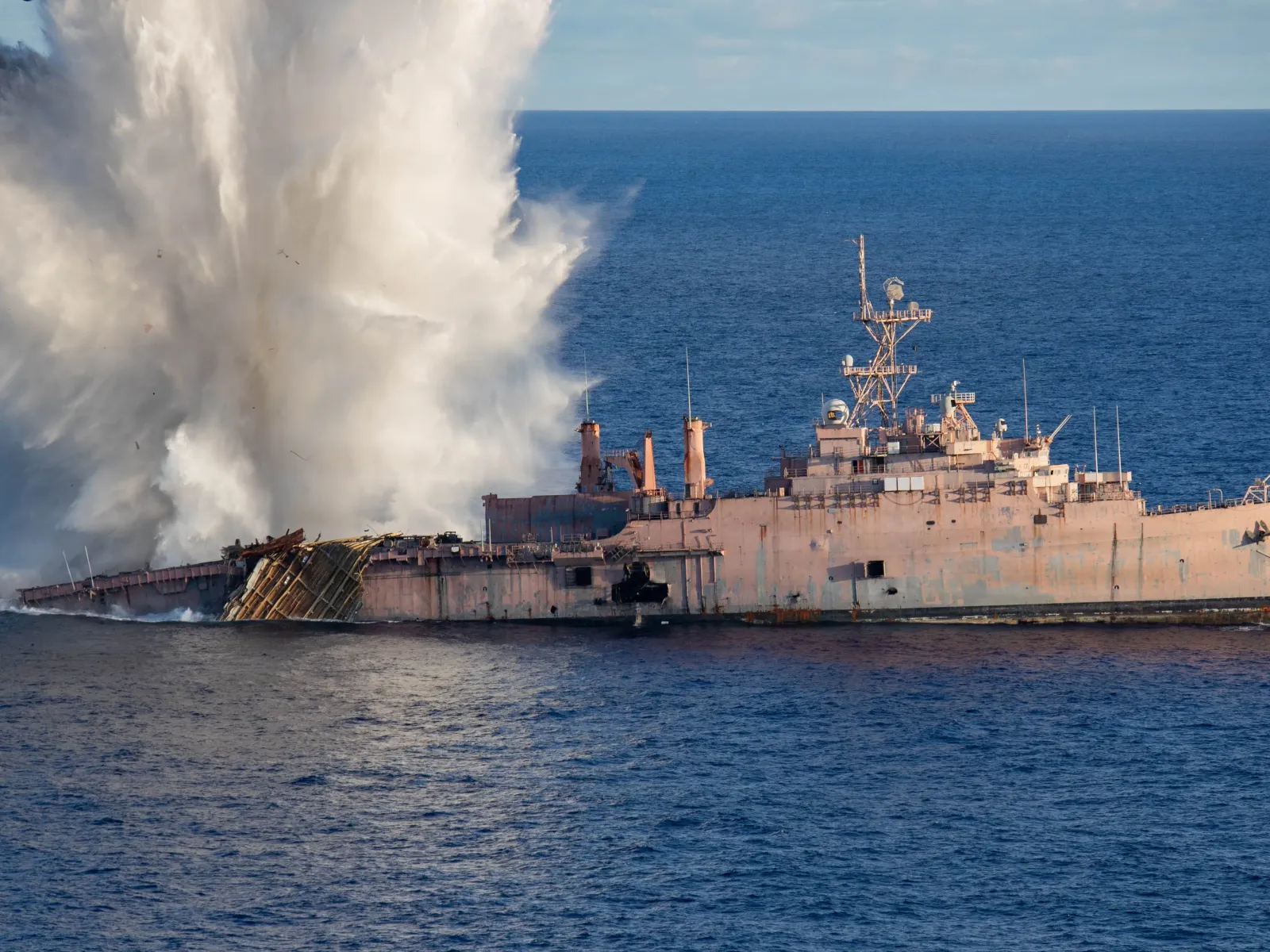
A Japan Maritime Self-Defense Force submarine torpedoed the decommissioned Austin-class amphibious transport dock USS Juneau during a SINKEX exercise. The move happened as the US Navy and Pacific allies trained to integrate capabilities across air, sea, land, space, and cyber.
The USS Juneau is going down again, and the details are eerie for anyone who remembers how it first ended. During Valiant Shield 2026, a live-fire SINKEX drill, a Japan Maritime Self-Defense Force submarine struck the decommissioned USS Juneau with a torpedo, sending the ship to the ocean floor. It is a modern exercise built on old history: the original USS Juneau was also sunk by Japanese torpedoes in World War II.
The Navy says this was not theater for its own sake. The live-fire sinking was part of a larger effort to practice coordinated warfighting with American allies and partners across air, sea, land, space, and cyber, in a more realistic environment than simulation alone. The event brought the US, Japan, Australia, Canada, and New Zealand together to test weapons and train as a team, turning one ship with a famous name into a training target with hard consequences for how readiness is measured.
If you are wondering why anyone in uniform would choose a real sinking instead of sticking to modeling and screens, the answer is blunt: live targets stress systems. The Navy described live-fire strikes on real, decommissioned vessels as a regular part of naval training, because it gives troops a realistic understanding of how weapons and platforms work on actual targets. Simulators are useful, but they do not replicate everything you see in the real world, from target behavior to timing and coordination. In SINKEX, you are not just asking, "Did the weapon work?" You are asking, "Did the whole kill chain work together, under messier conditions?"
That is where the choice of USS Juneau matters. This is not the first Juneau to be used as a lesson. The first USS Juneau was an Atlanta-class light cruiser commissioned for World War II service, and it was sunk during the Guadalcanal campaign in November 1942 when a torpedo from Japanese submarine I-26 struck it. Before that, it had already been crippled by a torpedo fired from the Japanese destroyer Amatsukaze. The historical record is heavy, including a total of 687 people killed in action, and it even includes five brothers from Iowa who became symbols of wartime sacrifice after their ship was lost. Only 10 crew members survived the attack.
Fast-forward to the present exercise, and the Navy points to how far the US and Japan have moved since the end of World War II. The recent SINKEX was held more than 200 nautical miles offshore in the Mariana Islands Range Complex. Before the live-fire event, crews removed hazardous materials and pollutants from the ship. The Navy also surveyed the sinking site. Those details may sound procedural, but they underline what the exercise is really optimizing for: operational realism with environmental responsibility and careful planning.
The ship in this drill is USS Juneau (LPD-10), an Austin-class amphibious transport dock ship that entered service in 1969. It participated in the Vietnam War and operations in the Middle East, transporting troops into combat. The Navy decommissioned the ship in 2008. Named after the capital of Alaska, the vessel is designed to move forces to land in conflicts. As a result, sinking it in a live-fire drill is a way to stress the amphibious and maritime integration that allies are trying to coordinate now, particularly in the Pacific theater where emerging threats have only strengthened ties.
Commanders framed the drill in terms of integration, not just marksmanship. In a press statement, Rear Adm. Eric Anduze, commander of Carrier Strike Group 5 and Task Force 70, said, "This SINKEX provided an outstanding opportunity for our joint team to integrate capabilities across domains, honing the lethal precision and coordination essential for high-end maritime operations in the Pacific theater." The key point for decision-makers is that SINKEX is designed to test coordination across multiple domains at once, which is exactly where programs, budgets, and procurement decisions can either click or collide.
For executives and boards, the second-order implication is how training exercises like Valiant Shield 2026 can reveal gaps that do not show up until you stress everything together. When a joint live-fire event spans air, sea, land, space, and cyber, it becomes a real-world diagnostic of readiness, interoperability, and timelines. And because the exercise partners include US allies and specific countries like Japan, Australia, Canada, and New Zealand, the results can affect expectations for cross-national systems, logistics, and integration efforts that often carry multi-year procurement and contracting timelines. In other words, this is a training headline, but it is also a risk and capability signal for anyone funding the next generation of maritime operations.
This story's Key Insights and Take-aways are locked.
Create a free account to unlock Executive Actions for one credit.
Register to UnlockAlways free for Executives Club members. Join the Club
More in Science

Alaska's 1,580-foot tsunami had warning signs. Scientists just found them.
Rapid glacier retreat, heavy rainfall, and thousands of tiny tremors preceded Alaska's 1,580-foot tsunami, a warning for every coastal community in a warming world.

The rare mutation that lets high-risk brains dodge Alzheimer's
Scientists found a natural defense against protein buildup, opening a new path to preventive treatments.

3,000 steps a day may halve Alzheimer's decline, study finds
New research links a modest daily walk to less tau buildup and nearly half the cognitive and functional decline, even for those with early signs.