

JPL’s ERNEST rover drives 16 miles autonomously, NASA targets smarter moon and Mars robots
A 26-kilometer desert trek with minimal intervention tests the autonomy, wheels, and active suspension NASA wants next.
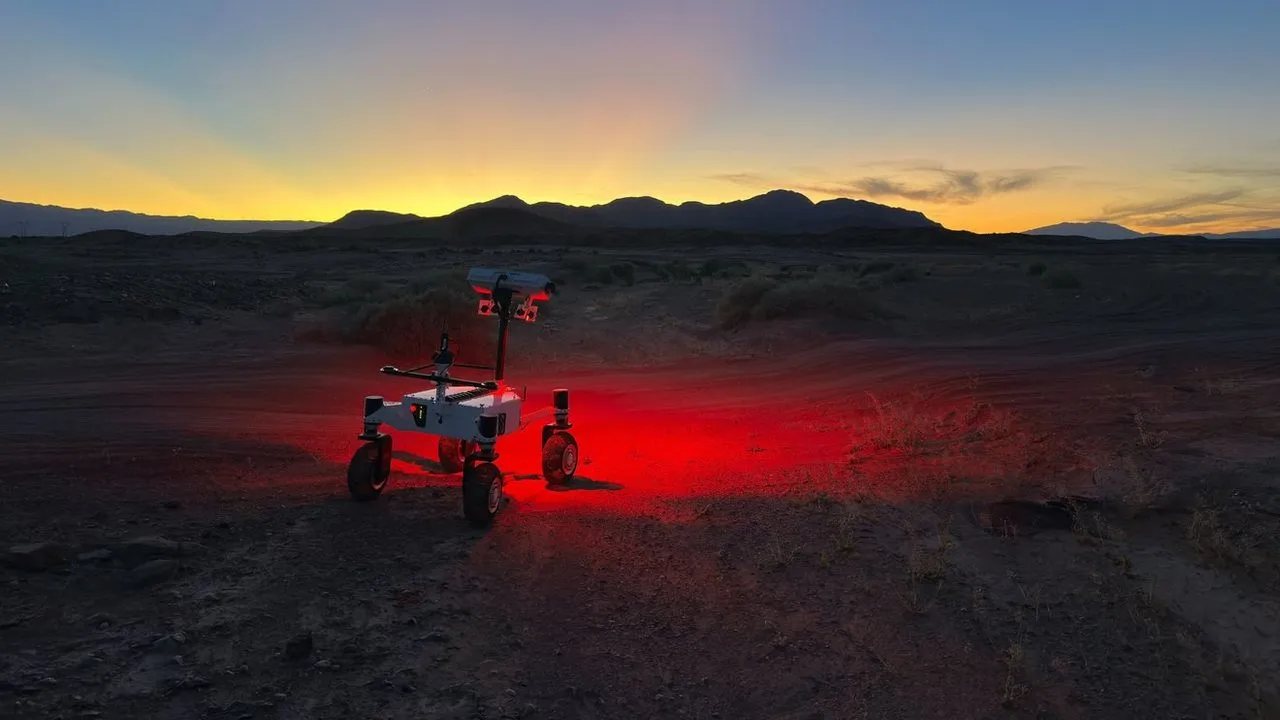
NASA’s Jet Propulsion Laboratory (JPL) tested its Exploration Rover for Navigating Extreme Sloped Terrain (ERNEST) in Southern California, completing a 16-mile (26-kilometer) autonomous drive over seven days. For decision-makers, ERNEST is a concrete prototype for mobility and autonomy that could make future moon and Mars missions move farther and faster than today’s rovers.
NASA’s Jet Propulsion Laboratory just put a new Mars-capable rover prototype through its paces in the California desert, and the headline number is the point: ERNEST completed a 16-mile (26 kilometers) trek. The journey took more than 37 hours of driving time across seven days, and it did so almost entirely autonomously, “with minimal intervention” from engineers monitoring the test, according to a JPL statement.
That autonomy matters because NASA is trying to solve a very real rover failure mode: getting stuck in dusty, uneven terrain where older navigation approaches struggle. ERNEST was built to navigate extreme sloped terrain, and the test included low-lighting and nighttime conditions intended to simulate parts of the lunar and Martian environment. If a rover can keep moving when lighting gets ugly and the ground turns hostile, mission planners can spend less time babysitting and more time covering distance.
So what exactly is ERNEST, beyond a great acronym? Developed at JPL, the prototype is part of a broader push to design robots that can “think for themselves” and make navigation decisions onboard. NASA hopes this technology can be incorporated into future rovers for the moon and Mars, with the goal that they could one day travel farther and faster than their predecessors by relying on onboard programming to assess and navigate treacherous landscapes previously unreachable by robotic explorers.
Under the hood, ERNEST blends hardware changes with adaptive intelligence. The rover’s mobility is built around novel wheels and an active suspension system. It uses paired adaptive artificial intelligence to identify obstacles along its path to either avoid or overcome them as it travels toward its next destination. The learning process started in simulation: months of reinforcement learning in a virtual environment, where ERNEST accumulated thousands of hours of experiential data in just a few days by running multiple simulations simultaneously. Then the team tested what it learned outside the virtual world, first putting the rover through an obstacle course at JPL’s Mars Yard before graduating it to the desert.
The design also intentionally breaks from what many people think of when they think “Mars rover.” Past rovers such as Perseverance and Opportunity have used a “rocker-bogie” system designed to distribute weight across their six wheels via open pivot points. ERNEST is a four-wheeled prototype, and instead of rocker-bogie it uses two joints on its front chassis that gimbal to alter the rover’s gait. The rover’s motion is described as mimicking “squirming, wheel-walking, and obstacle-climbing,” with additional capability to steer each wheel so it can maneuver side to side, not just forward and backward.
NASA and JPL are leaning into a simple logic: the physics of terrain interaction have been studied for decades, but that doesn’t mean today’s mobility is optimized for every scenario. “While the rocker-bogie system has been very successful over the past 30 years, there’s been a lot of research in that time on mobility and understanding terrain interaction,” said Hari Nayar, lead principal technologist for the ERNEST team, in the context of the work described by JPL. Another JPL technologist, Issa Nesnas, framed the broader test purpose as refining both the mobility hardware and the autonomy software needed to navigate extreme distances across a wide range of terrain and lighting conditions anticipated on the moon, again in a June 18 statement. During a week-long test this past March, engineering teams monitored ERNEST across several navigational scenarios, including traveling at night and other poor lighting conditions to simulate certain lunar environments.
ERNEST’s performance specs help explain why this matters for future mission architecture. The rover measures 4 feet (1.2 meters) long and drove at speeds up to 0.6 mph (1 kph). That speed is important because it’s faster than rovers currently operating on the moon and Mars like Perseverance, which, after five years on the Red Planet, has only recently crossed the distance that equals a marathon run on Earth (26.2 miles, or 42.2 km). Engineers hope ERNEST will become a model for even larger, more capable rovers designed to go much farther and at higher speeds.
From an operator and funding perspective, the second-order implication is straightforward: autonomy and mobility are expensive to test in space, so the money and engineering discipline shift earlier, into field trials and simulation. Development of ERNEST started in 2022 using JPL internal research and development funding. It has since been brought under the umbrella of the NASA Science Mission Directorate’s Exploration Science Strategy and Integration Office, as well as the agency’s Mars Exploration Program. That organizational placement signals that NASA is treating ERNEST not as a one-off demo, but as a building block for mission planners who care about time, risk, and coverage.
For boards, investors, and executive teams watching deep tech and space systems, this is the kind of milestone that can change roadmaps. A prototype that can traverse long distances with minimal intervention is not just “cool robot footage.” It’s a measurable step toward reducing operational overhead on future lunar and Martian missions. If the next generation of rovers can reliably handle extreme terrain and low-light scenarios with onboard autonomy, then mission design can evolve, and the competitive center of gravity shifts toward teams that can deliver both mobility hardware and trusted autonomy at mission scale.
This story's Key Insights and Take-aways are locked.
Create a free account to unlock Executive Actions for one credit.
Register to UnlockAlways free for Executives Club members. Join the Club
More in Technology

Nvidia's $89B data center quarter: the 9 companies cashing in
The AI buildout is minting fortunes beyond GPUs, and memory, cloud, and cooling suppliers are riding the same wave.

Google quietly links your phone number to every Android account on your SIM
Adding a SIM now ties your phone number to all Google accounts - and future accounts inherit it. Here's the security and privacy stakes.

Hijacker AI 'Skynet mode' runs 100,000 attack steps against exposed models
Symantec caught a criminal AI agent that borrows other models, steals data, and mines crypto; the only relief is no confirmed victims yet.