
Kae Tempest joins Kneecap to perform “Irish Goodbye” at Crystal Palace Park
A surprise guest at Kneecap’s biggest headline gig to date comes with a clear political message and fallout context.
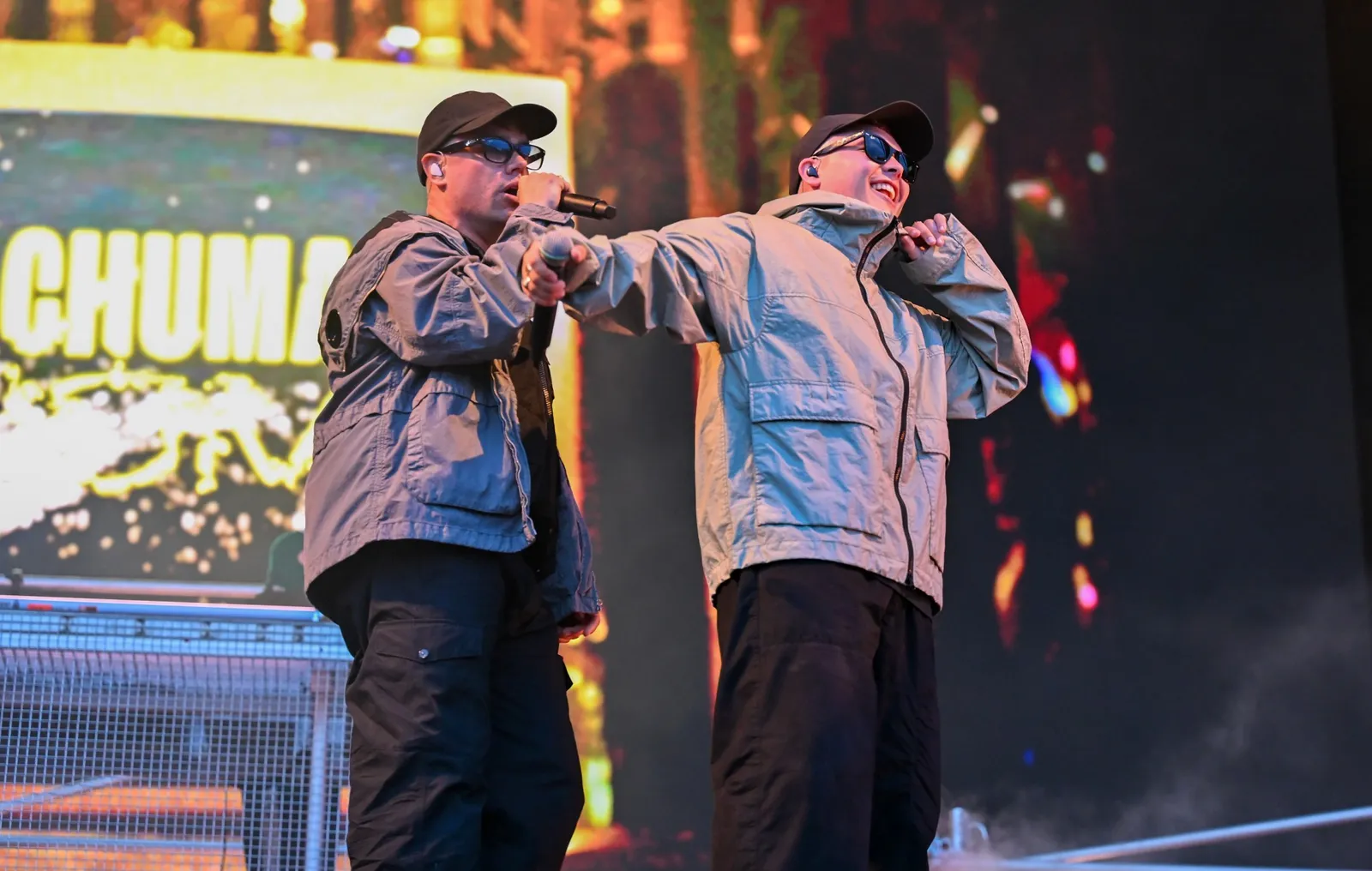
Kae Tempest appeared with Kneecap at their Crystal Palace Park headline show on June 27, joining the band for “Irish Goodbye.” The moment adds fuel to an already combustible year for Kneecap, as the trio continue to target UK political and pro-Israel positions while escalating their spotlight on Palestinian solidarity.
Kae Tempest took the stage with Kneecap at their Crystal Palace Park gig on June 27, joining the Irish hip-hop trio for “Irish Goodbye.” It was a surprise addition to what the band framed as their biggest headline gig to date in the capital, where they also brought in special guests including The Mary Wallopers, Fat Dog, Biig Piig, Gurriers, and Madra Salach, before a 25,000-strong crowd.
That cameo matters because Kneecap’s music has never been just music. Tempest appears on “Irish Goodbye,” a track Kneecap had already teased earlier in the year. When announcing “Fenian” back in April, Móglaí Bap, whose real name is Naoise Ó Cairealláin, said the lyrics were written after the death of his mother in 2020, “in the aftermath of coming to terms with the ‘reality of what has happened’.” In a quote included by NME, he said, “Suicide is hard,” and added that when someone dies by suicide, it can be difficult “to remember the good moments,” because “You get caught up in the dark times.” So Tempest’s appearance is not a random flex. It is a musical stamp of approval on a song that carries personal weight and the kind of rawness Kneecap turns into a loud live message.
But the emotional arc at Crystal Palace wasn’t limited to the setlist. Another standout moment came when Kneecap paid tribute to Trevor Dietz, a late music manager known for activism and campaigning for Palestinian human rights, including his work managing Fontaines D.C. On stage, an image of Dietz appeared wearing a “fuck Israel” shirt. It was paired with an image of the Palestinian flag and the text “Trevor forever.” Kneecap then reinforced the theme through words to the crowd, including the claim that there was “no bigger crime being committed, in our generation, than what’s happening in Palestine right now.”
If you are tracking why this keeps turning into a political storm, it helps to see how the show connects to the band’s ongoing legal and public pressure campaigns. Earlier this year, the High Court dismissed a terror charge against Kneecap member Mo Chara, whose real name is Liam Óg Ó hAnnaidh. The charge followed allegations that, during a gig at London’s O2 Forum Kentish Town in November 2024, he displayed the flag of Hezbollah, a proscribed organisation, and shouted “Up Hamas, up Hezbollah.” Kneecap has continuously denied supporting either Hamas or Hezbollah. They argued that the footage was taken out of context and described the legal action as a “carnival of distraction.”
At Crystal Palace, Chara nodded to that controversy directly, telling the crowd he had found himself “in quite the pickle” during the legal battle. Then he delivered the kind of scoreboard line that plays well in a crowd but also underlines how they measure institutional risk. He said, “anyone who was following it knows that we beat the British government three fucking times. That being said, let’s leave it at three nil.” After cheers, he added that the band was “happy with three nil,” and urged that if anyone had flags of prescribed organisations, give them to him. From there he tied the message back to historical and political framing, saying that as Irish people, they understand “after 800 years of colonialism,” what displacement and forced starvation of a population look like. He also said it was “important to us” to take time at every show to show solidarity with Palestinian brothers and sisters, and to support “the Filton 24.”
That last reference points to a specific, high-stakes activist landscape. NME notes that Chara was talking about pro-Palestine activists who in 2024 allegedly broke into and sabotaged an Elbit Systems factory near Bristol, which produces weapons for the Israeli military, and who then received “hefty fucking prison sentences.” Kneecap’s set then ended this segment with their slogan, “We know what’s right,” and the line, “Yes, the Israeli lobby is strong, but we’re fucking stronger. Free Palestine.”
This is the part where business and governance people should pay attention, even if you are not usually an events watcher. Kneecap is operating at the intersection of entertainment and enforcement, and the enforcement angle keeps pulling politicians into the spotlight. Last week, the trio reacted to Keir Starmer’s resignation as UK Prime Minister and leader of the Labour Party. NME reports that Starmer had pushed to have Kneecap removed from the Glastonbury 2025 line-up, and Kneecap responded by hitting out at him for “arming a fucking genocide” in Gaza. They also condemned Starmer on the ‘Fenian’ single “Liar’s Tale,” calling him a “scumbag” for involvement in helping to arm Israel.
The band’s relationship with political pressure is not hypothetical. In an earlier NME interview, Starmer doubled down on his stance against Kneecap. He said: “Kneecap shouldn’t be performing at Glastonbury, and I don’t support inciting violence as free speech.” He also drew a line between issues worth speaking about freely and “incitement to violence,” saying, “They’re two different things.” Kneecap, for their part, has argued the system is wired for sensationalism. In a NME interview last year, Móglaí Bap questioned why politicians are “so obsessed with artists saying things, rather than the origins of what they speak out about,” framing it as a “need for sensationalism.” He cited Starmer giving an interview about Kneecap playing Glastonbury, telling NME, “That’s weird,” and suggesting it makes politicians look good without real repercussions for them, calling the relationship “dysfunctional symbiotic.”
Put all of it together, and you get why a surprise guest like Kae Tempest at Crystal Palace Park is more than a fan moment. It signals that Kneecap can still widen their cultural reach while continuing to push on legal, political, and humanitarian fault lines. And for executives, boards, festival operators, or anyone making risk calls around live programming, the second-order implication is brutal: when artists fuse mainstream stagecraft with explicit ideological framing, the conflict does not stay in venues. It moves into courtrooms, headlines, and line-up politics. Kneecap’s post-Saturday path includes a series of European and UK summer festival dates, including Roskilde, Rock Werchter, and Boomtown, plus appearances at Reading and Leeds 2026 on the August Bank Holiday Weekend. Expect the same question to follow them from stage to strategy: how far does “free speech” travel before regulators, courts, and brands feel like they have to act?
This story's Key Insights and Take-aways are locked.
Create a free account to unlock Executive Actions for one credit.
Register to UnlockAlways free for Executives Club members. Join the Club
More in Entertainment

Russell Brand's accuser 'bewildered and confused' as he denies 7 sex charges
The criminal case against the comedian is a live test of how media companies manage talent risk when serious allegations go public.

'It's a Magic Trick': Ballet Experts Say Rosalía's SNL Pose Is Impossible
Three ballet experts tell Rolling Stone Rosalía's gravity-defying SNL stillness shouldn't be possible - and why the debate is now part of the show.

Activision CMO: GTA 6 Will Boost Call of Duty, Not Bury It
Activision's top marketer says Rockstar's blockbuster will drive players back to consoles and into Modern Warfare 4, even as the company admits its recent strategy failed.