
KFUPM women lead WiDS AI-Security Nexus with 250 attendees and 85 poster entries
A one-day Women in Data Science conference at King Fahd University turns AI-security research into mentorship, pipeline, and real-world credibility.
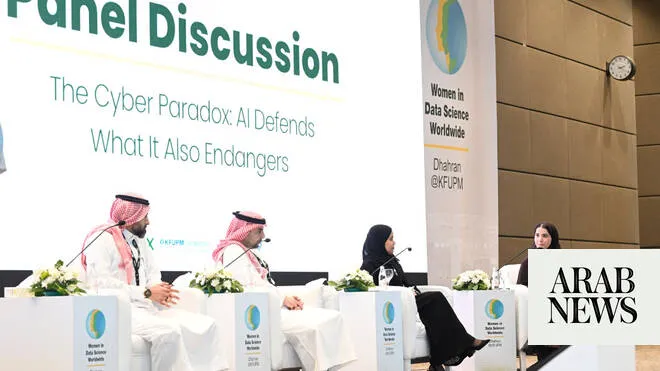
At King Fahd University of Petroleum and Minerals (KFUPM), Ph.D. candidates Asma Yamani and Linah Ali Abuhajar helped lead the university’s 7th annual Women in Data Science (WiDS) conference under the theme “AI-Security Nexus.” The event drew around 250 attendees from across the region, sparked 85 poster submissions, and connected academia, industry, and early-stage talent building.
DHAHRAN: In a single day at King Fahd University of Petroleum and Minerals, the WiDS community turned the messy overlap of AI and cybersecurity into something measurable. KFUPM’s 7th annual Women in Data Science conference, held under the theme “AI-Security Nexus,” brought together around 250 attendees from across the region and pulled in 85 poster submissions for a cash-prize competition. It is not just a celebration of research. It is a fast pipeline into the kinds of skills and networks that will matter as AI reshapes how threats work.
The people running it are not abstract “researchers.” Ph.D. candidate Asma Yamani, who has been involved since women first enrolled at KFUPM, led the organizing team of five students. Yamani emphasized that the conference is designed to highlight experts who happen to be women, reflecting how hard it can be to find speakers at the intersection of AI and cybersecurity unless you intentionally widen the lens. That matters, because the event’s stated frame is direct: as AI transforms cybersecurity, it is not only “strengthening our defenses,” it is also reshaping the threat landscape in ways researchers are only beginning to understand. In other words, the stakes are the same ones boards and security teams are already wrestling with, just from the other end of the talent funnel.
KFUPM itself is part of the context. The STEM-focused institution was founded in 1963 as an all-male university, but it began admitting women in 2019. The students featured in this story are among the first generation of women to study and graduate from the university. One of their earliest priorities was building a community of support and collaboration. That vision is what made WiDS feel less like a “conference you attend” and more like a “community you join,” with networking, mentorship, and confidence-building built into the program.
The conference also carries a timeline lesson for anyone who has tried to plan in a world shaped by lockdowns. Yamani described how, when the event was first set up, the speakers were already booked to arrive in three days, then the lockdown happened. Like many events during the COVID-19 pandemic, the conference started as a virtual gathering, later moved into a hybrid format, and then returned fully in person. That evolution is a quiet reminder that the AI and cybersecurity problem set is also changing quickly, and the people solving it have had to adapt their workflows, communities, and dissemination habits along the way.
Program-wise, the day mixed academia and industry voices around multiple sub-problems inside the AI-security umbrella. The conference press release framed the nexus as both defense and threat evolution. Session topics included “Securing the AI era” by Norah Al-Zahrani from Humain, “The arms race to secure LLMs” by KFUPM’s Abrar Al-Otaibi, and Arabic religious hate-speech detection on social media presented by Noha Albadi. Futun M. Al-Qahtani and Shouq Al-Qarni of Saudi Aramco discussed AI-driven cybersecurity solutions, UCLA’s Yuan Tian delivered a keynote on security and privacy in extended reality systems, and Mastercard’s Saja Al-Julaud joined virtually to discuss AI governance in fintech. That mix matters because AI security is not a single product problem. It touches model behavior, data pipelines, platform governance, and domain-specific risks.
If you zoom in on the talent signal, Abuhajar adds a particularly practical edge. Workshop facilitator Linah Ali Abuhajar is known as “the First female KFUPMer to launch a startup at DTV KFUPM.” Originally from Al-Ahsa, she founded a Dhahran-based startup focused on developing virtual reality and AI solutions. She holds a master’s degree in AI and is currently pursuing a Ph.D. at KFUPM, where her research examines human behavior and interaction in virtual environments. Abuhajar said, “We are including AI in all of our applications,” which captures how these academic themes are showing up in real deployments, even before a full commercialization cycle.
The conference is also linked to institutional expansion. KFUPM recently launched a dedicated bachelor’s degree in AI and Cybersecurity, and Yamani highlighted that this year the program started as a dedicated bachelor’s degree independent of the event. The coincidence, she said, was “nice to have,” because many students enrolled in the new program attended the conference and offered enthusiastic support and positive feedback. For boards and operators, that is a second-order effect worth paying attention to: when a university aligns degree structure with an industry-relevant theme, the talent pipeline stops being a one-off event and becomes a repeatable throughput mechanism.
Beyond schoolwork, Yamani brought a grounded reality check to the mentorship pitch. She is a mother of three, and she said that role gives a deeper perspective on the future Ph.D. students are helping build. She also pointed out that not everyone has families, but Ph.D. students still have other responsibilities like having a startup. With graduation expected in 2027, Yamani sees herself passing the baton to the next generation of organizers. The conference primarily targets graduate students and senior undergraduates, but this year attendance also included high school students, reinforcing the goal of inspiring younger girls to pursue science and technology. In the long run, the strategic stakes are simple: AI-security work will increasingly depend on who gets trained, who gets mentored, and who gets the first credible platform to present ideas, win recognition, and build relationships across academia and industry.
This story's Key Insights and Take-aways are locked.
Create a free account to unlock Executive Actions for one credit.
Register to UnlockAlways free for Executives Club members. Join the Club
More in Technology

Nvidia's $89B data center quarter: the 9 companies cashing in
The AI buildout is minting fortunes beyond GPUs, and memory, cloud, and cooling suppliers are riding the same wave.

Google quietly links your phone number to every Android account on your SIM
Adding a SIM now ties your phone number to all Google accounts - and future accounts inherit it. Here's the security and privacy stakes.

Hijacker AI 'Skynet mode' runs 100,000 attack steps against exposed models
Symantec caught a criminal AI agent that borrows other models, steals data, and mines crypto; the only relief is no confirmed victims yet.