

Kospi spikes 18% on record day as Trump pulls back on Iran, lifts U.S. futures
A global risk-on bounce is colliding with fresh Iran uncertainty and a week of labor data that tests the Fed's credibility.
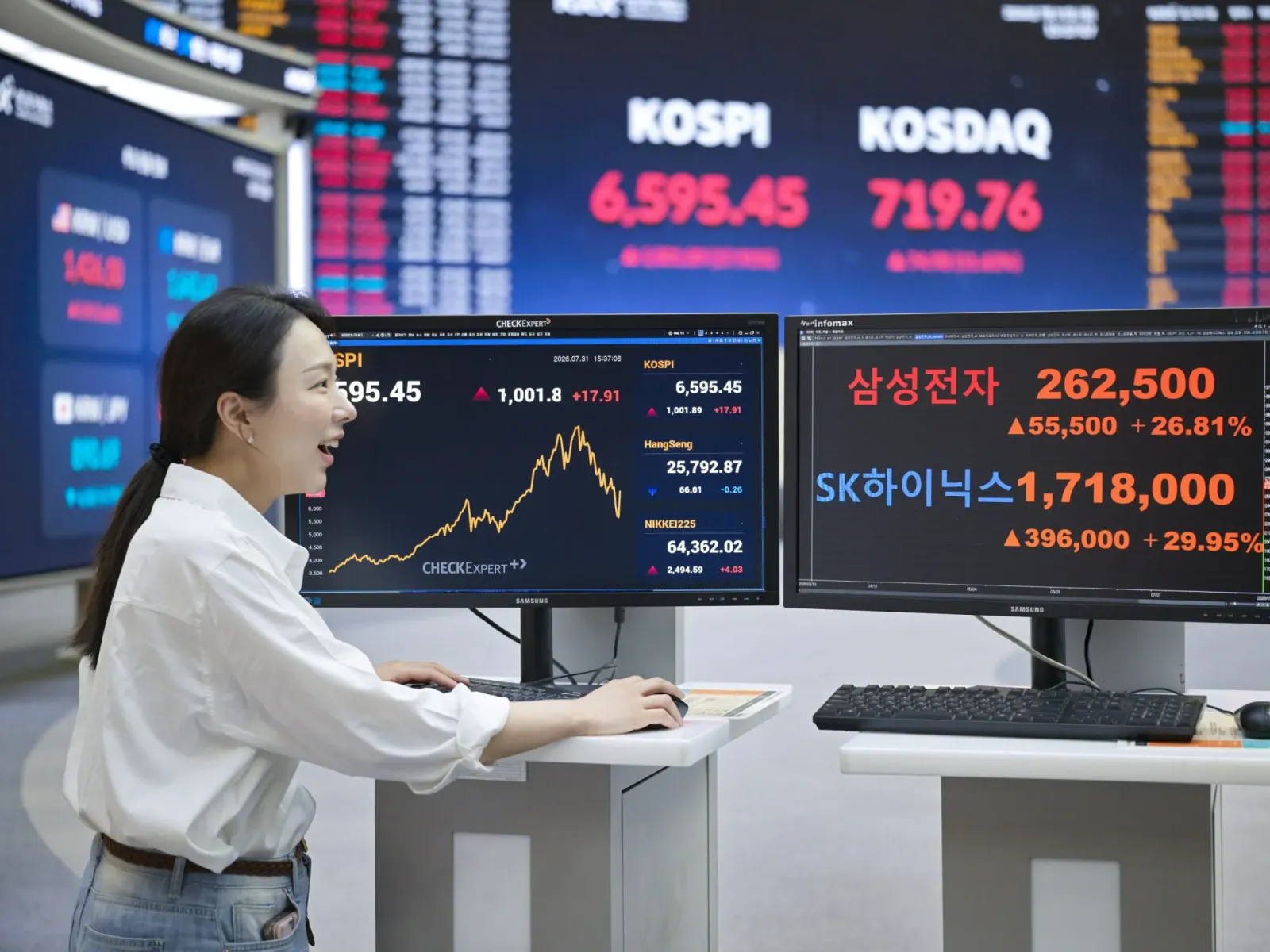
South Korea's Kospi surged 18% on Friday, the biggest single-day jump on record, while U.S. stock futures rose Sunday after President Donald Trump pulled back from a major attack on Iran. The market shift matters because oil prices, Treasury yields, and Fed expectations all swing when geopolitics and jobs data team up.
If you missed Friday’s move, markets are trying to make sure you notice now. South Korea’s Kospi surged 18% on Friday, the biggest single-day jump on record, and that shockwave is bleeding into global risk sentiment as U.S. stock futures rose again Sunday. Futures tied to the Dow Jones industrial average jumped 189 points, or 0.36%; S&P 500 futures rose 0.41%; and Nasdaq futures climbed 0.89%. The headline takeaway is simple: investors are back in buying mode, at least for now.
Part of the reason this rally is so loud is that it comes after a brutal selloff last month. The source describes authorities in South Korea rein in massive leverage that fueled wild swings earlier, which is an important detail for executives who care about how quickly market fragility can flip into resilience. When leverage gets restrained, volatility can cool, and “signal” moves like an 18% Kospi jump can persuade sidelined buyers to return. In other words, this is not just a chart flex. It is a risk-regime shift investors are testing with real money.
Across the ocean, the U.S. catalyst is geopolitical. Sunday’s futures uptick is tied to President Donald Trump balking at a major attack on Iran, a reversal that mirrored a familiar pattern from the Iran conflict: threaten a major strike, then pull back from the brink late Saturday. The source adds that Trump attributed the latest pullback to U.S. allies pleading with him to give diplomacy another chance. Markets like clarity. Even “not attacking yet” can function like temporary risk-off relief, because it reduces immediate tail risk that can spread through energy, shipping, and defense-linked supply chains.
But the relief is conditional. The same source notes experts also see signs Iran is gaining the upper hand, and it grounds that claim in what Iran is doing across the region. Tehran has expanded the war using proxies, most notably Houthis rebels threatening ships in the Red Sea. Those ships are described as trying to use the Bab el-Mandeb Strait to bypass the Strait of Hormuz. At the same time, Iran warned Persian Gulf neighbors they will be targets if there is renewed bombardment, after demonstrating its long-range weapons can evade U.S. air defenses. Dennis Citrinowicz, a former Israeli intelligence official who specialized in Iran, posted on X: “Last night’s events underscore a reality that is becoming increasingly difficult to ignore: for now, Iran appears to hold the strategic advantage in deterrence.”
You can see why executives watching capital markets should care about this nuance. Even when Trump pulls back, the market still has to price a conflict that is not neatly contained. And the commodity tape is already giving a clue about the market’s belief in “less immediate escalation.” U.S. oil prices tumbled 4.5% to $80.85 a barrel, while Brent crude fell 4.6% to $83.90. If investors think a deal could reopen the Strait of Hormuz, that helps explain why energy risk premium may be easing. For businesses, that matters because it influences input costs, transportation economics, and inflation expectations.
Rates are moving too, which is another reason this story is bigger than one index. The U.S. 10-year Treasury yield fell 2.7 basis points to 4.718%. Lower yields can reinforce equity optimism by reducing discount rates, but they also signal something else: markets are reacting to shifting probability distributions for both growth and inflation, not just geopolitics.
And then there is the week ahead, which is where the story gets prickly for anyone accountable for forecasts. Wall Street is looking ahead to labor market data amid doubts about the Federal Reserve's willingness to rein in inflation. The source lays out a tight sequence: ADP’s private payrolls report comes out Wednesday, weekly jobless claims follow Thursday, and Friday brings the Labor Department’s monthly jobs report. Analysts expect a gain of 85,000, with the unemployment rate rising to 4.3% from 4.2%.
This comes after what the source calls a “credibility shock” from Fed Chairman Kevin Warsh last week. The issue: he continued to offer zero forward guidance while suggesting alternative data and market tools could be used to fight inflation. According to economists at Bank of America, those remarks were so dovish that they will likely force a hawkish outcome, meaning other members of the Federal Open Market Committee must pick up the pieces. That is a boardroom-level problem because credibility affects expectations. If markets believe the Fed is behind the curve, borrowing costs, risk premiums, and equity valuations can reprice fast.
Bank of America points to the bond yield curve as an indicator of the central bank’s perceived commitment to price stability. The source includes the economists’ logic: “Flattening of the curve would mean markets still believe the Fed will do what it takes to meet its mandate,” while steepening on strong jobs or inflation data would indicate “the Fed is behind the curve,” raising “more serious questions about its credibility.” For executives, the second-order implication is blunt. You can’t just model earnings growth anymore. You also have to model how quickly market participants rewrite their assumptions about policy reaction.
So where does this leave peers making investment or financing decisions? The market is giving you a brief window of “risk-on” liquidity, powered by an 18% Kospi surge and a Trump pullback on Iran. But the underlying drivers remain unstable: oil is responding to hopes of a deal, Iran conflict dynamics are expanding through proxies, and next week’s labor data will decide whether the Fed looks credible or confused. In that environment, the executives who win are the ones who treat markets as a system, not a mood.
This story's Key Insights and Take-aways are locked.
Create a free account to unlock Executive Actions for one credit.
Register to UnlockAlways free for Executives Club members. Join the Club
More in Business

Anthropic’s Levant Alpöge cracks the Jacobian conjecture after 87 years
A Harvard valedictorian used Claude to hit a 1939 breakthrough, but the missing “why” is the real problem.

Uber buys Delivery Hero for nearly $15B, vaulting to top food delivery outside China
The deal doubles Uber's dual-services footprint and pushes a ride-and-eats bundling play into 50 more markets.

Epic and Google drop settlement bid, forcing rival Android app stores by July 22
Google told the court it is ready to carry third-party app stores starting Wednesday, July 22.