
LinkedIn, Walmart, Zendesk: agents aren't blocked by models, legacy infra is
VB Transform 2026 panelists showed how Kubernetes, data pipelines, and governance determine whether AI agents ship or stall.
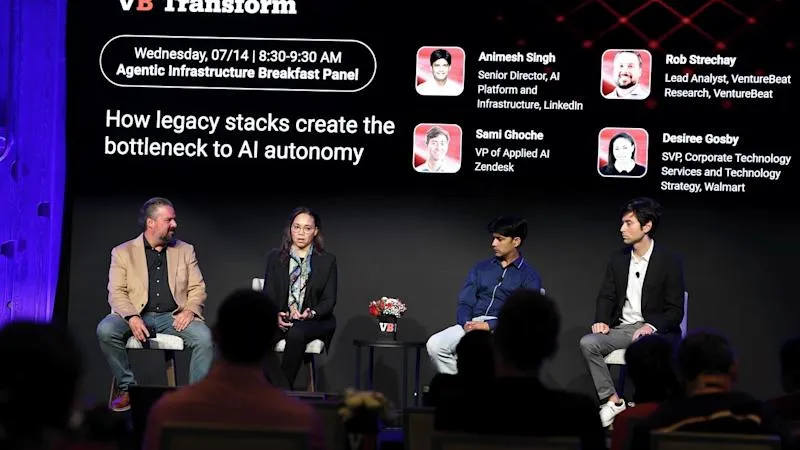
At VB Transform 2026, LinkedIn's Animesh Singh, Walmart's Desiree Gosby, and Zendesk's Sami Ghoche argued that enterprise AI agents slow down at infrastructure bottlenecks, not in the models. Their fixes, from container provisioning to eval harnesses and data pipelines, spell out the real go-to-production checklist for decision-makers.
AI agents don’t fail because the latest model can’t do the thinking. VB Transform 2026 made that painfully clear, with three enterprise leaders describing the moment their pilots met production reality: the bottleneck was legacy infrastructure, not model capability.
Animesh Singh, senior director of AI platform and infrastructure at LinkedIn, pointed to Kubernetes as the first choke point. Kubernetes is built around containers that spin up on demand, which assumes seconds of startup time are acceptable. Singh argued that speed assumptions like that are out of sync with how agents behave minute-to-minute. His answer was operational, not architectural in the model sense: move from on-demand provisioning to pre-provisioned pools of containers that can swap agentic workloads in and out in real time.
That opener matters for executives because it reframes “AI readiness.” Most organizations treat model selection like the hard part: pick a frontier model or an open-weight alternative, tune prompts, and you’re off. The panelists basically said the opposite: enterprises built their systems for humans. Humans are slow, request-driven, and forgiving. Agents are fast, autonomous, and relentless. The gap between those two operating rhythms is where the engineering work actually lives, and that work can either unlock shipping velocity or quietly kill it.
Once Singh got past the provisioning issue, a second wall appeared, and it was even more “system design” than “IT performance.” LinkedIn tested agents where an LLM evaluates another LLM’s outputs using a five-point evaluation system. It looked clean. Hallucinations kept showing up anyway. Singh described the structural failure mode: when an LLM evaluates an LLM, it shares the same failure behavior as the thing it’s judging. So LinkedIn changed control flow. Singh said they built their own harness and pushed LLMs to the leaf nodes, instead of letting LLMs orchestrate the loop. Roughly 80% of the workflow is now scripted, deterministic code, with LLMs used only where reasoning is required. Each step’s evidence is committed to disk before the system moves on. In plain English, it’s a move toward “prove it, then proceed,” not “trust the model vibe.”
Walmart’s Desiree Gosby approached the same gap from a different angle, and it still came back to infrastructure. Her bottleneck wasn’t that the system couldn’t run agents. It was that the system ran too well once employees got hands-on access. Gosby said an agent harness put directly into employees’ hands went viral internally, and what she called “citizen developers” started building their own agents. The upside was innovation that an internal engineering roadmap could not replicate fast enough. The downside was duplication, dozens of overlapping agents with no coordination.
This is the less-discussed second-order risk of agent rollouts: adoption can outrun governance. The fix, Gosby said, wasn’t to remove the harness or lock it down so tightly that nobody builds. Instead, Walmart built governance to spot duplication, promote the best version of an agent, and get it into production without engineering becoming a chokepoint. That distinction is critical. In agent programs, “permissioning” and “production pipelines” can become the real bottleneck if governance is bolted on too late. Walmart’s solution was to design governance as part of the infrastructure, not as a policy memo.
Zendesk’s Sami Ghoche brought the third version of the same theme: agents need the right data plumbing, not just more parameters. Ghoche joined through Zendesk’s acquisition of Forethought, which closed in March 2026, and he described sitting on what he called a “public figure of 20 billion customer conversations” in Zendesk’s repository. The tempting move is to hand that history to a model with a big context window and generate the agents a business needs. Ghoche said that doesn’t work in practice. His conclusion was straightforward: you have to invest in underlying data pipelines and the data infrastructure that makes that information usable. Big context windows are not a substitute for data engineering when the output has to be grounded, reliable, and operational.
All three leaders also agreed on a pragmatic stance toward open source and model independence. Their instinct was to own what you can, and lean on frontier labs only where they have a clear edge. Ghoche said enterprises would often prefer to own models and infrastructure wherever possible, and that reasoning is what drives Zendesk’s approach. He also noted that the “frontier reasoning work” slice where labs lead is shrinking relative to what enterprises do with AI overall.
LinkedIn’s independence strategy was concrete: build two subsystems specifically for independence. First, an AI gateway as a single interface for every outbound call to a model regardless of provider. Second, a memory subsystem that holds context independent of any model provider. Singh emphasized that every outbound call to an LLM follows the same semantics, the same API calls, whether public cloud or on-prem in their own data centers, making provider switching faster. Walmart built its own internal gateway to stay vendor agnostic across deterministic workflows, planner-and-reasoner workflows for open-ended tasks, and hybrids of the two. Compliance-heavy work stays deterministic by design, while governance, security, and evaluation run through the gateway regardless of which model is on the other end. Gosby also framed the model choice as workload-specific, not fixed: the “frontier model of today versus an open source model of tomorrow” decision depends on what’s most effective for the use case.
The modernization advice that landed across the panel was consistent with the bottlenecks they described. Invest in evals before anything else, because evals are common to every internal and customer-facing use case and force the problem to break down so you can move faster. Own your agent harness from day one and pair it with monitoring, since putting the harness directly in employees’ hands can unlock innovation early. And build for model and context independence so you can reuse context within the enterprise when you ship new models or harnesses.
If you’re responsible for shipping agentic products, the takeaway is simple and uncomfortable: the model is rarely the gating item. Kubernetes startup behavior, evaluation control flow, employee-driven agent proliferation, and data pipelines for grounded conversations can decide whether your AI roadmap turns into production wins or stalled demos. The executives who treat “legacy infrastructure” as the real enemy will move first. Everyone else will keep blaming the models.
This story's Key Insights and Take-aways are locked.
Create a free account to unlock Executive Actions for one credit.
Register to UnlockAlways free for Executives Club members. Join the Club
More in Technology
AWS billing glitch spiked some monthly fees from cents to billions
A billing error at Amazon Web Services reportedly turned small charges into massive invoices for some customers.

Vertu charges $6,880 for an AI agent, and TechCrunch tests what you get
The luxury foldable’s AI is not vaporware. Here’s how its daily performance stacks up, from workflows to battery and security.

Databricks’ $188B valuation jump signals AI-platform gravity, not a quiet side quest
The company positions itself as AI-first with research backing open-weight coding models and cost savings.