
Mark Carney says Anthropic export curbs prove the risk of “one option” for AI
Carney warns U.S. restrictions on Fable 5 and Mythos 5 highlight why governments and buyers must diversify beyond American providers.
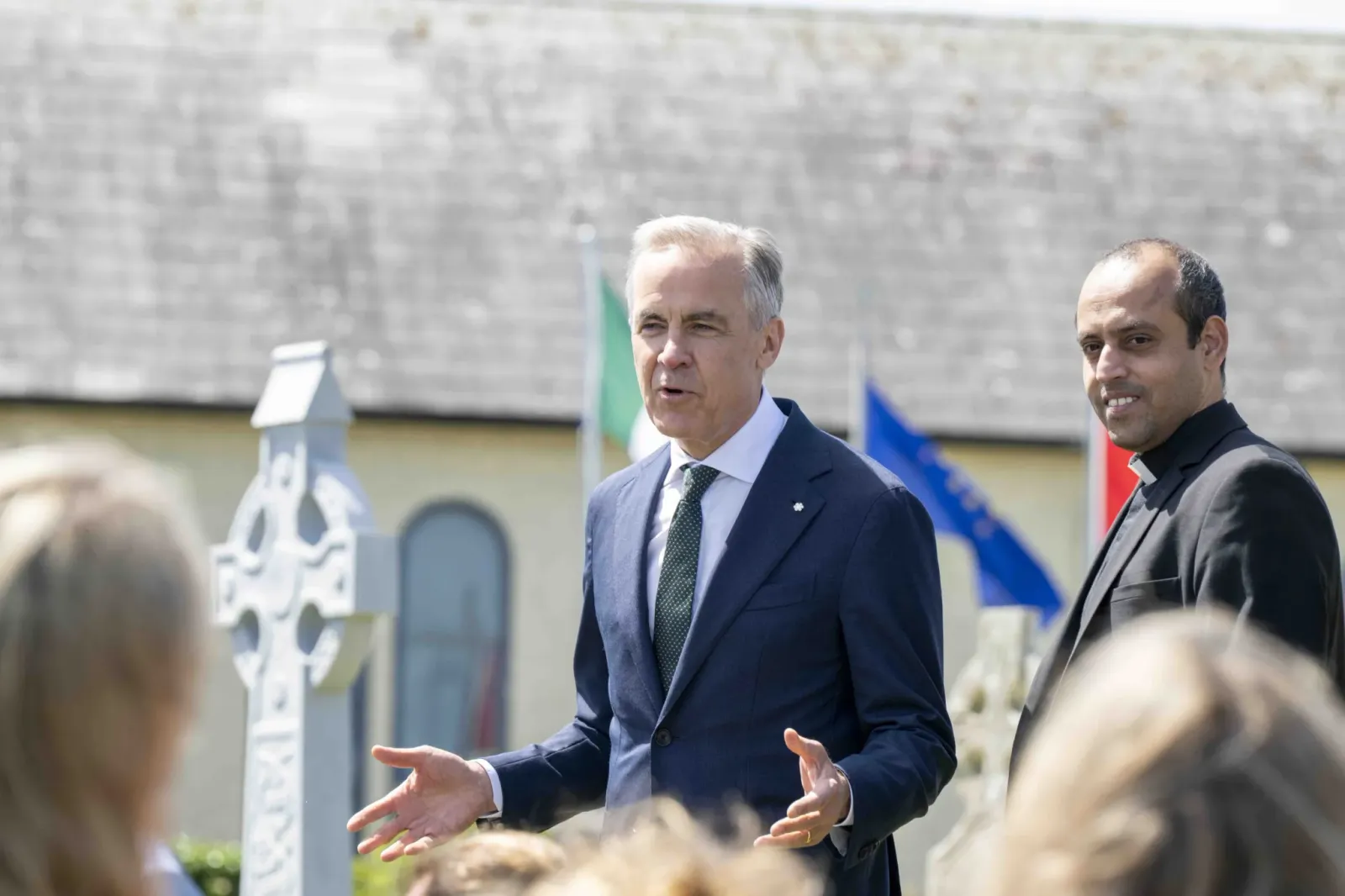
Canadian Prime Minister Mark Carney said U.S. restrictions on Anthropic’s newest AI models show the dangers of overreliance on a limited number of American providers. Anthropic took its latest models, Fable 5 and Mythos 5, offline to comply with a Trump administration directive, and Carney argues that lesson is being ignored.
Canadian Prime Minister Mark Carney put a spotlight on an unglamorous but dangerous failure mode in the AI era: having “one option.” Speaking in Ireland ahead of the G7 summit in Evian-les-Bains, France, Carney said the situation around Anthropic’s newest models is what happens when too many critical capabilities concentrate in a small set of American providers.
Here is the concrete trigger he pointed to. Anthropic said Friday it took its latest artificial intelligence models, known as Fable 5 and Mythos 5, offline to comply with a directive from the Trump administration to prevent their use by foreign nationals. In the same moment, the company released Fable widely this week, while access to Mythos remains tightly limited due to cybersecurity fears. Carney’s warning was not that any single party “did anything wrong.” It was that collectively, if governments and customers treat availability as permanent, they will end up with the wrong kind of dependency.
Carney framed it as a diversification and resilience issue, not a moral panic. “You’ll hear me say this over and over again. It is never a good idea to have one option,” he said. And the “lesson” he says needs to be learned is spelled out in his own logic: “Nobody has done anything wrong in the situation. But we will have done something wrong if we just accept this, don’t take the lesson, don’t build out and diversify.” In other words, the failure is not the export controls landing. The failure is what buyers and policy teams do next.
To understand why this lands so hard with executives and boards, you have to know what Anthropic is signaling about model risk. Anthropic, based in San Francisco, said its Mythos model, announced on April 7, is “strikingly capable” and that ability is exactly why it is limiting use to select customers. The company linked that limitation to Mythos’s potential to surpass human cybersecurity experts in finding and exploiting computer vulnerabilities. So even without export controls, the firm is already practicing scarcity for safety reasons. Add U.S. compliance directives on top, and you get an abrupt availability swing: wider access for a limited version, offline status for the newest models to comply with restrictions, and a tight leash on the “most advanced” component.
This is why Carney connected the U.S. AI curbs to Canada’s broader trade and technology strategy. More than 70% of Canada’s exports go to the U.S., and Carney has set a goal for Canada to double its non-U.S. exports in the next decade. He also described the wider political-economic backdrop: Trump’s trade war is causing a chill in investment. The implication for AI leaders is that model supply is not just a technical supply chain. It is also a policy supply chain. If your product depends on frontier models that live inside one regulatory regime, you are building on top of shifting geopolitical terms.
Carney’s summit remarks also show he sees this as more than a single-country negotiating tactic. He said artificial intelligence will be one of the major discussions on Monday night at the G7, and he warned against expecting a tidy headline out of the summit. “There will not be a mission accomplished banner” because the issues are complex. He also said he spent 45 minutes talking with French President Emmanuel Macron about AI on Friday night, underscoring that European governments are actively thinking about how to manage this moment.
The G7 meeting dynamics matter too. Carney said he doesn’t have a bilateral meeting scheduled with Trump at the G7 despite the free trade agreement between the U.S., Canada, and Mexico being up for renewal. Instead, he said USMCA discussions will be held at the summit among Dominic LeBlanc, the minister responsible for U.S. trade; Janice Charette, Canada’s chief negotiator; and U.S. Trade Ambassador Jamieson Greer and Treasury Secretary Scott Bessent. “The right way to do it at this stage, will be between the principal negotiators, which is going to happen in Evian,” Carney said. In plain English: this isn’t being treated like a side conversation. It is being treated like principal-level trade policy, and AI is now part of that bundle.
Carney’s message travels well beyond Canada. For any executive building products, platforms, or services that rely on advanced AI models, the second-order risk is continuity. Availability can be cut not by demand, not by cost, but by compliance directives. Mythos and Fable 5 are the specific examples in this story, but the mechanism is the broader one: concentrated provider dependency plus an evolving export-control regime equals operational uncertainty. Carney’s warning is basically telling boards and procurement leaders to audit their “option set” the way they audit vendors for security and uptime: diversify the supply, reduce single-model lock-in, and treat regulation as a first-class variable in system design. That is the lesson he says cannot be ignored.
(Background note from the story: Carney visited his family’s ancestral village of Aghagower, Ireland earlier Sunday. The article includes remarks about local pride from Owen Morgan, who was with his 17-month-old son, Malachy Morgan, wearing a Montreal Canadiens jersey.)
This story's Key Insights and Take-aways are locked.
Create a free account to unlock Executive Actions for one credit.
Register to UnlockAlways free for Executives Club members. Join the Club
More in Technology

Nvidia's $89B data center quarter: the 9 companies cashing in
The AI buildout is minting fortunes beyond GPUs, and memory, cloud, and cooling suppliers are riding the same wave.

A YouTuber dissected the iPhone Duo and thinks he found crackgate's cause
CuriousHagi's teardown of Apple's foldable reveals a gear-like hinge that may explain why screens crack in the same spot within hours.

Google quietly links your phone number to every Android account on your SIM
Adding a SIM now ties your phone number to all Google accounts - and future accounts inherit it. Here's the security and privacy stakes.