

Microsoft's $20 Copilot bet makes 365 Premium worth a hard look
Microsoft is discounting advanced AI features by 50% for 365 subscribers, forcing buyers to weigh productivity lift against another monthly tab.
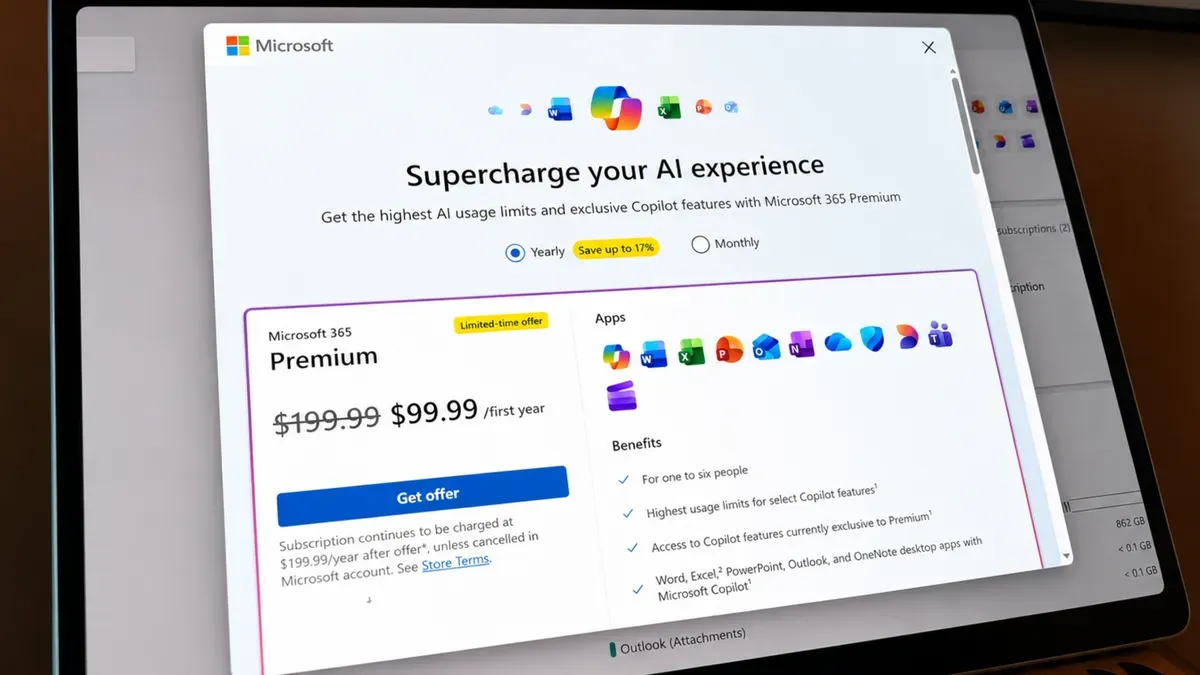
Microsoft is offering a 50% discount to 365 subscribers who want more AI Copilot features through Microsoft 365 Premium. The move changes the calculus for individuals and teams deciding whether to stay inside Microsoft's ecosystem or pay separately for ChatGPT Plus.
Microsoft just made a very specific play: it is offering a 50% discount to 365 subscribers who want more AI Copilot features, through Microsoft 365 Premium. In plain English, the company is trying to make the upgrade look less like a luxury add-on and more like a practical monthly decision. For people already paying for Microsoft 365, the question is no longer simply whether the bundle is useful. It is whether those extra AI capabilities are worth another $20 a month, and how that stacks up against ChatGPT Plus.
That is the real comparison here. Microsoft is not launching a standalone AI moonshot in a vacuum. It is packaging more Copilot access around a product millions of people already use for work, documents, email, and spreadsheets, then discounting the ask for existing subscribers. That matters because pricing is often the quiet lever that decides adoption. If the AI features feel expensive or redundant, people shrug and keep using the tools they already have. If the price feels manageable and the integration is tight, they upgrade without much drama. Microsoft is clearly betting on the second outcome.
For executives, operators, and anyone trying to manage software sprawl, this is a familiar strategic move with a fresh AI wrapper. The issue is not just whether Copilot is good. It is whether bundled AI changes how software gets bought. Historically, software vendors have loved bundling because it raises switching costs and keeps customers inside the ecosystem. AI makes that play even more potent if the assistant sits where the work already happens. A writer, analyst, or manager may not want to open a separate app for help if the help is already inside the tool they use all day. That convenience can be worth real money, but only if the user can clearly see the productivity gain.
The comparison to ChatGPT Plus is what makes this interesting. Microsoft is effectively saying: before you add another AI subscription, look at the version that lives inside the productivity suite you already pay for. That creates a simple but important consumer choice. Do you want a general-purpose AI product, or do you want AI embedded in the workflow you already trust? For many buyers, that question is not academic. It affects how many monthly subscriptions land on the corporate card, how IT teams think about standardization, and whether workers default to a separate AI assistant or the tools bundled into office software.
There is also a second-order implication for budgets. Even $20 a month can become a real line item once it is repeated across a team, a department, or an entire company. That is why discounts matter. A 50% discount changes the optics from premium indulgence to a more defensible productivity expense. It does not make the feature free, and it does not mean every subscriber should upgrade. But it lowers the barrier enough that decision-makers have to ask a harder question: if AI is becoming a normal part of office work, should it be purchased as a separate service or absorbed into the stack already in place?
That is where Microsoft has the advantage. The company controls the base layer and the add-on layer, which gives it a strong position to shape user behavior. If Copilot becomes the default next to documents, email, and meetings, Microsoft can make AI feel less like a novelty and more like an expected feature of modern software. That shift could matter well beyond individual subscribers. It sets a precedent for how enterprise software companies price AI: not as a flashy standalone product, but as a paid upgrade to an existing workflow. Competitors will be watching closely, because once buyers start comparing AI inside the bundle to AI outside it, the economics of subscription software start to move.
For now, the takeaway is straightforward. Microsoft 365 Premium is trying to answer a very practical question: is more AI worth $20 a month when the alternative is a separate ChatGPT Plus subscription? Microsoft is betting that for enough subscribers, the answer will be yes, especially when the offer is framed as a discounted upgrade rather than a brand-new bill. For leaders, the broader lesson is sharper: AI adoption is increasingly being decided not by hype, but by packaging, price, and where the tool sits inside daily work. That is the game now, and Microsoft just moved first.
This story's Key Insights and Take-aways are locked.
Create a free account to unlock Executive Actions for one credit.
Register to UnlockAlways free for Executives Club members. Join the Club
More in Technology

OpenAI says 10,000 agents cracked a 90-year math problem in 88 hours
The company's claim is audacious, but one mathematician is pushing back. Here's what it means for AI-driven discovery.

Meta still serves child sexual abuse ads on Instagram in India - BBC report
A new report following the BBC Eye investigation says the ads are still there - what it signals for every platform with a self-serve ad engine.

White House yanks 'Build the Wall' game after Tetris Company copyright warning
The administration's arcade game vanished in hours - and the takedown playbook every brand can learn from.