
MIT replaces cleanrooms for triaxial electrospray nozzles using a 3D resin printer
Luis Fernando Velásquez-García says they used a printer with 27 µm pixels to build emitter arrays without cleanrooms.
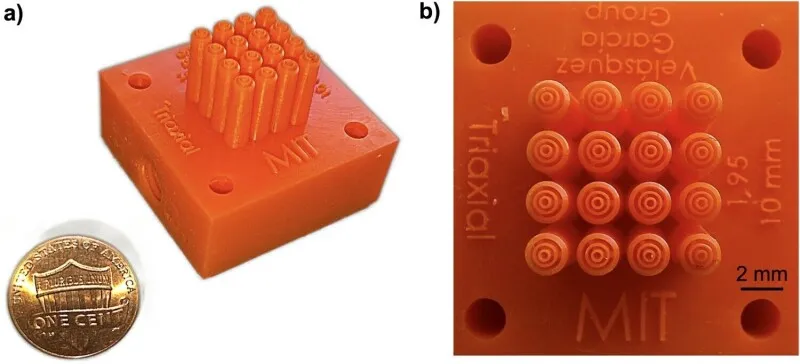
MIT principal research scientist Dr. Luis Fernando Velásquez-García led a team that 3D prints tiny triaxial electrospray nozzle arrays using resin printing. The breakthrough could lower the cost and timeline for manufacturing triple-layer drug-delivery particles and tissue-regeneration materials.
MIT principal research scientist Dr. Luis Fernando Velásquez-García just pulled electrospray nozzle fabrication out of semiconductor-style cleanrooms and into a 3D resin printer workflow. In a recent paper, his team describes printing tiny electrospray nozzle arrays designed as triaxial emitters, built to generate three-layer microdroplets.
That matters because electrospraying is built on extremely small nozzles, and the bottleneck has been “scalability issues” plus a lack of low-cost, high-precision parallel emitter arrays. The paper explains that manufacturing these miniaturized, uniformly operating emitter arrays has traditionally required cleanrooms, taking months and coming with high costs. Velásquez-García also tells The Register that triaxial electrospray emitters made in semiconductor cleanrooms do not exist, largely because of the “huge complexity” of their design.
So what did the MIT team actually do to remove the cleanroom dependency? They used an advanced 3D resin printer from Asiga with a 27 µm pixel size to produce working emitter arrays. The reason this level of precision is non-negotiable is that triaxial emitters are not just “one nozzle.” They require an intricate network of microchannels designed to route three different liquids into droplets that form three layers without mixing.
In plain English, electrospraying uses an electric field to atomize liquids into droplets, and those droplets can be smaller than what purely physical methods can achieve. The technique is flexible across many liquid materials and shows up in multiple domains, from ionizing liquids for mass spectrometry to space propulsion. But many of the most advanced applications hit a common wall: making arrays of the tiny nozzles with consistent performance, at scale, and at low cost.
This is where triaxial design raises the complexity bar. Velásquez-García’s approach targets three-layer microdroplets, where the three liquids do not mix before or during droplet formation. He told The Register that there are no coaxial electrospray arrays or triaxial electrospray emitters made in the semiconductor cleanroom environment because of that complexity. The MIT team’s choice to use 3D printing is basically a direct attack on that manufacturing reality, trading cleanroom lithography-level processes for resin printing resolution and a more modular internal geometry.
The team reports producing a working version of their emitter array containing 16 nozzles packed into one square centimeter. They add that the design is modular, so it can be tiled to create much larger arrays. For example, if tiled to a square foot, it would yield around 15,000 emitters. Velásquez-García’s key engineering point is also unusually specific: they demonstrated emitter densities of 16 emitters per square centimeter, and they say it cannot be denser because the bottleneck is the 3D printer resolution. In other words, the cleanroom problem seems addressed, but the density problem is now constrained by the printer hardware and the ability to maintain the microchannel network at higher complexity.
From an executive perspective, this is the kind of shift that can change the economics of an entire product category. If electrospray emitter arrays can be produced without semiconductor-level cleanrooms, the time-to-build can shorten and the cost structure can become friendlier to iteration. That matters not only for research labs, but for any company trying to scale manufacturing of microdroplet-based systems.
The MIT team points to several application areas that could benefit from cheaper, faster-to-produce arrays. First are three-layer drug-delivery particles, which could dispense medicines to specific parts of the digestive tract. Second are self-healing materials. Third are artificial cells intended to aid tissue regeneration. Velásquez-García described a concrete example for the three-layer drug-delivery concept: the outer layer as a protective layer that dissolves, the middle layer containing a medicine that promotes tissue growth and regeneration, and the core layer containing an antibiotic to protect the new tissue. He also emphasizes that there is flexibility in material choice for creating the three layers and tailoring the application.
For boards and decision-makers, the interesting part here is not just “a new fabrication method.” It is that triaxial, non-mixing three-layer droplet generation is a manufacturing capability that historically has been hard to scale due to the way hardware gets built. The Register reports Velásquez-García says the team’s innovation could be readily commercialized because they cracked a key problem in cleanroom-free electrospray array construction. He characterizes the “secret sauce” as the designs of the tube network and support structures.
Of course, commercialization is not automatic. Velásquez-García says practicality depends on material choices, because the resin feedstock used to create the nozzles may vary significantly based on the chemical composition of the material a partner wants to use. That is a real-world constraint: if your target drug or biological formulation requires a particular chemical environment, the printed structures still need to be compatible and manufacturable.
Finally, there is the institutional reality: MIT employees are not allowed to form their own startups to commercialize university research, but can advise those who license it. Velásquez-García told The Register he is ready to work with partners who want to commercialize the design by contacting the MIT team.
Strategically, the second-order signal to anyone in adjacent roles is clear. If emitter array fabrication moves away from months-long, high-cost cleanroom processes, electrospray-based microdroplet platforms could become faster to customize and cheaper to scale. That shifts competitive advantage toward teams that can quickly select materials, validate three-layer droplet performance, and integrate these arrays into manufacturing pipelines, instead of teams that simply have the cleanroom budget.
This story's Key Insights and Take-aways are locked.
Create a free account to unlock Executive Actions for one credit.
Register to UnlockAlways free for Executives Club members. Join the Club
More in Technology

OpenAI says 10,000 agents cracked a 90-year math problem in 88 hours
The company's claim is audacious, but one mathematician is pushing back. Here's what it means for AI-driven discovery.

Meta still serves child sexual abuse ads on Instagram in India - BBC report
A new report following the BBC Eye investigation says the ads are still there - what it signals for every platform with a self-serve ad engine.

White House yanks 'Build the Wall' game after Tetris Company copyright warning
The administration's arcade game vanished in hours - and the takedown playbook every brand can learn from.