
Mitch McConnell’s month-long disappearance sparks health-demand questions and Senate delay fears
There’s no rule for medical disclosure, so allies, rivals, and constituents fill the void with memes and pressure.
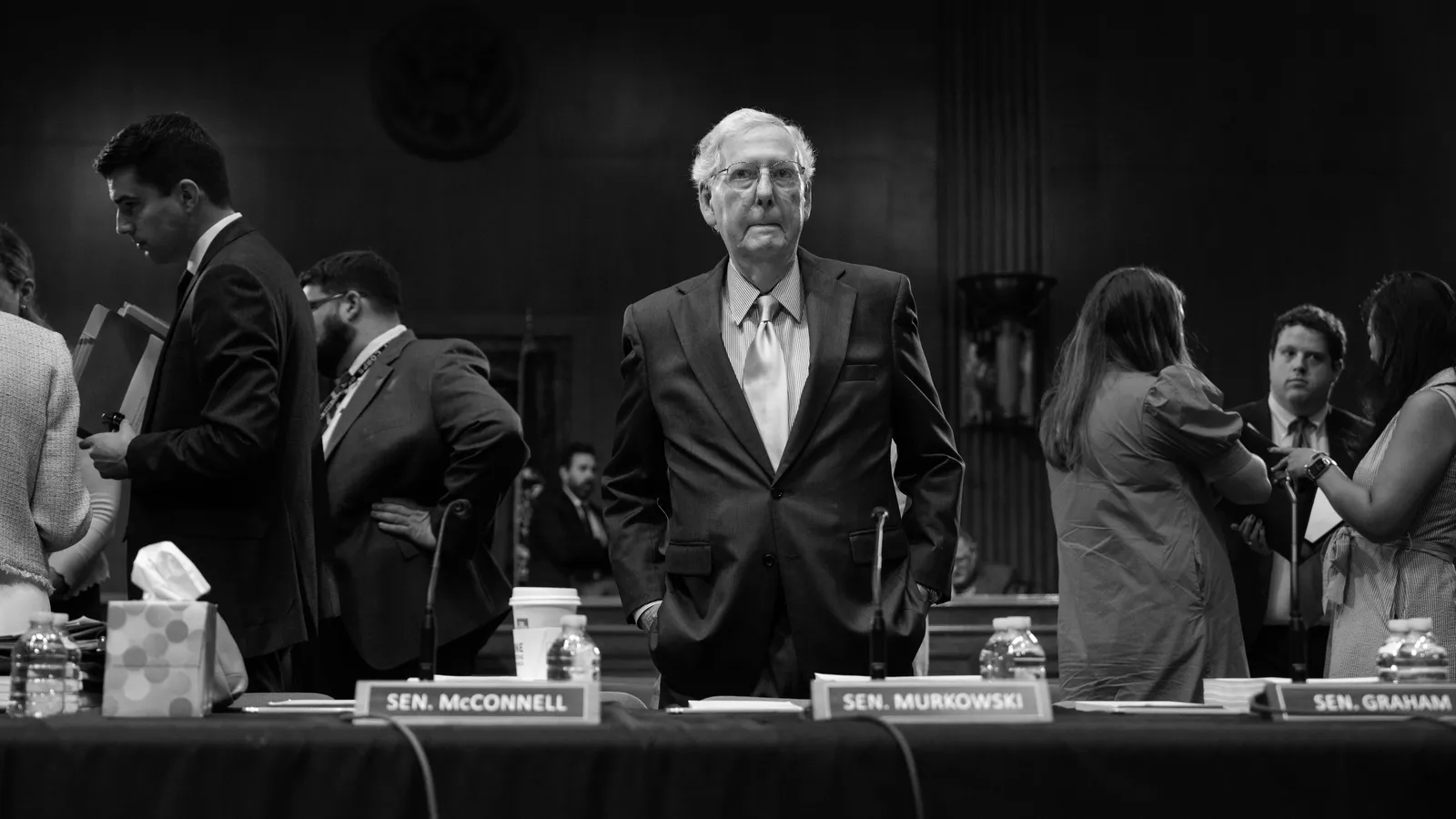
Sen. Mitch McConnell has not been seen in public for almost a month after being hospitalized on June 14, and his staff has offered minimal updates. The uncertainty is colliding with Congress’s thin-majority dynamics and upcoming funding deadlines, reigniting calls for clearer expectations about when members are not on the job.
Mitch McConnell has not been seen in public in almost a month. The Kentucky senator, and former majority leader, was hospitalized on June 14, and his staff has declined to elaborate beyond the same line: “The Senator continues to improve, and is working closely with his staff on Kentucky and Senate matters while the Senate is out of session.”
By now, the silence has done what silence always does in politics: it fills with competing narratives. McConnell’s allies say they recently spoke with him, but doubts still piled up. Yesterday, Kentucky Governor sent a formal letter requesting a health update from the senator. President Trump told reporters he had “no idea” how McConnell was doing. And as Congress debates whether anyone is actually available to do the work, the real stake is not just personal privacy. It is whether the Senate can execute its business when key votes and committees do not operate in theory, they operate in real time.
This is not the first time a lawmaker effectively went off-grid. The Atlantic points to Representative Tom Kean Jr. of New Jersey, who disappeared for nearly four months this year and missed 142 House roll-call votes before resurfacing in late June. Kean explained that he had been receiving treatment for depression. In 2024, then-Representative Kay Granger of Texas, a Republican and former chair of the House Appropriations Committee, was absent for months until The Dallas Express reported that she was living in “a local memory care and assisted living home for some time after having been found wandering lost and confused.” Senator Dianne Feinstein of California, who died in 2023, remained in office as her health rapidly deteriorated while her staff downplayed her condition.
What makes McConnell’s case especially combustible is that the Hill has very few formal rails for this exact scenario. The source is explicit: there are no formal rules governing disclosure of medical conditions for lawmakers, and there are no official procedures for declaring a member medically incapacitated and removing them. In other words, there is a norm of secrecy and protection of private life, especially around sensitive mental or physical health. But that norm collides with another reality: when Congress is ruled by shifting and often thin majorities, absences show. People notice. Leaders notice even more.
And once they notice, the internet does what it always does. McConnell’s absence has prompted memes, some featuring Ouija boards, AI-generated Mitch-zombies, Weekend at Bernie’s-inspired scenes, and reports that the kid from The Sixth Sense “reached” the senator. On the political side, Hasan Piker, a leftist Twitch streamer, challenged McConnell to publicly deny that he and Piker are engaged in a romantic tryst. Scott Jennings, a Republican pundit, attempted to dampen speculation by sharing that he had spoken with McConnell “for just shy of 20 minutes” about issues including Iran and Ukraine, which then became a Mad Libs-style template for fake conversations. Representative Thomas Massie, a fellow Republican Kentuckian who recently lost his primary to a Trump-backed opponent, sarcastically wrote that he spoke with McConnell for “about 20 minutes” about how he’s “really sorry about how my primary turned out.” CNN mistakenly ran a screenshot of a parody account claiming to have spoken with the senator.
Beneath the jokes, there is an institutional problem. The source notes that there is no modern playbook for how to formally remove and replace a member medically unfit to perform the job. It offers a historical exception: in November 1980, Maryland voters elected Gladys Spellman to a fourth term. Days before Election Day she suffered a heart attack, survived, fell into a coma, and never regained consciousness. Through a first-of-its-kind House resolution passed in February 1981, her seat was declared vacant. That April, in a special primary for the Democratic nomination, Spellman’s husband, Reuben, finished second to Steny Hoyer, then a 41-year-old lawyer and former Maryland state senator. Spellman died seven years later. Hoyer later spent two decades in top House Democratic leadership, and now in his 23rd term, announced earlier this year he would not seek a 24th. The point is not trivia. It is that Spellman’s situation required extraordinary steps, and the system has not built a routine for this ever since.
To longtime observers, cases like McConnell’s and Kean’s are not unprecedented. There is a long history of staff shielding ailing legislators from journalists and political opponents, even if it reduces transparency for constituents. Senator Carter Glass of Virginia spent his last four years absent from public view due to illness before dying in 1946 and did not answer a single Senate roll call after 1942. Senator Karl Mundt of South Dakota suffered a stroke in 1969 and did not appear on the Senate floor for almost three years before deciding not to seek reelection in 1972. John F. Kennedy hid his diagnosis of Addison’s disease, an adrenal insufficiency, from voters. Numerous lawmakers in more recent years stuck to their offices as they grew visibly frail or as their mental capacity was called into question, while staffers demurred or denied anything was amiss. Aides around Sen. Robert Byrd of West Virginia were especially tight-lipped as his health declined. Mississippi Sen. Thad Cochran’s frailness and disorientation were an open secret before he stepped down in 2018, a year before his death.
So is this the moment lawmakers finally build better disclosure rules? Some signals suggest the pressure could rise. Congress returns from recess on Monday, and if McConnell’s absence continues, it could complicate the Senate’s business, particularly attempts to meet the late-September deadline to fund the government for the next fiscal year. McConnell sits on the Appropriations Committee and leads the Defense Appropriations Subcommittee, which is responsible for military spending. That puts his operational availability into the same category as budgets and deadlines, not just committee calendar preferences. A social-sciences professor at Arizona State University, Steven Smith, told the source that there should be a rule obligating members’ chiefs of staff or others to report bosses’ absences, noting that they are employees of taxpayers. He said it could still be vague, but there should be a requirement to indicate that a member is literally not on the job. Scott Tillman of U.S. Term Limits said the cases involving McConnell and Kean make their case more salient, arguing that people are deprived of representation when the elected person is not being represented.
Others are less optimistic. Julian Zelizer, a Princeton historian, told the source that each seat is extraordinarily valuable and each vote is as well, which leads parties to keep issues secret as possible. And staff incentives matter too. “As long as God created staff,” Jim Manley, a longtime aide to Harry Reid who spent more than two decades on the Hill, told the source, “there’s always going to be folks that are going to try and do what they can to keep this stuff out of the media.”
For executives, founders, and board members watching from the outside, the second-order lesson is blunt: rules lag real life, and silence turns into a governance problem long before it turns into a medical one. In a Senate where committee work, votes, and appropriations timelines depend on availability, uncertainty about capacity is not just a PR issue. It is operational risk. And when it becomes operational risk, pressure for reform tends to spike, even if privacy norms make the first move politically difficult.
This story's Key Insights and Take-aways are locked.
Create a free account to unlock Executive Actions for one credit.
Register to UnlockAlways free for Executives Club members. Join the Club
More in Politics

Trump dusted off
How a “communist” attack line helped Trump package economic anger into a sharper message aimed at Democrats.

Ann Widdecombe went from Brexit right-winger to Strictly animal-loving TV star
Her reinvention shows how political brands now survive by moving onto reality screens, with real reputational risk and upside.

Police probe Reform UK donations from George Cottrell’s mother, Times reports
A donation-linked investigation tests Reform UK’s fundraising scrutiny and forces every political committee to tighten its checks.