

Mojtaba Khamenei still unseen as Iran’s six-day funeral ends
As US and Iran resume strikes, the last day of Ali Khamenei’s funeral becomes a stress test for succession signals.
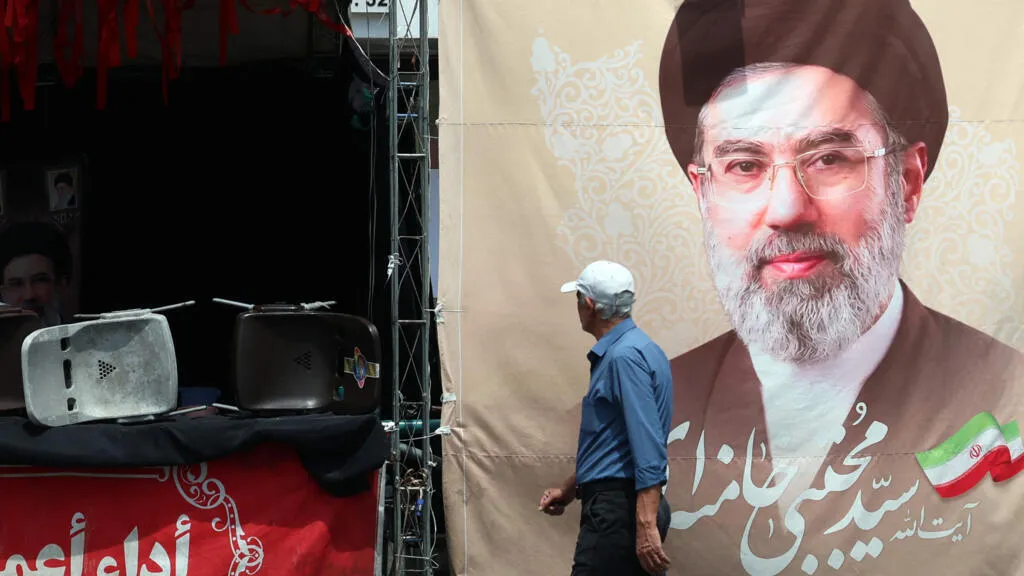
Iran is preparing for the final stage of a marathon six-day funeral for Ayatollah Ali Khamenei, killed on February 28 alongside close family members. Decision-makers are watching whether his son Mojtaba Khamenei appears publicly, while US and Iran resume strikes that threaten full-scale war.
US and Iran have resumed strikes, raising the risk of a return to full-scale war. At the same time, Iran is preparing to bury Ayatollah Ali Khamenei, who was killed alongside close family members on the first day of the US-Israeli war against the Islamic republic on February 28.
The last of a marathon six days of funeral ceremonies is now in focus, and it is getting extra attention because of one missing signal: his son Mojtaba Khamenei has yet to appear in public since being appointed. That absence matters because public appearances in succession periods are not just ceremonial. They function like confirmation, organization, and narrative control, especially when the background includes open military escalation.
This is the kind of moment where security events and political optics move together, even when the headlines are about missiles and ceremonies. The reason is simple: strikes can change the near-term battlefield, but leadership legitimacy shapes what happens after the shooting. In Iran’s case, the funeral timeline is being watched for signs of who holds influence next, and Mojtaba Khamenei is the key variable because he has been appointed but remains publicly unseen.
The stakes for executives and investors outside the region are not theoretical. When US-Iran tensions flare and strikes resume, markets price risk across energy, shipping, insurance, defense-adjacent supply chains, and any business exposed to sanctions friction. Even without new details in the source, the underlying pattern matters: the return of strikes after a pause, combined with high-profile internal events, increases uncertainty. Uncertainty is expensive. It pushes counterparties to demand better terms, slows decision-making, and can force compliance teams to re-check exposure limits and operational continuity plans.
Meanwhile, a succession watch during a major funeral is also a governance signal for the people who actually have to make decisions inside Iran and among those who work with it. In many political systems, transitions are managed through messaging, attendance, and visible coordination. Here, the article’s focus is specific. It says Mojtaba Khamenei has yet to appear in public since being appointed, and that the last day of ceremonies will be closely watched for signs tied to him. That tells you the story is not just “a funeral happened.” It is “a leadership transition is being inferred from what is seen, and from what is not.”
There is another second-order effect executives should keep in mind: escalation can alter the cadence of policy and compliance. When the risk of full-scale war rises, regulators and governments often move faster, and compliance teams often have less time to interpret guidance. Businesses operating with cross-border constraints may face tighter scrutiny, more frequent attestations, and higher costs to verify counterparties. Even if no new regulatory action is described in the source, this is the logical environment that accompanies renewed strikes and heightened geopolitical urgency.
For boards and senior leadership teams, the key strategic question is how to plan under rapidly shifting conditions. If the last day of funeral ceremonies brings public confirmation tied to Mojtaba Khamenei, that could stabilize expectations about internal direction, even as external strikes continue. If, instead, the pattern of invisibility persists, that can amplify uncertainty about who is empowered to make decisions during the next phase of the crisis. Either way, the signal will be read. The market response, supply chain planning, and risk models will adjust around it.
France 24 frames the situation as a convergence: the fighting is resumed, the funeral is nearing its close after six days of ceremonies, and the public still waits for a key figure. The end of those ceremonies is not an endpoint. It is a checkpoint that could influence how actors inside Iran coordinate, and how external partners anticipate the next moves while US-Iran strikes continue to threaten a wider war.
This story's Key Insights and Take-aways are locked.
Create a free account to unlock Executive Actions for one credit.
Register to UnlockAlways free for Executives Club members. Join the Club
More in Politics

Glacial collapse, not rain, killed 180 in Nepal's Himalayan flood
The Himalaya's extreme geography hid the true cause of Nepal's catastrophic flood, a glacial collapse that turned a geological battleground into a mass-casualty zone.

Iran’s Esmail Baghaei says Oman talks start shipping via Hormuz, not US talks yet
Temporary route plans with Oman aim to restart commerce while Tehran says Washington dialogue is not on the table.

Standards watchdog opens probe into Reform UK deputy leader Richard Tice over interests
The parliamentary standards commissioner says it began an investigation on 28 July into a possible undeclared interest.